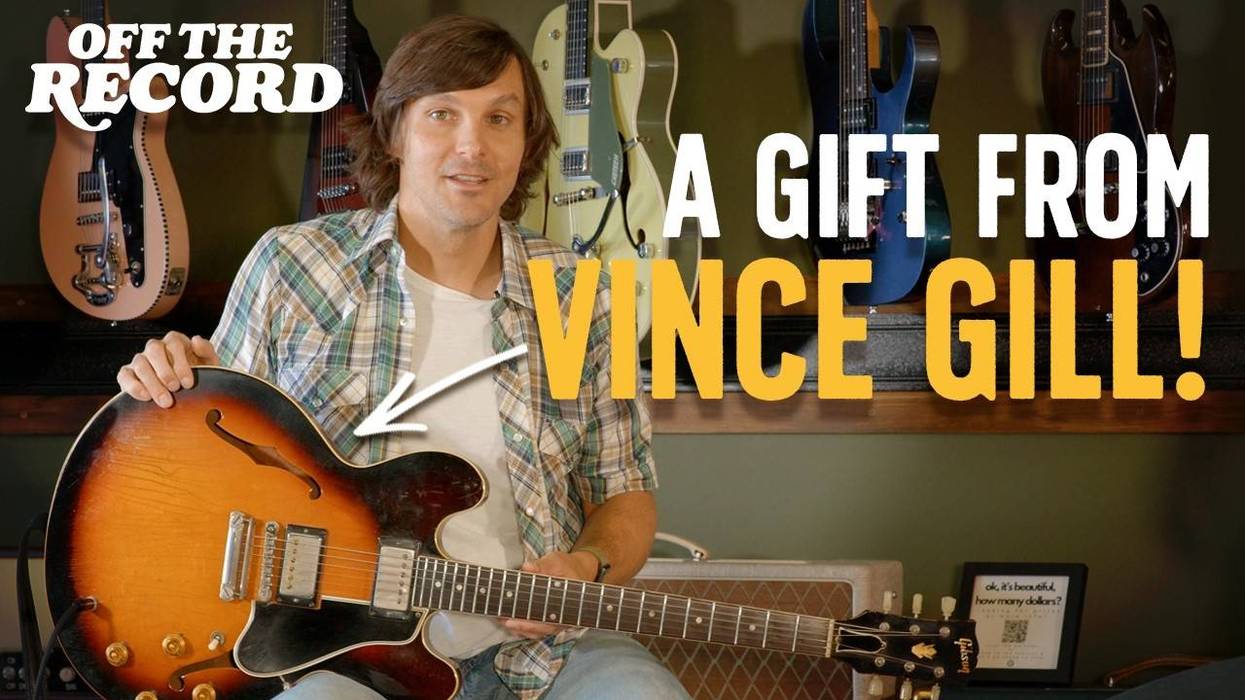
The Nashville fixture shares his long journey from a bluegrasser in Mississippi to Music City fixture that's included studio time alongside Lainey Wilson, Luke Combs, and Carrie Underwood, touring in bands fronted by Vince Gill & Dierks Bentley. He tells John Bohlinger about his struggle from band member to band leader and details the ultimate honor when Vince Gill invited him to join the Grand Ole Opry in August 2026. Twenty years into his stay in Nashville, Charlie Worsham isn't going anywhere but up.
Renowned pedal firebrand Mr. Black has introduced the CAT distortion pedal, a unique take on one of the world’s most beloved – and bruising – circuits.
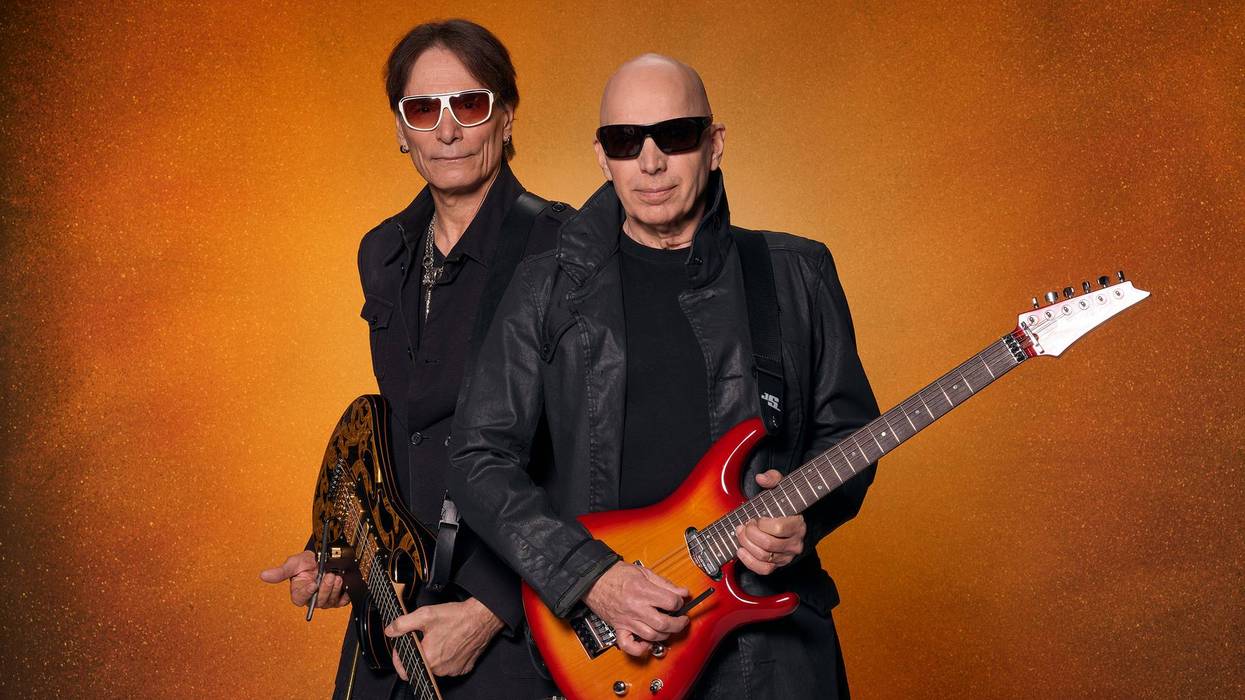
The last song on Joe Satriani and Steve Vai’s first album together begins with the oldest thing on it, a recording made in a teenage Satriani’s bedroom in Carle Place, Long Island, sometime in 1973. More than 50 years later, neither of them can tell you who’s playing what on it.
“The recording is pretty flat,” Satriani says. “There’s no low end, there’s no high end. And there’s a lot of personality in those areas. You can tell the way people play. But it’s just this sort of midrange thing going on.”
The 1973 recording is called “Reflections on a Year and a Half,” the year and a half in question being how long Vai had been playing guitar at the time it was made. He was still turning up weekly for lessons from Satriani, a few grades ahead of him at Carle Place High and also his guitar teacher, in a bedroom that he describes five decades later with the reverence of a 13-year-old.
“It was a glorious teenage bedroom,” Vai says. “It had all the greatest posters and albums stacked up all over the place.” In one corner was a two-track, reel-to-reel tape machine. “I would just ogle at it.”
“I think it was a Sony,” Satriani says.
“It was a Sony,” Vai continues. “And then one day Joe said, ‘Hey, let’s record.’ So Joe showed me this riff, and he was playing with some chords…”
“…every time I hear it, I still can’t figure out who’s who,” Satriani says with a laugh.
Fifteen years or so after the fact, Satriani mailed the reel to Vai, who transferred it and then did nothing further with it for a very long time. What brought it back out was this new album, and specifically an email from Satriani containing two pieces of music, which eventually became two new Satriani-Vai songs, “The Sea of Emotion, Pt. 1” and “The Sea of Emotion, Pt. 2.” Vai had an idea for a third. “I just got the idea, oh, I’m gonna take this little snippet of us both playing when we were kids, basically, and start the song and embellish the riff,” Vai says. “Try to make a song out of it.”
Photo by Jon Luini
The song that resulted is “The Sea of Emotion, Pt. 3: Reflections on a Year and a Half,” and it closes the new record, which is also called The Sea of Emotion, and is officially credited to SatchVai. All of which means that an album made better than half a century into one of the most thoroughly documented friendships in the history of the instrument starts its final track with two Long Island kids and a tape machine that neither of them can identify himself on—and then builds the rest of the song out of what they were playing.
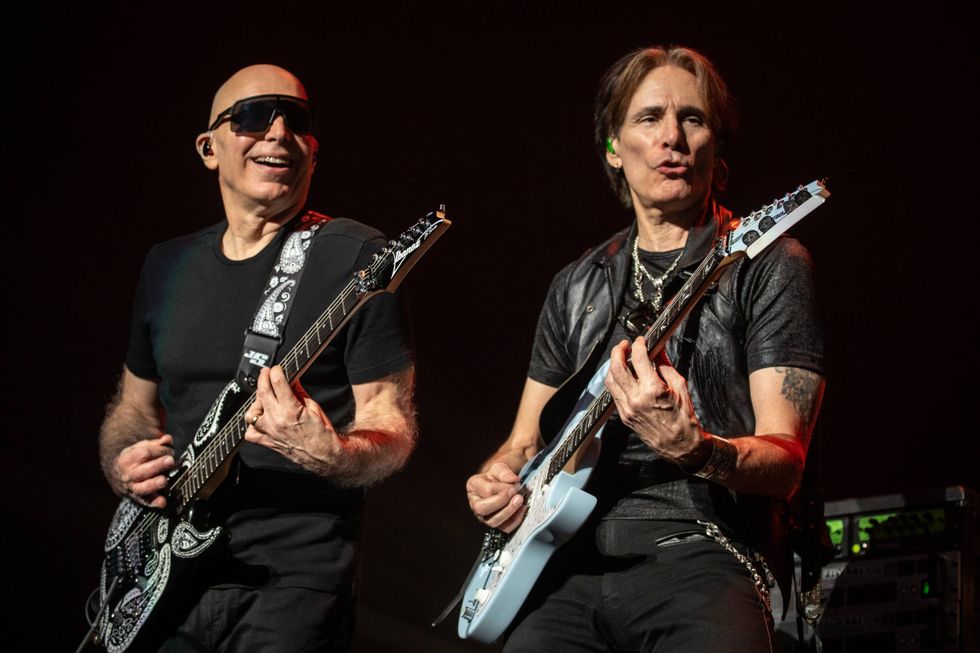
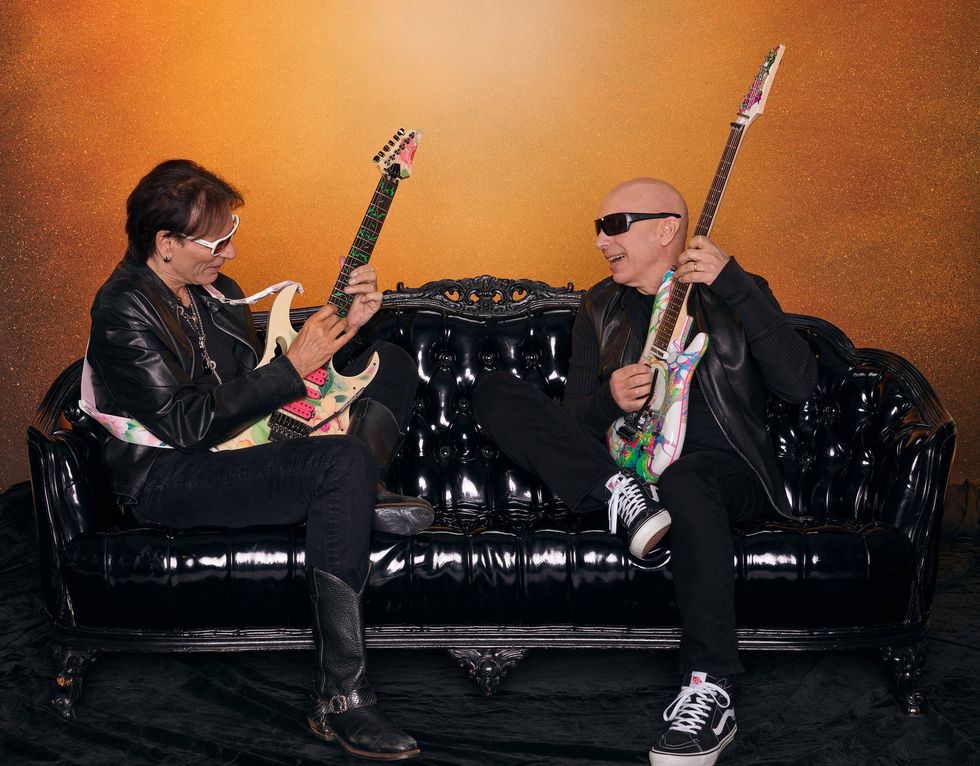
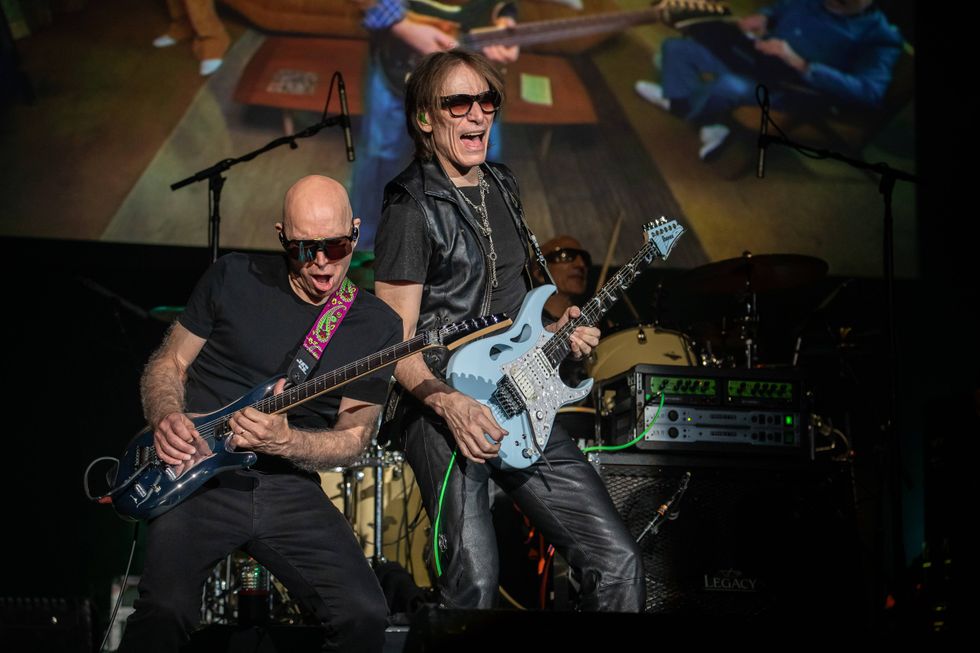
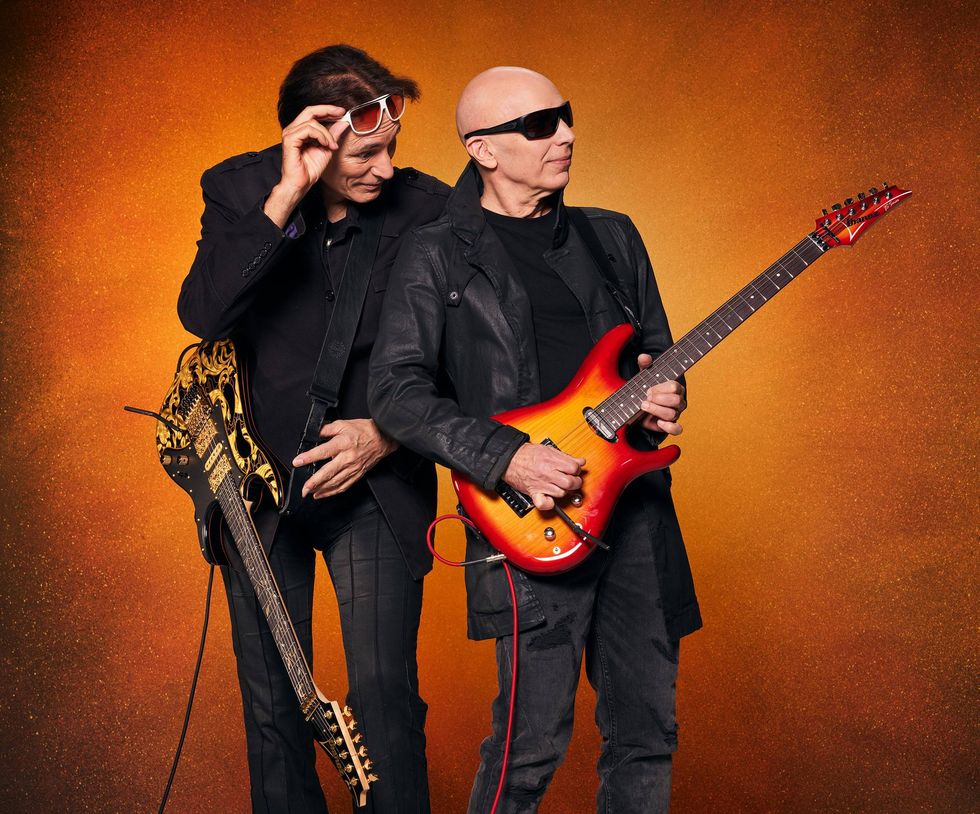
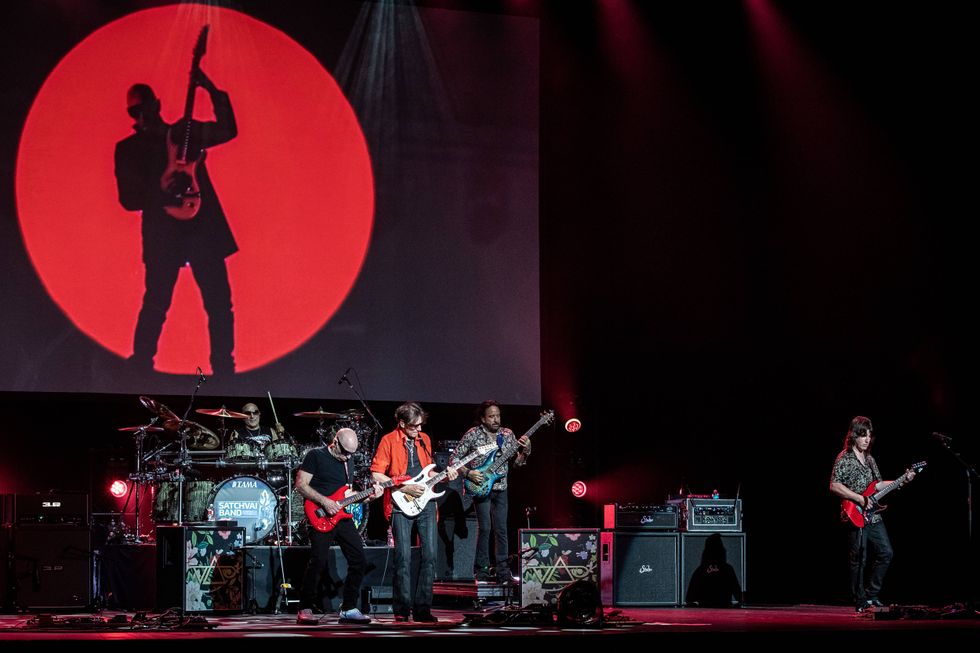
The Sea of Emotion is the first album Satriani and Vai have made together, which is a strange thing to consider given these two players’ careers have been entangled since one of them was 12 years old (the other was a ripe old 16). They’ve toured together, on and off, for three decades under the G3 banner, turned up on each other’s records, and shared magazine covers going back to the 1980s, but until the formation of the SatchVai Band—the two of them plus guitarist Pete Thorn, bassist Marco Mendoza, and drummer Kenny Aronoff—they had never actually been in a group together. And until now, they had never written an officially-released song together as adults.
Photo by Larry DiMarzio
While the SatchVai Band is a touring proposition, the record itself was cut with a rotating cast of musicians drawn from both players’ inner circles, with Gregg Bissonette, Jeremy Colson, Aronoff, Matt Chamberlain, and Mike Mangini trading off behind the kit and Billy Sheehan, Bryan Beller, Philip Bynoe, Matt Bissonette, Mendoza, and Henrik Linder handling the bass. The album takes its title from a field on the Carle Place school grounds where Joe and Steve used to go after dark to talk, memorialized in the suite that takes up the final three tracks. By the time The Sea of Emotion hits streaming services and store shelves, Satriani and Vai will have spent a spring playing a good deal of it live, on a 40-date North American run that also featured openers Animals as Leaders. (We’re talking backstage at one of the stops, in Durham, North Carolina, a few hours before doors open.)
Arguably, none of this would have happened without Satriani’s filmmaker son, ZZ, who called him a few years back about documenting what was then the 25th anniversary of the G3 tour, an idea that turned into a reunion tour with Satriani, Vai, and Eric Johnson—the same three who had headlined the inaugural G3 run in 1996. Afterward, Joe and Steve decided to keep going, with nothing more ambitious in mind at that point than maybe cutting a track together and playing some shows.
“We were so busy,” Satriani says. “We had finished the G3 reunion, and then we realized we weren’t going to be able to continue with G3, and we decided, well, Steve and I’ll go out. And the idea was to also do a track. But we still had work that was booked immediately, so we were either on the road with somebody else, or we were at home in our studios going, ‘I’ve got eight hours to come up with something and send it to the other guy.’”
Photo by Jon Luini
Despite the time crunch, the ideas started flowing. To the point, eventually, where they found themselves working on an album. “We had probably 17 relatively roughed-out ideas,” Vai says. “And then it comes that time where you’ve gotta cut off one of your toes, you know? And you just start hacking at the songs. But it went very seamlessly. We kind of resonate similarly like that—’How does this record feel? What is it missing?’”
Before they could answer those questions, they hit the road together as SatchVai—first in America and then across Europe. These runs were, as far as the album was concerned, a hiatus. “I like a bit of solitude to get away from influences,” Satriani says. “And when you’re on tour, it’s just nothing but influences—especially our tour, because we’re improvising onstage every night. You can’t be locked into your own writing mode.”
“It’s remarkable to me how Joe has just been a profound figure in my life through my whole life.”—Steve Vai
Once they were home, they approached the material with fresh ears, and with the experience of having played together night after night. “We’re slowly going, ‘Oh, that song’s not gonna work. It’s the wrong character.’ That kind of thing,” Satriani says. “And then there were other songs that started to get written and sort of snowball, and you go, ‘Wow, that song that we didn’t think was a winner is just turning into this huge thing.’ So that was a nice surprise.”
Co-writing isn’t something Vai does much of, and he says so himself. “I usually don’t do that. I like being the master and commander of my own ship. But Joe has such a great ship.”
For 50 years he had been listening to Satriani’s playing as a fan, but what changed here is that there were now stakes attached. “Okay, we gotta get down to business,” Vai recalls. “We have to impress each other. And we have to raise our bar the best we can. And for us, that means better, more effective melodies. And of course you want to try to up the technique game. But the real fun for me was when the emails would come in…”
One song, “The Feeling I Know,” started as a voice memo on Vai’s phone of some chord changes he liked, which he sent over and got back with what he calls “this beautiful samba-esque Lydian thing” on top of it. “And then we went, ‘Oh, chop this up here.’ ‘What about a melody there?’ ‘Okay, you do that melody there, I’ll put the harmony and then I’ll do this here.’ And it was very seamless. I’ve never had an experience like that,” Vai says.
“And what I also noticed was, yes, we are different musically. We reach for different [sorts] of notes at times. But there was almost an intrinsic understanding—yes, this will work. No, this won’t work. It got to the point where I would go to think about doing something and I would have an instinct whether he was going to like it or not. And my only fear was that he would say yes to something that he actually didn’t like. But then, I know Joe better than that. He’s not that—”
“—nice,” Satriani cuts in.
“No,” Vai says with a laugh. “He’s not that guy.”
Which tracks, given that this is the same teacher who once sent a 13-year-old Vai home early from a lesson for not memorizing the notes on the fretboard—and still made Steve pay for the session.
Photo by Larry DiMarzio
At one point Vai sent Satriani a video of the Italian singer-songwriter Paolo Conte performing “Dancing,” a song the two of them went on to cut for the record. “That [song] is something I would never do,” Satriani says. “I’d probably hear it walking down the hallway somewhere and never stop to say, ‘Who is that?’ But knowing Steve, I thought, well, he wouldn’t be attracted to it unless he heard something really outrageous. And sure enough, when the session arrives and I hear 15, 20 guitars playing all those horn parts, that’s when I know—ah, he did have a vision. He’s not crazy.” Satriani laughs. “He’s not totally crazy.”
Vai also sent over “Bronco Freight Train,” but was unsure of where it was heading. Satriani had no such doubts. “As soon as I heard it, I thought, well, this has to be on the record,” he says. “And he sent it like, ‘I don’t know about this thing, this isn’t really a song yet.’ And I’m like, are you crazy? Don’t call me, ’cause I’m working on it right now.”
“I liked the core, I liked the guitar effect, and I liked the bridge,” Vai says. “And Joe just whacked the whole rest of the song and rebuilt the parts. I finally had somebody that I could really co-create with. And I’m sure there’s other people out there, but I never bothered to find them.”
The other key voice on the record belonged to producer and keyboardist Eric Caudieux, whose suggestions could be unusual, but tended to make the songs better. “He could just do the craziest things with these demos that we would send him,” Satriani says. “Changing whole passages that were in minor keys to major keys, and just assaulting our brains.” He was also the one who cut those guitar-generated horn parts out of “Dancing,” telling Vai they weren’t authentically him. Vai pushed back, but ultimately wound up agreeing it was better that way.
“Knowing Steve, I thought, well, he wouldn’t be attracted to it unless he heard something really outrageous.”—Joe Satriani
The rest of the record covers a lot of ground. Opener “Mayhem” came from Satriani, built on a riff he wrote in his home studio and sent over half-apologizing for how adolescent it was, and which Vai answered by doubling his own lines alongside Satriani’s solo. “Zoot Suit Riot,” with Mike Keneally on keys, was something of Vai’s that he thought had an “odd groove,” and had been sitting around for a while until Satriani helped finish it. The riff on “Old Sins Have Long Shadows” was Satch’s as well, with a groove inspired by Buddy Miles’ drumming on Hendrix’s “Machine Gun.”
Guitar-wise, Satriani primarily stuck to his signature Ibanez JS models on most of the record, while Vai’s workhorses were two signature Ibanez Jems: FLO, which is slightly scalloped and equipped with a Fernandes Sustainer unit, and REVO, which he says is wired similar to a standard Jem. Both are loaded with DiMarzio Evolutions in the neck and treble positions. Interestingly, Satriani cut all his guitars direct, via TONEX, SansAmp, and Brainworx SE100 plugins, and Vai used plugins for most of his parts, too—a variety of Neural DSP Archetypes, a prototype Neural DSP Vai plugin, and a SansAmp. The one exception in the amp department is “The Sea of Emotion, Pt. 3,” where Vai used his live touring rig.
On paper, what Satriani and Vai have in common is technique—fast, difficult, incredibly complex playing. But go back to the two kids in Carle Place and the thing they actually shared was composition. Both of them were writing music, and thinking seriously about writing music, at an age when most kids just want to play riffs and solos—and look cool doing it.
The SatchVai Band onstage (l-r): drummer Kenny Aronoff, Satriani, Vai, bassist Marco Mendoza, guitarist Pete Thorn
Photo by Jon Luini
Both credit the same man for it: Bill Westcott, their music theory teacher at Carle Place High who, as Satriani puts it, could “make anything sound like Bach or Chopin or Gil Evans.”
“I have great memories of him just sitting down at the piano with me and saying, ‘Now, Joseph, listen to this,’” Satriani says. “And he put one hand here and he goes, ‘You hear those two chords? They can go together. And when they go together, you add up the notes, and then those are the notes you can use to play on top of the chords.’”
“Jazz was born,” Vai says.
Westcott also told them each something they still go back to. “He specifically said it to me one day, ‘Your brain will keep developing as a musician after all these points where you figure out that maybe your hands don’t do this, and your fingers won’t do that, and you’re not hitting these technical milestones that you thought you were gonna hit. Don’t worry about it. It’s all what happens up here [in your head]. So learn to write away from your instrument,’” Satriani recalls. “And we both got that. Whenever he told us separately, we both agreed and said, ‘He’s right, we’re gonna follow that.’”
There wasn’t much precedent for what the two of them would go on to do with any of it. Instrumental rock songs existed, but instrumental rock artists—players whose catalogs were instrumental and categorized as rock rather than, say, fusion—weren’t really a thing. The closest thing was Jeff Beck, and Beck had made his name in bands, playing three-minute songs. Vai dates the start of it precisely, and not to himself.
“It wasn’t until Surfing with the Alien,” he says. “And I wasn’t surprised when I heard it, because I knew that Joe had a pull toward pop, simple pop. I would listen to the Squares [Satriani’s late ‘70s/early ‘80s power-pop trio] tape that he sent me when he was in the band, and it was this intense, raging guitar being played in a pop format. There wasn’t anything to stack it against. And then when I heard [Satriani’s 1986 full-length solo debut] Not of This Earth, I said, ‘Okay, something is really forming here.’”
He continues. “And once Surfing came out, it felt like the perfect amalgamation between Joe’s polished, classical musical ear, the culmination of an evolution of guitar technique in the fingers, and a sense of the absurd coupled with pop sensibility. It was a perfect storm. And that was really, to me, the first instrumental rock guitar record.”
Vai also thinks some younger guitarists draw the wrong lesson from it. “A lot of young players feel that there was a time when instrumental rock guitar was popular and you could get signed, but it’s not now. ‘You were lucky, I’m not.’ But they’re missing the point. He created it. It’s not because it sits under the moniker of instrumental rock guitar. It sits under the moniker of inspired melodic energy.”
For Vai, all of it goes back to the field behind the school and the bedroom with the Sony in the corner. “It’s remarkable to me how Joe has just been a profound figure in my life through my whole life,” he says. “Joe always represented excellence. Just excellence. Like, this melody is written by an inspired person. Everything I hear, everything I see. Now, it could be from my perspective as a kid that was ogling at his teacher. But now it goes beyond that. I had many teachers. I’ve seen many guitar players, I’ve played with a lot.”
What’s most striking about The Sea of Emotion, in the end, are those inspired melodies. It isn’t the speed, it isn’t the near-impossible feats of agility, it isn’t the technical dazzle—it’s that the record is musical.
“It has to be,” Vai says. “If it isn't, you’re a novelty.”
Joe Satriani Gear
Guitars on The Sea of Emotion:
Ibanez signature JS Series models (JS1CR, GD, Paisley, MCR)
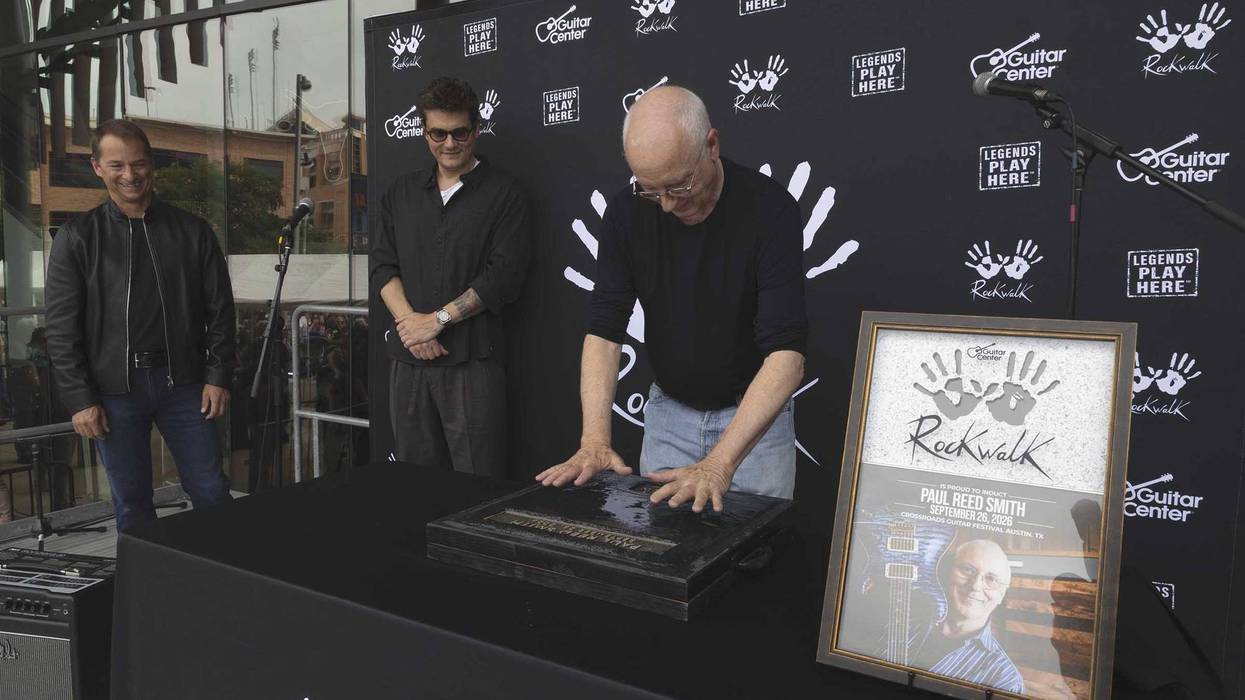
Guitar Center honored Paul Reed Smith, founder and managing general partner of PRS Guitars, with an induction into the famed Guitar Center Rockwalk on Saturday, September 26, during Eric Clapton’s Crossroads Guitar Festival 2026 in Austin, Texas. The honor recognizes Smith’s five decades of craftsmanship and innovation as a guitar maker, from his early work building instruments for artists including Carlos Santana and Peter Frampton to founding PRS Guitars in 1985 and building it into one of the world’s leading guitar manufacturers.