
Though every guitar company loves to have a legacy built on iconic, proven instruments, none want to be seen as unable to evolve. That’s why brands as different as Martin, Gibson, Taylor, and Fender always experiment with novel body shapes, electronics, and materials—even as their most famous and foundational axes continue to sell and flourish in the marketplace.
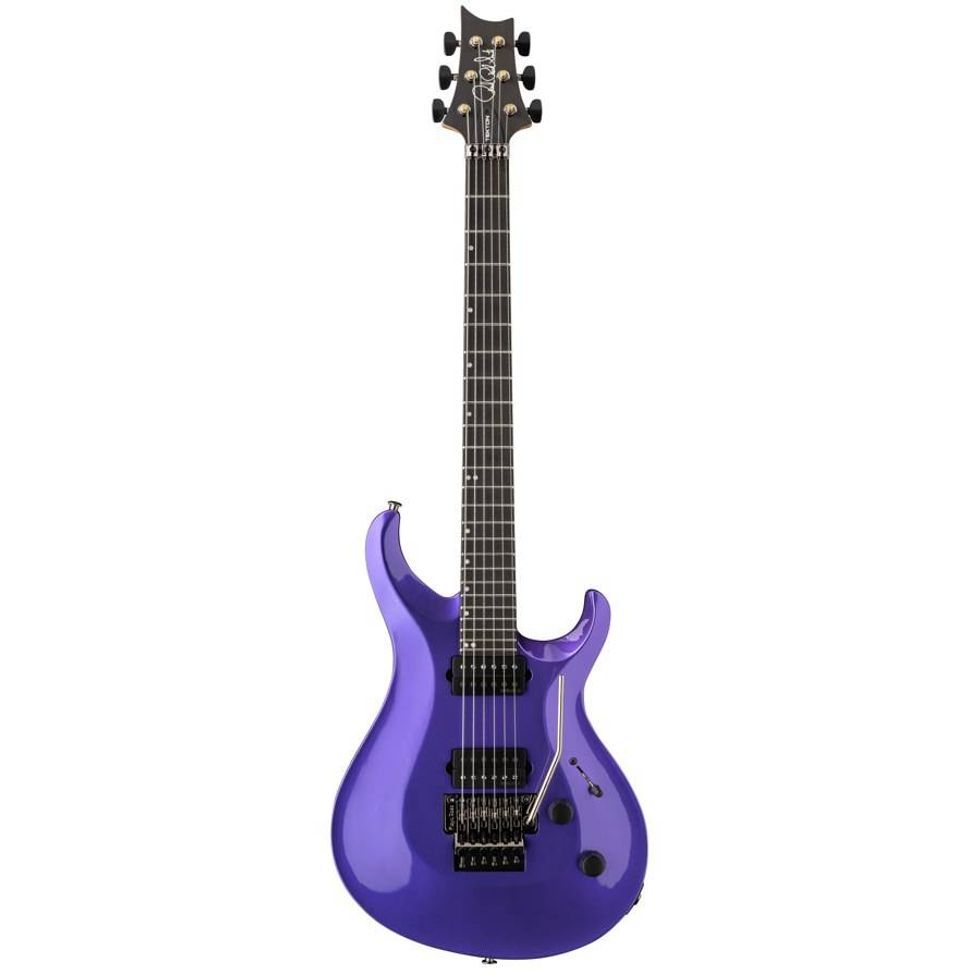
PRS staples like the Custom 24 and the McCarty 594 can, at this point, be counted among such bedrock instruments. They’re classics—plain and simple. And models like the Silver Sky and the Fiore have demonstrated that the company is willing to experiment beyond the business’ ballyhooed bulwarks. The new PRS Tekton line, however, which includes the standard Tekton, Tekton T (with PRS two-point tremolo), Tekton ”Floyd” (with a Floyd Rose 1000 double-locking tremolo), and Tekton SVN seven-string, represents one of the most radical additions to the company’s line in its history.
Body By Design
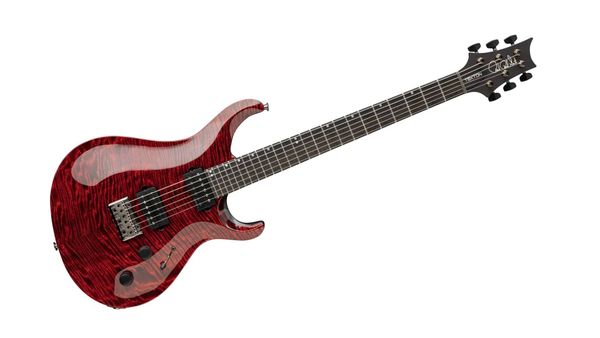
With a fresh, all-new, light and thin body design, an ultra-sleek “modern-D” neck shape, and the brand-spankin’ new PRS Stylus pickups onboard, the modern metal-aligned Tektons are more than an edgy new riff on traditional PRS methodology—they are a true departure. In some respects, in fact, they address the changing ways that modern metal and other technical players make music, most notably the move to digital modeling and amplification systems. They are future-gazing instruments.
Though the Tekton guitars mark a radical deviation from the norm, there are recognizable links to the PRS family line. For instance, it’s easy to see traces of the Custom 24 and the offset Vela in the profile. From there, though, the differences become apparent fast. The Tekton features the thinnest neck and thinnest body ever to emerge from the PRS factory, which is a bolt-on, rather than set-neck design. The bodies are crafted from mahogany and feature bold-figured mango tops, except for the Tekton Floyd, which trades mahogany for an all-alder body, which is lighter and offsets the weight of the Floyd Rose 1000 vibrato. The super-slim bodies are extremely comfortable to hold whether sitting or standing, and the violin-style top carve and sculpted belly make it feel like an extension of the player. Some players may find the mango top’s hard upper edge a bit tough on the picking-hand forearm. But that’s about the only potential gripe. Otherwise, it’s super comfortable.
With a 24-fret neck featuring stainless steel PRS jumbo frets (stainless previously appeared only on the Joe Walsh Limited Edition), you can access the upper reaches of the neck with ease—a sensation that is enhanced by the Tekton’s treble-side scoop, which, to this reviewer, feels deeper than that on a Custom 24. Combined with the thin neck profile, satin nitro finish, new-for-PRS 16" radius, and a lovely Indian ebony fretboard, the Tekton six-string necks offer instantly tangible extra speed and accuracy. You can really feel it, and the sensation is heightened by the slightly wider string-spacing, which will appeal to those with a bit of classical training (or just big hands). The more generous spacing is also a boon for sweep-picking or just playing similar scale and chord shapes up and down the fretboard. Neck stability, by the way, is supported by internal hormigo wood strength rods, which complement the truss rod. Another notable departure: PRS ditched the classic bird inlays for slightly offset dot markers and blue Luminlay side markers.
No Muck In These Pickups
Even with all the reimagined body and neck design going on here, the main story is arguably the new PRS Stylus humbuckers. These Alnico 5 units are notable not so much for their color or character, but for their relatively flat response. This makes them hard to peg as typically PRS in terms of voice, but it makes them very well suited for modeling and profiling platforms.
That doesn’t mean they aren’t great with big, loud tube amps. They are distinctly mud-resistant and bell-like, and this translates across amplification platforms. I couldn’t get a bad sound out of them, and where I often find humbuckers with push-pull coil taps thin or a bit of an afterthought, the coil tap on the Tekton and Tekton Floyd revealed many character-rich tones that sounded especially cool in lower-gain and clean settings and would be right at home in Vertical Horizon, Porcupine Tree, or Opeth-style applications.
“The Tekton six-string models offer instantly tangible extra speed and accuracy”
Take Me to the Bridge
There’s probably not much you can say to a diehard Floyd Rose fan to talk them out of the Tekton Floyd's 1000 tremolo. But I’d make the case that the hardtail Tekton (or the Tekton T, featuring PRS’ excellent two-point tremolo, which we did not review here) offer superior tuning stability, the most sustain, and less maintenance time when you’re re-stringing or adjusting intonation.
There are ergonomic considerations too. The edge of the palm rests much more naturally on the smooth, simple carved tops of the Tektons when a hardtail bridge is in place than with a Floyd Rose, I certainly noticed my palm mutes were more nuanced when using the hardtail. The hardtail bridge also looks more elegant on these sleek beauties. Plus, the PRS hardtail could be the best hardtail bridge on the market. It’s total class in my book.
The Verdict
PRS did not cut corners bringing the Tekton series to realization. The body design, neck, materials, and electronics all reflect a drive to serve contemporary technical players and the evolutionary approaches they use in their craft. The guitars aren’t cheap. You’ll pay $2,899 for the Tekton and Tekton T and $2,999 for the Tekton Floyd and SVN. But those prices are right in line with vintage-spec instruments from other manufacturers that offer little in the way of rule-breaking design. The sense of premium manufacturing and features is plain to see in the build quality, but also the dazzling mango tops and luxurious colors. But the serious R&D that went into these instruments makes these prices look especially fair. And to the extent that they can facilitate a fast-track trip to a shredder’s Mt. Olympus—at least for a certain sect of disciplined, technical players—this new breed of PRS offers an impressive convergence of design, quality, and practical value that can flat-out elevate your playing. PG
PROS An innovative and forward-thinking design from PRS. Light materials. Great ergonomics, along with the thinnest body and neck PRS has produced. Flat-frequency pickups that deliver in modeling situations and with trad tube amps. Super-fast and smooth playability.
CONS Some PRS players will miss the color in more traditional PRS pickups like the 85/15, 58/15 LT, and 59/09.