When my editor approached me about reviewing this bass, I had a very visceral sensation of being 12 years old again. That’s when I started playing bass—and perusing basses in a Swedish mail order catalog that had everything from home improvement tools to musical instruments. I distinctly remember scanning that catalog, once upon a time, and spotting a Precision Bass lookalike called the “Hard Puncher,” which, I suppose, sounded much more heroic to a non-native, beginning-English speaker than “P-Bass.”
The Hard Puncher, as it turns out, was made by Tokai, a Japanese manufacturer of what are now known colloquially among collectors as “lawsuit guitars.” Tokai’s instruments were more than just catalog eye candy for European and American players that couldn’t afford a real Fender or Gibson. Most Tokais of the ’70s and ’80s were also exceptionally well-made instruments. So, when the company ceased exporting instruments in the ’90s, it left behind a dedicated cult of fans. That cult is bigger these days, and Tokais are no longer cheap, secret sleepers among the collector set. Good ones fetch pretty hefty prices. So, it’s little mystery that Tokai is having a go at exporting these Japan-made gems again—this time with a push from Audio Collective Group, a distribution company founded by Warm Audio.
Picking Up Where They Left Off
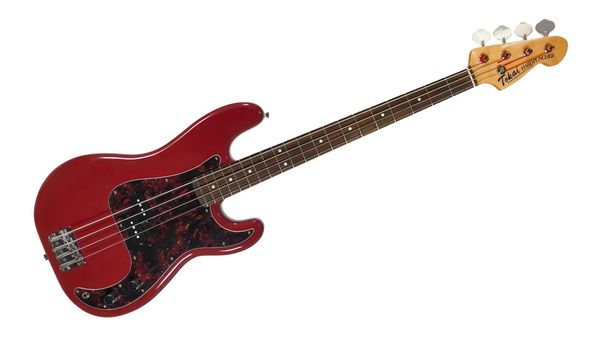
The quality that makes original Tokais minor treasures is recognizable here by feel alone. Fretwork, the neck joint, and the bone nut seat are all tight and solid. The gloss polyester finish is rich and very well executed in a deep dakota red with hints of brown and oxblood that looks fantastic against the red tortoiseshell pickguard. Options abound, though—the new Hard Puncher is available in seven different finishes, and Tokai even offers a choice between alder and ash for bodies, and maple and rosewood for fretboards. (You can select these options on the Tokai website, which, in turn, directs you to a dealer with an instrument that matches your order.)
The 1-piece maple neck is U-shaped and employs a fairly thin slice of rosewood for the fretboard, if you opt for one. The neck has a very nice profile for those of us without large hands, and the compound 7.25" – 10.25" radius lends a natural feel under the fingers. But the neck is also reminiscent of real 1960s-vintage Fender Precisions I have known. As nice as that vintage familiarity is, I wouldn’t complain if Tokai opted to eschew authenticity and use a satin finish on the neck instead of the glossy one on our test instrument. But thanks to the general profile, the feel is fast.
More Extra Effort
Though the basic fit and finish on our Hard Puncher was easy to observe, I was impressed by deeper details—like how carefully the pickups were set up. The E-string side of the P-bass pickup was screwed deeper into the body than you tend to see from most manufacturers. This is the very first adjustment I perform on any bass I buy to compensate for naturally louder low E-strings. The move suggests to me that the folks at Tokai are hip to real-world performance challenges as well as pure aesthetics. It’s a nice thing to see.
The action was great, too—neither too low nor too buzzy. And like the pickups, the careful adjustment meant one less change to make before I took the Hard Puncher on the road or to a session. It’s easy to imagine living with the instrument onstage in most other practical respects, too. It’s comfortable, the medium weight feels good, and it’s very well balanced. Perhaps the only disappointment with the design is that the truss-rod access is a little too much like a vintage P-Bass. You can’t make an adjustment without removing the pickguard first. That’s not a big deal for many players, but as a touring professional who travels between drastically different climates, frequent and easy truss rod adjustment is pretty important.
Force and Flexibility
Rumbling through an amp with tone and volume wide open, the Hard Puncher rewards with a rich, punchy, classically P-bass sound. It’s free of the upper-midrange honk that plagues some P-styles, but retains the immediacy and low-mid emphasis in transient notes that a great P-style should have. Just as importantly, the upper notes on the neck have real body and strong sustain, while the lower notes never feel muddy or too big. The output is just very balanced.
It’s very easy to shape the output from that foundation, too. The tone control has a very usable sweep that allowed me to carefully shape the top end I wanted to tame, rather than just going fully bright or completely dark, which happens in some affordable basses. Dark tones still exhibited great sustain, by the way, which perfectly suited my reggae experiments with the Hard Puncher.
As a player who performs a lot of rock shows, I want to know that a P-style instrument will sound big, warm, and almost piano-like in that setting—particularly with a pick. To find out if this was the case with the Hard Puncher, I swapped the nickel-coated strings that came with the bass for steels. The new set really made the Tokai come alive, without sounding too bright—even on the thinner strings. As you might have suspected, it’s a great rock machine
The Verdict
The Hard Puncher’s $1,499 street price puts it in a very competitive bracket. But I think there’s room there for a high-quality, Japan-made instrument like this. The tones are super solid. The feel inspires confidence from a playability and quality standpoint. Plus, there’s just something hip about a Tokai. It’s a cool way to break from the pack, but it’s also just a great performer with a familiar, even vintage-like feel. Even in a crowded product space, the Hard Puncher screams “contender!”