

No matter what kind of guitarist you are—even if you never plan to own an acoustic 12-string—a session with a Guild F-series jumbo is an essential playing experience. It’s a guitar that you feel as much as you hear—both for its size and its rib-rattling resonance. 4 latest big 12-string, the F-412 reviewed here, deviates from the formula in a few ways. Most fundamentally, it has solid mahogany back and sides, rather than the maple or rosewood back and sides that are Guild F-series 12-string signatures. It also boasts a satin finish, which makes this U.S.-made F-412 a little more accessibly priced. But playing the F-412 is such an immersive sonic experience—and so easy on the hands—that you tend to think about little else. One rarely considers tonewoods and bank balances when they’re drowning in beautiful overtones.
12-String King
In the six decades since the first jumbo-bodied F-series 12-strings appeared, you could argue that no mass-produced acoustic 12-string has surpassed them in terms of tone or beauty. Taylor in particular built some excellent 12s, but the most iconic of these, the 855, beautiful as it is, always seemed like a respectful tip of the cap from Bob Taylor to Guild. Pete Townshend, Peter Buck, and Tim Buckley all made F-series 12-strings foundational parts of their recording and performing quivers—and really, what more do you need to know about a guitar’s qualifications and potential as a rhythm and song machine?
The F-412 has those same qualifications in abundance. But its knack for practically spilling songs from its soundhole starts with its playability. Few 12-strings are easy to handle compared to a 6-string. And if you’ve got smaller hands, the 1 7/8" nut width is no joke, nor is the 25mm neck thickness at the 9th fret. Yet as substantial as these dimensions are, the low action and lovely neck shaping assure that you’ll rarely feel you’re stretching too far or squeezing too hard to make a familiar chord shape. My wrist tendonitis had been acting up of late, and over the many hours I spent with this instrument I never felt as though I was exacerbating the issue. In fact, some of my most playable and slimmest-necked electrics gave me more problems. It’s just a very natural feeling instrument—something 12-strings don’t often manage to be. And the substance in the neck (reinforced by a single truss rod and two graphite support rods) gives the guitar great stability and the sense that you can really lean on it and dig into it with abandon. (It’s little wonder Mr. Townshend considers F-series 12-strings such reliable companions!)
The neck also feels fast—another quality uncommon in acoustic 12s. The guitar practically commanded me to delve into very hyperactive Johnny Marr/Townshend chording and arpeggiating up and down the length of the neck, and dashing from a first-position triad to a 12th-fret shape in a flash felt every bit as effortless and accurate as it would on my favorite 6-string 00.
In Bloom
If you’re lucky enough to have had multiple sessions with a classic maple- or rosewood-backed Guild F-series 12-string—or own one—you’ll notice real differences between those guitars and this mahogany-backed F-412’s tone profile. For starters, it’s less boomy than a maple or rosewood version. It’s definitely midrange forward, but not in a manner that is even remotely grating. Even under vigorous strumming attack, the mahogany seems to warm up the midrange and sand away sharp edges that would tip the tone into stridency. In this respect, the F-412 almost sounds like it has a built-in compressor and EQ.
There’s also headroom and dynamic range aplenty. Delicate fingerpicking does not suffer for having to move all that air in the jumbo body. Rather, the Guild responds to a light touch by highlighting detail and sparkling overtones. And if you should perversely, suddenly, switch gears to flailing Townshend rhythm mode, the F-412 doesn’t flinch. The detail remains, and to the extent there is blurring in the overtones the output retains the structure of a chord’s makeup. And though the F-412 might be discernibly more midrangey than its maple- or rosewood-backed counterparts, that doesn’t mean it won’t boom. In fact, one of the most pleasing and interesting parts of the F-412 playing experience is the way a relatively light touch on the sixth string will activate a big, blooming bass tone that you can contrast with bright, aggressively picked bell tones from the highest three. The F-412 is highly pianistic in this way, which is a very satisfying and alluring quality to have at your disposal when composing or performing.
Seamlessly Satin
Befitting a guitar with a $2,799 price tag, the F-412 is pretty much perfectly put together. That fast, easy playability we talked about? It’s the product of superb execution that spans beautiful rounding of the fretboard edges, flawless fret seating, and immaculately prepped and cut nut slots. The same attention to detail is apparent everywhere else, too. Perfectly sanded and shaped bracing? Superb finish? Check and check!
About that finish. No doubt some readers will take a pause to think about a $2,799 flattop with a satin finish. I know the feeling. But the reality is that the F-412’s price is very competitive with comparable U.S.-built 12-strings that, depending on your perspective, may have a lot less personality and musical potential. That $2,799 does not include the LR Baggs Element VTC electronics that appear on the F-412E, which will up the bill for the Standard to just about $3k. But again, cruise the catalogs of competitors, and you’ll find that the F-412’s price squares fairly with comparable instruments, to the extent such instruments exist. Satin finish or not, there are not a lot of U.S.-made jumbo 12-strings out there. This Guild is a star in a very narrow field, but a star nonetheless.
The Verdict
Acoustic 12-strings are not a priority for everyone. And a jumbo 12, which is truly an armful for a player of smaller stature, might, literally, be a poor fit. I’ll admit a bias for Guild F-series 12-strings, regardless of their practicality. I love the way they look and I’m intoxicated by the way they sound. But it’s easy to overstate the perceived impracticality of an instrument like this. If you’re a serious studio recordist or composer—pro or amateur—that likes to work with a broad palette, it’s hard to put a price on what a sweet-playing and unique sounding instrument like this can offer, especially if you’re into extending its utility via alternate tunings and recording methods.
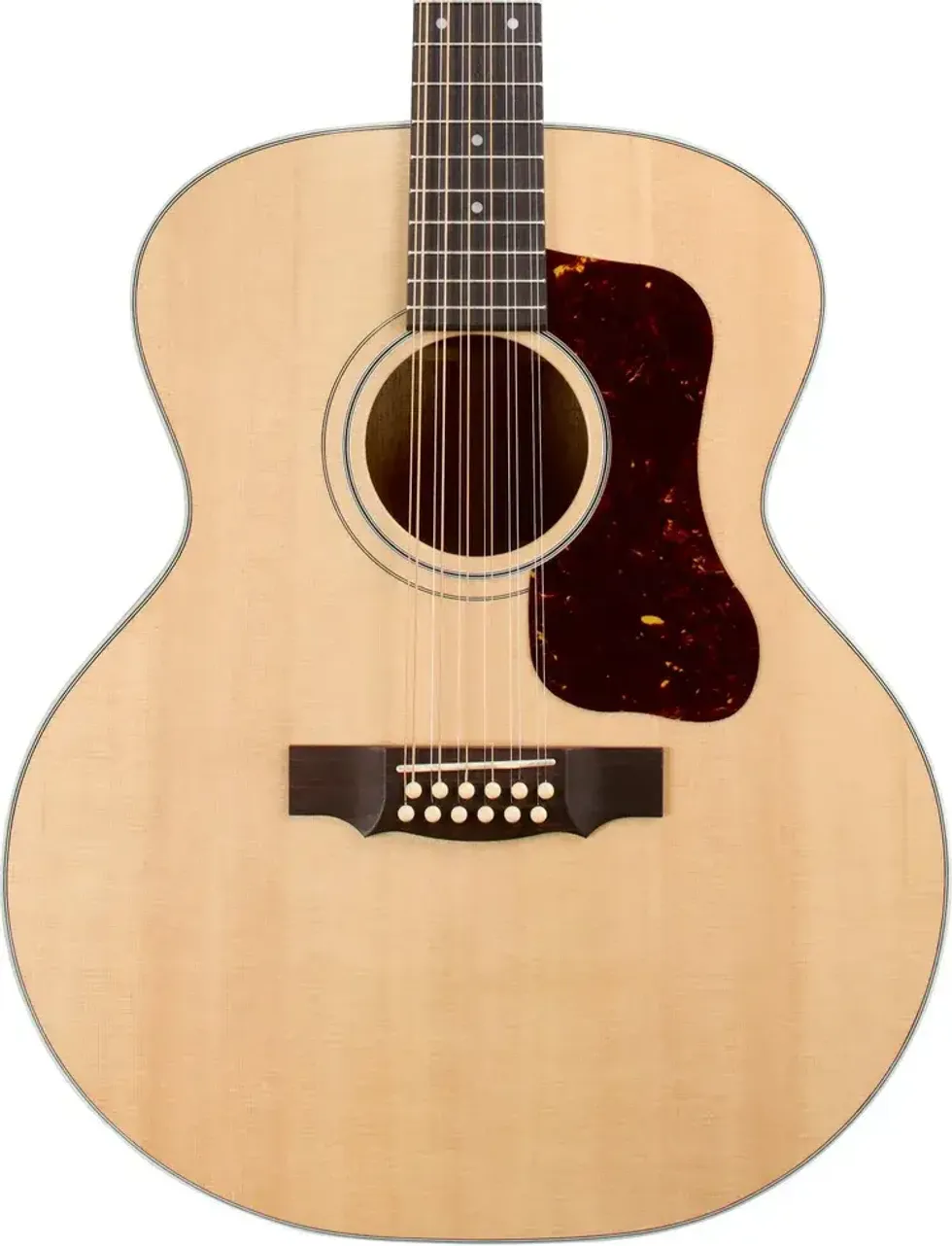
F-412 Standard 12-string
12-string Acoustic Guitar with Spruce Top, Mahogany Back and Sides, Mahogany Neck, and Rosewood Fingerboard - Natural


![Rig Rundown: The Black Crowes’ Rich Robinson [2026]](https://www.premierguitar.com/media-library/youtube.jpg?id=66952027&width=1245&height=700&quality=70&coordinates=0%2C0%2C0%2C0)