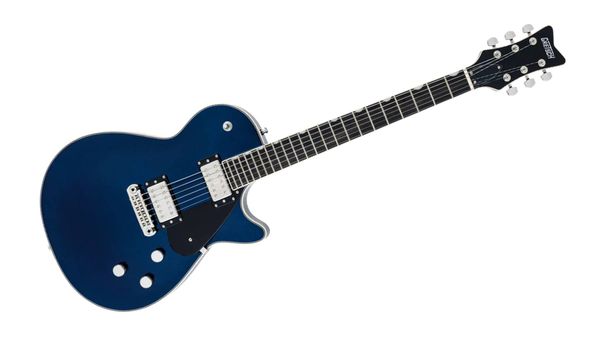
Because I come from a family of Beatles freaks, I think the first Les Paul-style guitar I saw was really George Harrison’s black Bigsby-fitted Duo Jet. I loved that guitar—in no small part because it was a symbol of the Beatles’ punky Hamburg and Cavern days. The new, relatively affordable Electromatic Premier Jet reviewed here is, of course, a descendent of that old Duo Jet. It’s a lot flashier than George’s Jet, but you can see the silhouette, gentle curves, and balanced, handsome proportions that make the Gretsch such an appealing Les Paul alternative. The Premier Jet is also a very different and evolved animal in terms of sound and feel. Stylish though it may be—and in a very vintage Gretsch way, at that—the Premier Jet is an instrument with very modern leanings.
Light and Flash
Gretsch Jets differ from Gibson’s single-cutaway standard bearer in significant ways that aren’t obvious to the uninitiated. Jets are almost always chambered. They typically feature classic Gretsch family pickups like Filter’Trons and DynaSonics, each of which has a personality very different from PAF pickups. (P-90 players might find more common ground.) The Electromatic Premier Jet isn’t equipped with either of those classic Gretsch pickups. But the solid maple-capped mahogany body is chambered, and trimming some heft results in an instrument that hangs comfortably on the shoulders. It’s not featherweight, exactly, but it doesn’t immediately induce thoughts of the chiropractor’s office like some solidbodies can.
Light weight isn’t the Electromatic Premier Jet’s only ergonomic virtue. The volume knob is positioned just below and nearly parallel to the Lockdown locking wraparound bridge, facilitating easy volume swells and other active uses of the control. The two tone knobs are nicely spaced and oriented relative to their respective pickups, with the bridge positioned behind the neck. The tone controls each feature a no-load position which removes the tone capacitor from the circuit entirely. The no-load position is marked by a detent at the maximum position, which is great for confirmation that you're running the Jet wide open. But I would occasionally click into the no-load zone while searching for the maximum-tone-load-with-capacitor setting. I’m sure a little practice makes this maneuver second nature, but it threw me off balance more than once.
"Players that fight fret-hand fatigue will find the Electromatic Premier Jet to be friendly company.”
Back to the ergonomic upsides: The 10-14" radius ebony fretboard is a playground for the bend-happy set. Even though the action is low, full-step bends at the way up to the 22nd fret feel easy. And while George Harrison was on my mind from the second I opened the case, I’m pretty sure it was the slinky feel of the fretboard—rather than the guitar’s vague likeness to his Duo Jet—that led me to tinker endlessly with variations on his bubbly, bendy, super-fluid “Something” solo. This guitar practically compels you to play in this fashion—bluesy, languid, even tenderly. And between the compound radius and medium-jumbo frets, such expressions tend to feel effortless. Certainly, players that fight fret-hand fatigue will find the Electromatic Premier Jet to be friendly company. As far as the "performance-c"neck profile goes, players that like Gibson’s SlimTaper neck shape—one that appears across many Gibson and Epiphone models—will be very much at home here. I switched a lot between this guitar and a 1964-spec SG while seeking points of reference, and the two necks felt very similar in many regards.
Plump, Powerful, Brash, and Bratty
If the Electromatic Premier Jet’s compound radius fretboard, Luminlay side dots, locking tuners, and slyly flash “clairvoyant” sparkle finish (which shifts from deep blue to purple depending on the light and angle) weren’t hints enough, this guitar is not an exercise in vintage authenticity. It’s geared for players that are unencumbered by vintage-correct specifications and sounds, and this design orientation is most apparent in the Sphera Twin Six humbuckers.
The Spheras are driven by Alnico 6 magnets. They’re pretty hot, which has a significant effect on their basic voice. If you’re hunting for humbucker sounds in the most classic PAF mold (and given the guitar’s visual similarities to a Les Paul it’s reasonable to assume there are sonic ones, too) it’s wise to play the Gretsch before you buy. Oddly, at times the Spheras sounded as much like a hot, jumbo-sized Stratocaster pickup as anything else (especially when I used the push-pull, low-cut Lumen Filter). And compared to a PAF—even an Alnico 5 version—the Spheras are tightly focused and less airy around the edges where many harmonics and overtones do their most playful work.
On the other hand, you can hear a family resemblance to Gretsch’s hotter humbuckers like the Full’Tron, and more appropriately in this case, the muscular Broad’Tron. There’s midrange punch to spare that pairs handsomely with Fender-style amps, which offer the Premier Jet the headroom it needs. (Not surprisingly, jumped-up rockabilly through a piggyback Bassman and a Fender Reverb unit sounds pretty great.) British-style circuits are good running mates for the Spheras if you crave pure power. But even attenuated volume settings from the Jet tended to lead straight to crunch world with a midrange-y Marshall or Vox voice downstream, and consequently there’s a lot less dynamic space and headroom. There are many great sounds to find in these pairings, but they may confound expectations among less experienced players. Considering what amp you use the most and how you’ll use it with the Electromatic Premier Jet is time well spent.
The Verdict
There’s much to love about the Electromatic Premier Jet. It’s outwardly seductive and arresting—particularly in the “clairvoyant” blue/purple sparkle. It’s comparatively light, and the flat-out ease of fretting, bending, and moving around the compound-radius fretboard makes it easy to disappear into a long practice or writing session—particularly if you dig fleet-fingered leads or melodic chord sequences. Features like the carved heel and belly and knee cuts make it more comfortable still. The locking tuners allow for quick string changes, and the overall quality of the instrument is excellent. If your sonic aims fit those of the hot, midrangey pickups, the $799 street price will be a bargain. For players that like more vintage-style sounds and style, Gretsch alternatives like the G5230T Electromatic Jet may make more sense. But if you’re unbound by such constraints, the Electromatic Premier Jet can prod a player down very different paths. And while its raw power can make it seem like it’s straining at the leash, the way it functions as a natural extension of the player’s body and fingers can, paradoxically, make the Jet quite civilized, too.

![Rig Rundown: The Black Crowes’ Rich Robinson [2026]](https://www.premierguitar.com/media-library/youtube.jpg?id=66952027&width=1245&height=700&quality=70&coordinates=0%2C0%2C0%2C0)