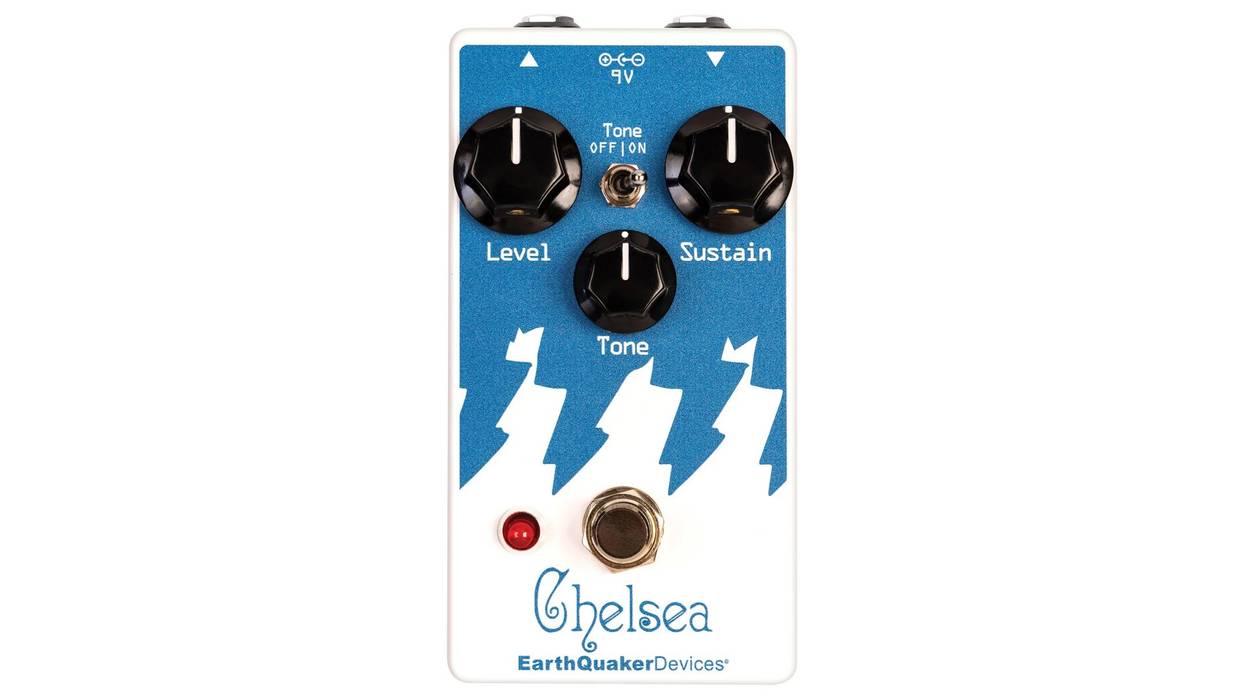
Running two effects of the same kind concurrently can yield amazing results. Stacked fuzzes or RATs? I’m in heaven. Other effects work less reliably well in pairs. Two reverbs, for instance, can sound killer but can turn an otherwise carefully crafted signal to smog. Twin phasers, in my experience, can be counted among the effects that are delicious together. It takes just two simple one-knob phasers to get very weird. Build two phasers into one, though, and add a few extra tone shaping controls, and the weird gets weirder fast.
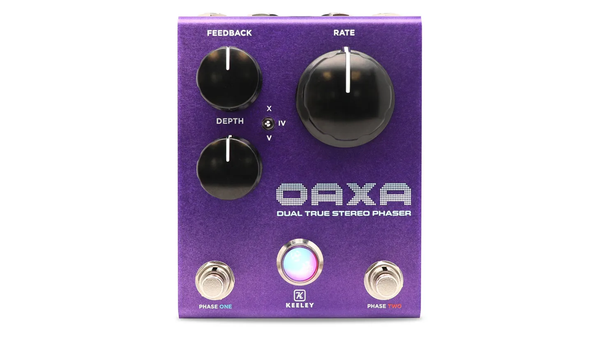
Keeley’s new U.S.-made, digital Oaxa twin phaser can feel nearly as simple and straight ahead as two Small Stones running side by side, and honors the elegance and ease of that solution in many ways. There’s just three knobs—for rate, feedback, and depth. A small 3-position toggle switches between 10-stage phase, 4-stage phase, and a Uni-Vibe-style mode. Two footswitches select between the individual phaser or a combination of the two. If you want to keep things simple, you can dive in no further than that and have a great time. But Oaxa bears many secrets for deeper diggers.
Working the Waves
The phase effect is fun to use intuitively. And adding it in and out can be low stakes. Feeling that a riff sounds lifeless? Add a phaser and twist the rate. Maybe it’ll be exactly what a song needs. Maybe it will sit like rotten mayonnaise. But it won’t have taken much effort to try, and you’ll probably have fun along the way. The Oaxa is deeply satisfying in this manner.
The brilliant, big rate knob can be adjusted with precision using just a toe (provided you have the right shoes). And while the depth and feedback controls might be an affront to Phase 90 and Small Stone users, Oaxa’s controls open up useful phase possibilities without leaving you feeling doomed to get lost in the weeds. The depth control, for instance, has so much range it can render the phaser all but subliminal—making it a killer always-on sweetener that can be nudged in and out of prominence via the depth knob. Those just-barely-there depth settings can also be subtly re-shaped by the similarly rangey feedback control, which acts like a filter, adding wah-like focus at mild depth. At more intense depths, the feedback adds appreciably more vowelly “wow” tonalities that give Oaxa more than a hint of a Mu-Tron’s beautiful vintage essence. This variation—and interactivity—among depth and feedback colors alone makes Oaxa a great production, arrangement, and guitar layering tool, particularly in spacious arrangements.
Bear in mind that all the phase phenomena I’ve described here were observed in the 4-stage phaser voice—my most natural and familiar phase space. But the 3-way toggle can also be configured for 10-stage voicing or as a Uni-Vibe-style phase effect. The 10-stage voice is a little more binary than the 4-stage, and can obscure some overtone nuance in the wash. At extreme depth settings it can even sound almost tremolo-like. For a lot of players, the more focused modulation waves in the 10-stage voice will be a perfect fit for rhythmic delays or staccato passages begging for a little extra wobble and a more interesting tail. The Uni-Vibe style setting, meanwhile, is a pretty authentic version of the effect and delivers a recognizable take on the drippy “whoop”-like phase created by a Uni-Vibe’s optical circuit. Like the real deal, it sounds fantastic with fuzz.Multiplied by Two ... and More
When both phasers are on, Oaxa’s jewel lamp flashes blue and red, and the visual suggestion of a party is apt. There are deep and crazy sounds here that can take you deep into the wee hours. But not all combinations are magic. Certain pairings of modulation rate and harmonic peaks can obscure details that might make a single phase voice pleasing. But the option to run the two phasers in parallel or series enables more or less detailed versions of a compound phaser voice, respectively. And just-right phase-rate relationships combined with contrasting voices, depth, and feedback can yield fantastic results. Fast-throbbing U-Vibe style modulations combined with slow, deep 4-stage phases are extra dimensional—as are just about any two high-contrast rates. Nailing these combinations and hearing them via stereo—the other great force multiplier on Oaxa—can pull you deeper still into the pedal’s capacities.
The Verdict
Do you remember what I said at the top about the Oaxa being simple? It’s true. It’s just that Oaxa’s elegant design also has a lot in store for troublemakers willing to dig a bit. And if the stereo and dual-phase settings aren’t trouble enough, you can use the footswitches and knobs to introduce compression or extra filtering, or reconfigure the toggle to include 2- and 6-stage phaser voices. I’d venture that using the most basic functions will make the $199 price well worth it over time. But you’ll likely celebrate the day you stumble across one of Oaxa’s more complex finds. I suspect such days will be many in number, too.