
When Leo Fender conceived the Telecaster, he had relatively modest aspirations: Perhaps, if he crafted an affordable, easy-to-manufacture-and-service solidbody electric Spanish guitar that didn’t feed back like hollowbodies were prone to do, the country musicians in and around his hometown of Fullerton, CA, would embrace it. Spoiler alert—the gambit succeeded. But the Telecaster’s appeal evolved way beyond the ten-gallon-hat crowd. Bluesers, greasers, mods, hippies, punks, new wavers, shredders, indie rockers, metalheads, and players in almost every other musical subgenre subsequently embraced the Telecaster with open arms, turning this profoundly utilitarian instrument, now 75 years old, into an enduring cultural icon. (Sticklers will note that prototypes and an early batch of Esquires with truss-rod-less necks were already circulating by 1950, so you could argue 2026 technically marks the Tele's 76th birthday—because those were Telecasters in all but name.)
Diamond Time
Many players swear the Telecaster was perfect from the get-go. So evolving the model—while honoring both its bare-bones roots and Leo Fender’s lifelong drive to keep tinkering with his own designs—is a real tightrope walk. Fender pulls it off in style with the American Ultra II.
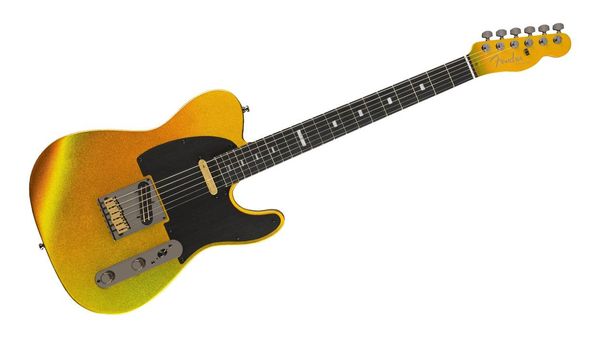
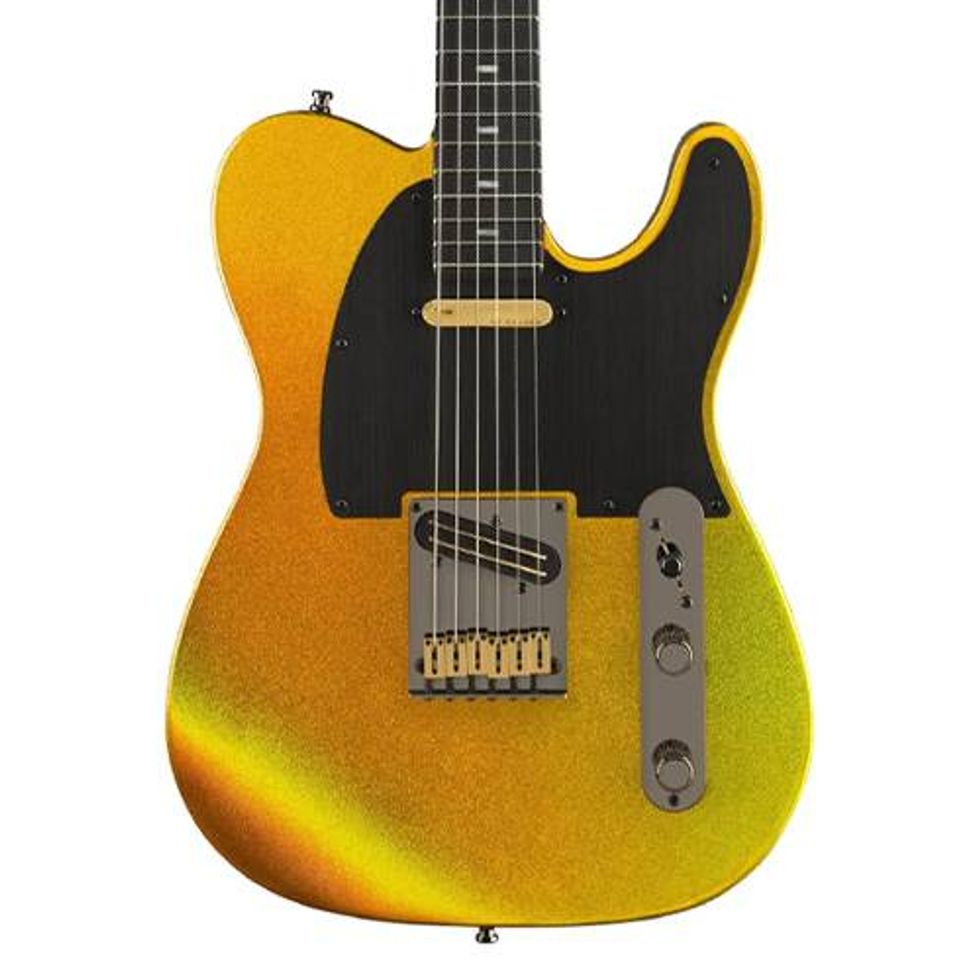
On one hand, it’s almost a riot of color. But the iridescent polyurethane “liquid gold” finish that graces the body and matching headstock is positively striking and perfectly offset by the guitar’s black anodized pickguard, “black chrome” locking tuners and hardware (“gunmetal” might be a more useful description), as well as gold neck pickup cover and bridge pickup rails.
The Ultra II’s select alder body is light, and incorporates comfortable upper bout and belly contours (innovations introduced by Leo himself in 1954 with the Stratocaster) as well as a sculpted neck heel for easy upper fret access. The quartersawn maple neck is graced with many fancy features, too—a sleek, “modern D” profile, ebony fretboard with ultra-ergonomic 10-14" compound radius, high-visibility Luminlay side markers, rolled fretboard edges, and small block inlays inspired by position markers on early Fender lap steels. It’s a flashy, and also mighty classy, package.
Flick of the Switch
Though it’s visually distinctive, the Ultra II Telecaster’s true magic is in its electronics. It’s equipped with an Ultra Noiseless Tele unit in the neck position and Fender’s first pickup featuring a rail design—the 75th Anniversary Fastlane Humbucker—in the bridge position. The guitar features the usual 3-way selector, albeit angled at a very practical slant more akin to a Strat’s. A volume control with an embedded S-1 switch configures the two pickups in series, while a tone control, also equipped with an S-1, switches the bridge humbucker from series to parallel operation. I don’t have space to describe every possible permutation, but by my calculations, this control layout provides players with seven possible tone foundations to explore.
Ultra-Sound
The American Ultra II Telecaster sounded equally great paired with an American-voiced Carr Super Bee and a more Brit-style, EL84-equipped, class-A 3 Monkeys Sock Monkey, which speaks to its adaptable nature. And it was an absolute joy to put through its paces in both scenarios. For starters, the guitar feels fantastic under the fingers. It arrived perfectly set up, and the locking tuning machines provide rock-solid stability. The compound radius allows for comfortable chording at the lower frets, while upper-register bends of a whole step and more can be executed without fear of choking notes.
Neck pickups are regarded by some as an Achilles heel on vintage Teles. But here, the neck unit yields open, bell-like chime that won’t make you wish for a Stratocaster pickup in that position instead.
Beyond superior playability, though, the instrument offers tone versatility that could make it the only guitar you need for a session or gig. In series mode, the bridge Fastlane humbucker retains a glassy sheen, but it rocks with aplomb when juiced with overdrive, or even distortion that dances at the edge of the metal zone. Run in parallel, the same bridge unit yields snap suited for tight funk lines or Bakersfield twang. Neck pickups are regarded by some as an Achilles heel on vintage Teles. But here, the neck unit posesses open, bell-like chime that won’t make you wish for a Stratocaster pickup in that position instead. The pickup configuration that is truly revelatory, however, is when the Ultra II’s pickups are run in series via the S-1 switch. This is a mod that many Fender players adopt, but it requires either modifying the neck pickup or purchasing a unit that already has an extra third wire. Here, the voice is available at the press of a button, and it’s pure indie rock nirvana—full and beefy, yet bright and alive—almost like a Jazzmaster’s combined pickups with the tone and volume dialed up just right. Honestly, if the guitar only delivered this one sound, you might still consider adding it to your arsenal.
The Verdict
As an inveterate guitar curmudgeon and owner of more than a few T-style axes, it was tempting to find fault with the near $3k 75th Anniversary American Ultra II Telecaster. Yet that was almost impossible to do. It’s a spectacular-looking, great-sounding, and smooth-playing instrument that benefits from tweaks and innovations that Leo himself would surely have considered true advancements. At the time of this writing, Fender lists this limited edition guitar as sold out. Whether that’s a temporary situation or not remains to be seen. But even if you have to take to the used market to find this gem, this future classic built on a time-tested foundation is worth the hunt—and the expense.
75th Anniversary American Ultra II Telecaster
Solidbody Electric Guitar, Limited Edition, with Alder Body, Maple Neck, Ebony Fingerboard, 1 Single-coil Pickup, and 1 Humbucking Pickup - Liquid Gold



![Rig Rundown: The Black Crowes’ Rich Robinson [2026]](https://www.premierguitar.com/media-library/youtube.jpg?id=66952027&width=1245&height=700&quality=70&coordinates=0%2C0%2C0%2C0)