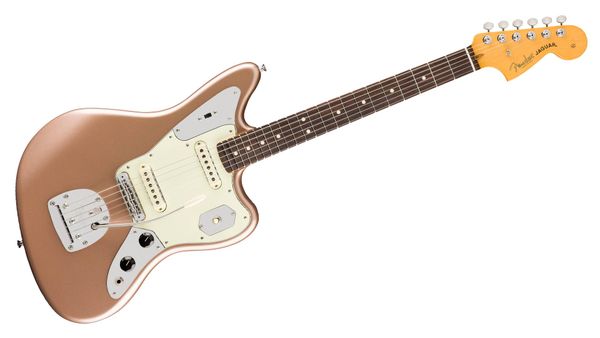

When I was young, I thought guitarists that considered Jazzmasters and Jaguars junk were stodgy, stuck-in-the-mud grumps. In retrospect—and after many decades of Jaguar and Jazzmaster wrestling—I can concede that some of their arguments had merit. Original Jaguar and Jazzmaster vibratos are indeed idiosyncratic things. The rhythm circuits can bleed tone energy. But to the extent such arguments might be true, I still consider these limitations potential strengths, depending on one’s approach.
In many ways, the American Professional Classic Jaguar and Jazzmaster could be compromises designed to appease my contrary young self and all the guitar shop owners that insisted I needed a Stratocaster instead. Both guitars eliminate the rhythm circuit. Each substitutes a Mustang-style bridge for the sometimes cranky, clattery Jazzmaster unit. And both boast features that reflect contemporary shifts in guitar-design trends. The pickups are overwound relative to vintage spec and use Alnico 5 magnets, giving each guitar a meatier voice at most settings. Fretboards are a flatter 9.5", with medium-jumbo frets. But outwardly, each guitar exudes an early ’60s design spirit. The changes will be obvious to seasoned, vintage-oriented Jazzmaster and Jaguar heads, some of whom will cry foul. But they could be very appealing to those who have yet to give the offset twins a shot.
Of Colors and Cost Strategies
Cruising Fender’s website these days is a lot like taking a trip to the candy store: colorful and brimming with temptation. In practical terms, though, Fender’s abundance of choices can make for a complex decision matrix—and that’s before you consider the many appealing Squier offerings. On the Fender-branded Jaguar side, the new American Professional Classic fills an obvious hole between the Mexico-made Player II ($869) the ’70s spec Mexico-made Vintera II ($1,569) and the U.S.-made Johnny Marr Jaguar ($2,699). Fender’s Jazzmaster options are more extensive. The American Professional II Jazzmaster offers modernizing enhancements like the Panorama vibrato and V-Mod pickups for just less than $2K. The ’50s and ’60s spec Mexico-made Vintera II’s are about $1,300. And then there’s the American Vintage II 1966 Jazzmaster at $2,729.
Curiously, at the time of this writing, there are no U.S.-made Jaguars or Jazzmasters built to late ’50s or early ’60s specification outside Custom Shop offerings. Obviously, the new American Professional Classic Jaguar and Jazzmaster aren’t vintage-correct options either (there’s even a maple neck and a black pickguard in the mix to further confuse matters). But if these instruments lack vintage electronics, there’s little arguing their vintage-cool good looks, especially in faded firemist gold, faded sherwood green metallic, and faded dakota red finishes. These guitars might be simpler versions of their vintage predecessors, but leaning against an amp they still can yank at the heartstrings of a vintage-inclined Fender aesthete.
Killer Kitty
Even now, decades into its return to the limelight, the Jaguar remains an odd fit for some players. It was passed over when Fender issued the American Vintage II line—a shame given what a great guitar the original American Vintage Jaguar is. The move suggested the model might be waning in popularity for a second time. But while this Jaguar still might not win over players that won’t mess with the short 24" scale and the guitar’s unique tone signature (punchier and thicker than a Stratocaster, but more focused than a Jazzmaster), those that are less rigid about such things could find much to love.
Switching between 25 1/2" and 24" scales isn’t completely effortless. If your playing style is based on refined technique developed over years on a longer-length scale, it can be problematic. But as a player who moves regularly between Jaguars, Jazzmasters, and Telecasters, I can attest that it is a surmountable problem, and can even be a source of inspiration. (If you don’t believe me, ask Marc Ribot or Mike Campbell).
“Vibrato, which can be less than totally stable on some models, is a star on the American Professional Classic.”
That sense of possibility is compounded by this Jaguar’s inviting playability. The modern “c” neck profile, as Fender calls it, feels a lot like other Jaguars of recent vintage. It isn’t chunky, but it also doesn’t feel too slight, the way some old Jaguars and Mustangs can. The satin neck is fast, and the medium-jumbo frets and short scale conspire to make string bending and vibrato feel natural and effortless. If your mind and muscle memory can overcome the short scale obstacle, you’ll find the American Professional Classic Jaguar a cool and comfortable alternative vehicle for exploring leads and jazzy chord extensions. Additionally, the vibrato, which can be less than totally stable on some models, is a star on the American Professional Classic. It stays where you left it, doesn’t rattle, and is butter smooth.
Growl, Howl, and Purr
The Jaguar’s Coastline pickups are discernibly hotter than vintage Jaguar pickups and vintage-spec replacements. For players that find a classic Jaguar’s voice too thin, this will be a welcome change. These pickups are louder and throw more weight around in the low-mid zone—a potential boon for folks that like a Jaguar’s fast feel but crave more body. The Coastline pickups retain that profile when distortion and fuzz enter the mix, too. More vintage-minded tone chasers might be less charmed. Vintage and vintage-style Jaguar pickups may seem thin by some standards, but they leave a lot of room for additional voices in a band or song arrangement, have a bell-like purity, and bloom beautifully when you add spring reverb—or any time or modulation effect—in copious quantities. But when you play an old-school Jag side-by-side with the American Professional Classic you’ll hear the difference, and it would be wise to check out both guitars at a shop if you can to see where your tastes fall.
If the Coastline Jaguar pickups don’t nail classic Jag sounds, the way they work with the guitar’s simplified controls could make the American Professional Classic Jaguar more versatile for many players. With the onboard Greasebucket tone circuit (which preserves low-end clarity as you roll back treble) and the bass-cut “strangle” switch, which Fender wisely preserved and positioned on the upper bout control plate, you can reshape this Jag’s output in many ways without turning it to mud. The sounds may be slightly different from those of a vintage Jag, but there are many to explore.Jazzmaster Made Simple
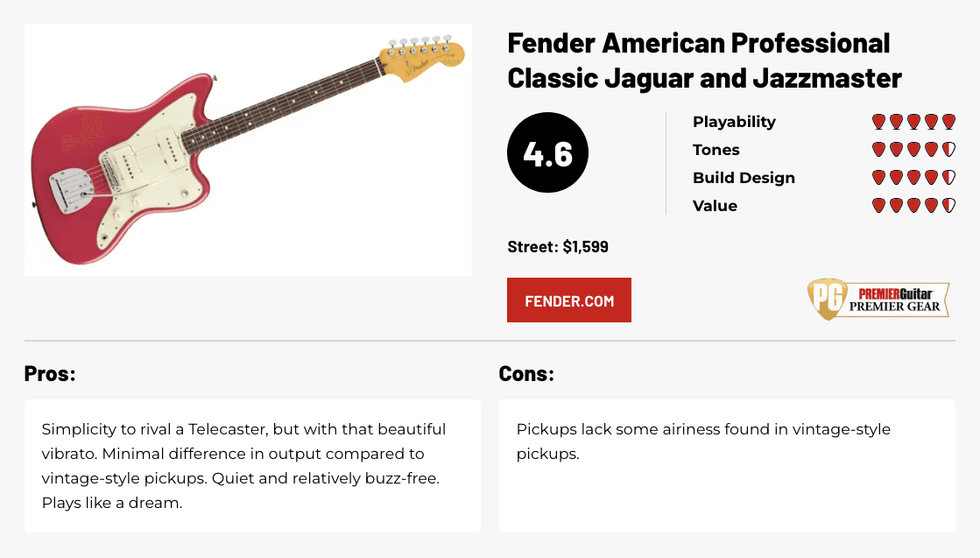
If the American Professional Classic Jaguar is a simpler evolution of its predecessor, the Jazzmaster entry in the series is the kind of offset that could make a Telecaster or Esquire fan cheer. Apart from the Greasebucket tone circuit control and the volume, there’s not much to this very straight-ahead instrument. And in the absence of any controls on the upper bout section of the pickguard, the American Professional Classic Jazzmaster presents a bit like a no-frills Chevrolet to a vintage model’s bells-and-whistles Cadillac. But even as one of those sickos that likes and uses the rhythm circuit on a Jazzmaster, I found the economy of design here very appealing.
“The Greasebucket tone control is a perfect fit for this instrument.”
With so few variables in the mix—the lovely vibrato is about the only other thing to distract you—there isn’t much to consider outside what is coming out of your amplifier speaker at the moment, and in the case of the American Professional Classic Jazzmaster it’s satisfying stuff. For starters, the Coastline ’65 versions of the Jazzmaster pickup are very quiet compared to vintage Jazzmaster models—which are, famously, not very quiet at all. You can park this Jazzmaster in the bridge- or neck-only pickup positions without fear of rendering your clean tone a sea of buzz. But unlike the Jaguar, the difference between the Coastline ’65 pickups and the pickups in the American Vintage II ’66 Jazzmaster is much less pronounced. Like the Jaguar’s Coastline pickups, the Jazzmaster’s are a little less airy in the top end and more focused in the midrange, resulting in a slightly less expansive tone profile. But there’s much less difference in output. In fact, in some situations the American Vintage II Jazzmaster used for comparison seemed louder.
The Greasebucket tone control, meanwhile, is a perfect fit for this instrument. It’s especially effective in bridge pickup settings, which can be pretty piercing at full tone and volume settings, and its mellowing effects yield copious subtle but effective color shifts in all three pickup positions that are conducive to dynamic moves within a tune.
Playability on our review specimen might be even nicer than that on the Jaguar, which is saying a lot. The modern-c profile seems like an especially nice fit for the 25 1/2" scale and the medium-jumbo frets lend a balanced, effortless feel to the instrument. It’s a joy to play.
The Verdict
Even dyed-in-the-wool vintage Jaguar and Jazzmaster players will have a hard time arguing with the charms of these two guitars. Both are a delight to play, are tuning stable—even when you get loony with the vibrato—and are well-crafted, high-quality instruments. They compel you to play as well—even if that faded Dakota red looks a bit more like coral pink mixed with a light tomato cream sauce.
There are other aesthetic gripes than vintage-minded Fender-philes could reasonably submit: The black pickguard on the sunburst models results in an odd mashup of ’60s and ’70s design elements, and I’m sure more than a few folks would rather see the lake placid blue model with a rosewood neck. A small minority of players will miss the rhythm circuit switching, and a greater number will prefer that a more old-school pickup voicing was on offer—particularly on the Jaguar. But in terms of bringing practical, performance-oriented changes to two beloved models with dedicated cult followings, Fender threaded the needle gracefully here. And at $1,599 each, they’ve managed a fair price for a couple of beautiful, reliable, Corona, California-made instruments.



![Rig Rundown: The Black Crowes’ Rich Robinson [2026]](https://www.premierguitar.com/media-library/youtube.jpg?id=66952027&width=1245&height=700&quality=70&coordinates=0%2C0%2C0%2C0)