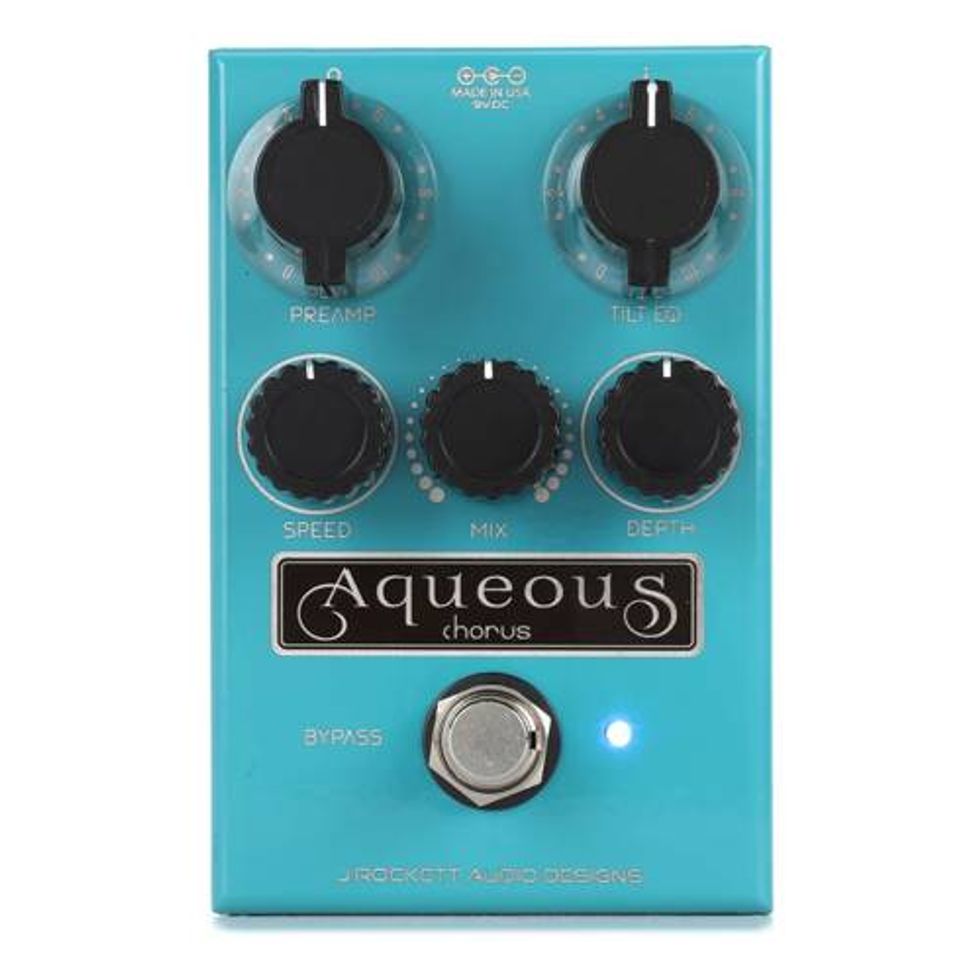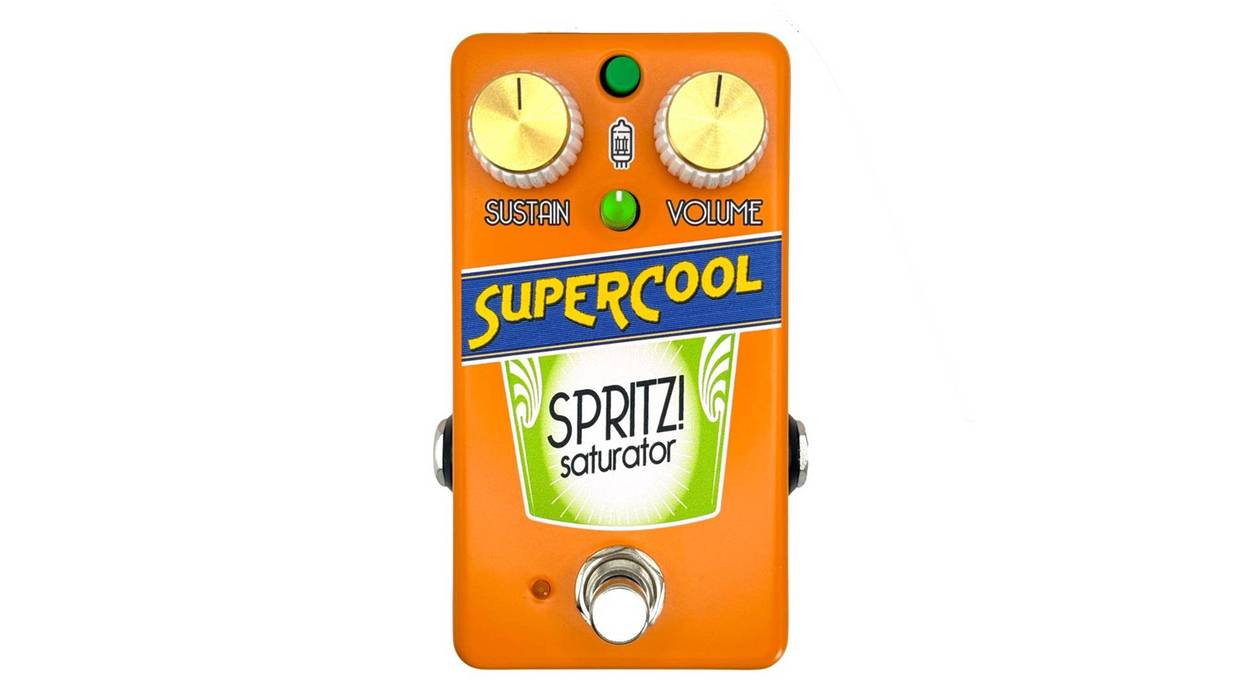
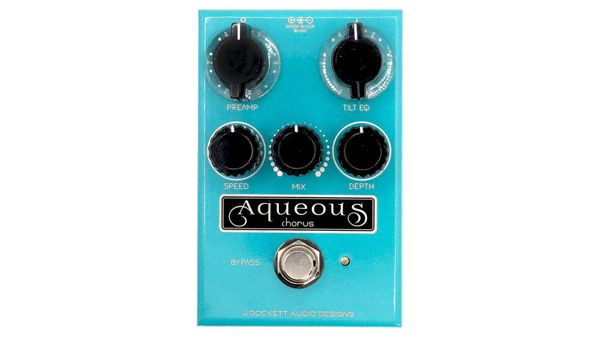
It might be an overstatement to call the J. Rockett Aqueous chorus “surgical.” But for any player that has lamented a lack of subtlety in vintage-style chorus effects, the Aqueous offers an impressive level of control, making it a promising studio and performance tool and an intriguing alternative to the classics—even as it often excels at those sounds.
Waves on the Turquoise Sea
J. Rockett seems to relish a challenge. Even drive pedals, like their Archer series of Klon clones, sit either at the head of their class or are designed to the specification of a very particular, discerning player. In some cases, they have collaborated with designers responsible for stompbox institutions, with the aim of redefining them. They rarely build anything ordinary, and in that way the Aqueous fits the company’s lineage well.
The Aqueous’ digital circuitry is built around the Accu-Bell ABE-1, an effect module constructed by the same company that makes the popular Belton Brick module at the heart of many popular and excellent digital reverbs. Though it’s a digital circuit, Aqueous’ sounds make it a spiritual descendant of many pedals that vintage heads obsess over, like the Boss CE-1 and CE-2 and Electro-Harmonix Poly Chorus and Clone Theory. With the exception of the Poly Chorus, most of these pedals were straightforward affairs offering little control beyond rate and depth. Where additional controls existed, as with the Poly Chorus, they often served to make things extra weird. What’s cool about the Aqueous is that it uses its extra flexibility to achieve greater precision and subtlety instead.
The most interesting of these additional controls are the preamp and tilt EQ knobs. The former will appeal to some as a way to compensate for perceived volume loss. But it’s also capable of subtle drive that blurs modulations and makes them sound like a more cohesive part of your signal, not unlike a dark analog delay. The tilt EQ adds either real darkness by subtracting high end, or brightness that brings a more analog-like liveliness to the output. The tilt EQ works beautifully in concert with the wet-dry mix control, another much less common chorus control parameter, to enable very specific shaping of the modulation intensity and presence.
The practical importance of chorus—or any modulation—that can be foregrounded or tucked back into the hidden corners of a mix in this fashion is hard to underestimate. In live situations, different rooms can respond to the EQ peaks and valleys created by chorus in the same way overdrive or distortion can, and the ability to adapt to those shifts can be the difference between a guitar that goes missing in a mix and one that vibrates with life. The studio benefits of a chorus this nuanced are even more obvious. In both situations the Aqueous can be a great scalpel.
I Threw a Brick
As we’ve noted in earlier J. Rockett reviews, the company has a way of building things to a bulletproof standard. This applies to the Aqueous for sure. Though the I/O and 9V DC jacks are mounted to the printed circuit as well as the enclosure, the enclosure itself is robust enough to be used in self-defense. And it’s hard to imagine many shocks, bumps, or bruises that the Aqueous couldn’t handle. The knobs, meanwhile, are the kind that make on-the-fly adjustments easy. They are smooth, sensitive, and resistant to accidental adjustments. But the real beauty of the control set is the use of Neve-style wing knobs for the preamp and tilt eq, which stand up a little taller and facilitate easy adjustment with your toe.
The Verdict
If you're open-minded about what chorus can be, the Aqueous merits more than a casual tryout. Vintage-aligned players with very specific opinions about how chorus should sound might find certain elements of classic voices missing. Aqueous’ tendency to be many things could also come at the expense of super-deep, over-the-top sounds like those a vintage Poly Chorus or Way Huge’s Blue Hippo can generate.
But if you’re less attached to those templates, Aqueous might leave you wondering why anyone bothers with less tailorable chorus units. A colleague suggested that Aqueous might be a chorus for people who don't like chorus. I’d venture that Aqueous is simply a great chorus for players who want a more flexible one.