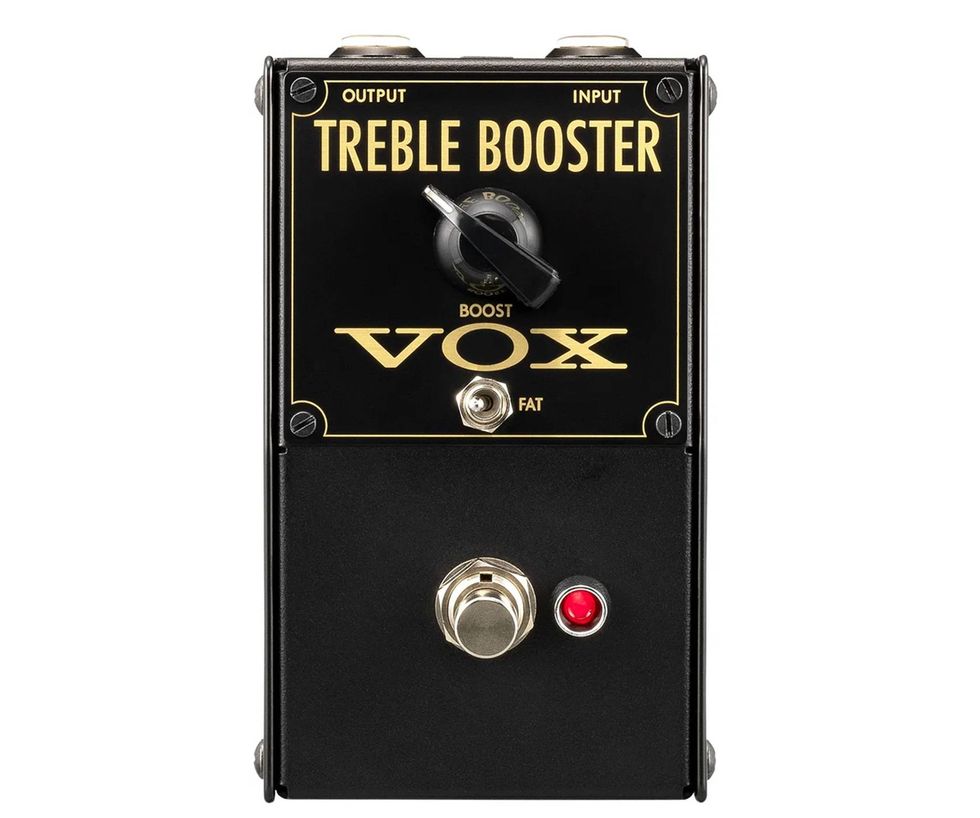
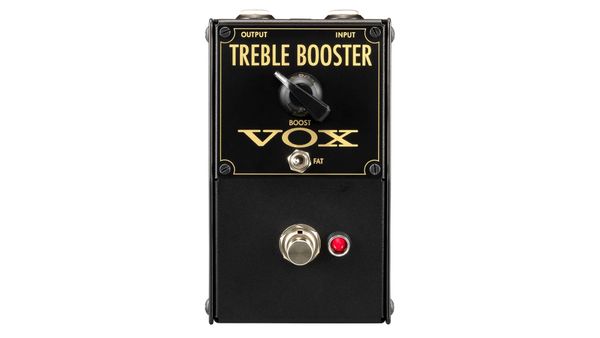

Vox’s VTB-1 Treble Booster is a little packet of dynamite. It might also cloud the mystery around the treble booster effect’s history and nomenclature in general. You see, Vox made a Treble Booster around 1966. It was one of the company’s odd plug-in effects, which also included the Fuzz Face-in-disguise Vox Distortion Booster. But this pedal is not that treble booster. Instead, the VTB-1 is inspired by the most famous treble booster of all, the Dallas Rangemaster.
This is a sensible move on the part of 21st-century Vox. The Rangemaster’s knack for kicking a foggy, tame, and listless amp in the derriére has held the fascination of guitarists since it first appeared in 1965. Vox’s new version takes some liberties with that original Rangemaster design—most notably the use of a silicon rather than germanium transistor in the engine room. But it’s hard to argue with its effectiveness once you’re plugged in. The VTB-1 has fangs.
Bright and Burly
It’s difficult to imagine now, given their association with terms like “chime” and “jangle,” but early Vox AC30s and AC15s tended to be dark if you pushed them. Marshalls had a similar problem. This issue was compounded by other forces. By 1966, a zillion guitarists were taking visual cues from the Beatles and Stones. Keith, John, and George may have used P-90-fitted Epiphone Casinos, but they sparked a fascination with semi-hollow archtops that sold innumerable humbucker-equipped Gibson ES-335s. Keith also used a Les Paul. So did Clapton in the Bluesbreakers. Humbuckers were in. But that meant a lot of players were fighting through tone mud of their own making.
“Flip the fat switch and you can practically see Brian May hand the baton to fellow Rangemaster user Tony Iommi, as he prepares to craft a wall of doom.”
That’s where pedals like the Vox Treble Booster, Dallas Rangemaster, and Hornby-Skewes Treble Booster entered the picture. Though they shared some design DNA with the many fuzz tones then coming into vogue, they were designed to push midrange and top-end specifically. And as anyone who has goosed the mid and high-mid range on an amp can attest, a lot of very appetizing harmonic distortion lives there.
A treble booster’s job was simple—and appropriately, its form, function, and inner workings mirrored that simplicity. In the original Rangemaster design, the germanium transistor driving the works was complemented by three resistors and four capacitors—that’s it. There isn’t much more going on under the hood of the VTB-1. There’s a metal-can BC-109 silicon transistor in place of a germanium one, and thin-film resistors instead of carbon composite, in order to reduce noise.
But there are other critical differences. Vox’s circuit uses several more capacitors than the Rangemaster. More conspicuously, there are two red LED diodes in the circuit. The diodes don’t clip, but they help Vox’s engineers achieve some of the non-linearity in the original germanium circuit, which can sweeten the distortion. In the estimation of the engineers, LEDs also help the silicon circuit deliver germanium-like dynamic sensitivity to guitar volume. That elevates the performance, feel, and sound of the VTB-1 and makes its tone smorgasbord very expansive.
More Flavors Than a Candy Shop
The surprise in using any good treble booster is its unexpected versatility. The Vox excels on this front. Much of this evaluation was done with the AC-style channel on an EL84-powered Carr Bel-Ray and a ES-335 copy. Together, they make a weighty sound, but darken the signal significantly. However, adding the VTB-1 with just a touch of boost transformed the output. The rig was more alive, definitely more sparkly, and heftier, too. Attenuating the guitar volume didn’t do much to diminish the VTB-1’s considerable presence. Instead, the output became chimier across a range, from acerbic to airy depending on the guitar tone setting.
On the neck pickup, adjustments to the guitar volume and tone yielded many shades of Peter Green—smoky and mysterious, with a hint of menace. At the other end of the VTB-1’s gain spectrum you hear the heaps of saturation with diamond sparkle on top that enticed Brian May. Flip the fat switch and you can practically see May hand the baton to fellow Rangemaster user Tony Iommi, as he prepares to craft a wall of doom.
For all the favors the VTB-1 does for humbucker-and-EL84 parings, you shouldn’t be shy about hooking it up to single-coils or Fender-style amps. Though these combinations can be a handful in the searing, spiky ways you would expect, a Telecaster and the Bel-Ray were among my favorite companions for the VTB-1 for the way they dished hot-neon, midrange Revolver tones. The combination of the 335 copy and a late ’60s Bassman, meanwhile, could easily pass for an early plexi. With a Fender Reverb unit, the output became even more sweetly Peter Green. And while you’d want to take care running a Telecaster wide open in front of the Reverb and Bassman, working the guitar’s volume and tone controls yielded a feast of varied sounds, from blue-sky jangly to nasty.
The Verdict
It’s beautiful that one knob and a little toggle can do so much to liven up your tone. Criminally, I don’t have a Rangemaster or Rangemaster copy on hand, so I can’t tell how the VTB-1 matches up at the spectrum-analyzer level. What I can say is that I heard beautiful tones in abundance, that they capture the spirit of a Rangemaster, and that they were more inspiring than any overdrive or amp-style pedal I’ve played in a long time. One knob, yes. But so many possibilities.