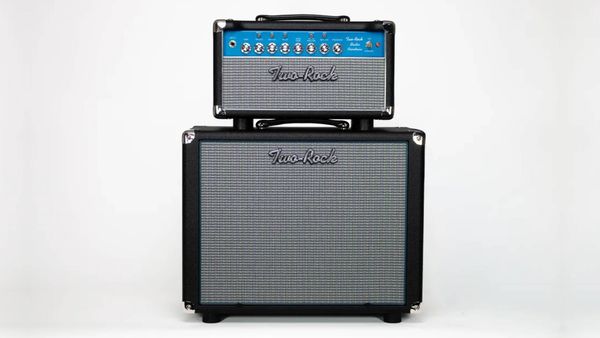

The “Studio” moniker is used in the Two-Rock camp to denote compact, efficient models suited to recording environments. But “club” could just as easily substitute for "studio" in the name of the newest Two-Rock.
The Studio Overdrive is light, feature-packed, and versatile, and will easily fill a small-to-medium room with Two-Rock’s signature clean-to-overdriven tones—without PA system assistance. Even in head-and-cab format (the model is available as a combo) the Studio Overdrive is a pretty perfect grab-and-go package. But if you just took a quick look at the specs on the page, you might guess it’s a much bigger amp: 35-watts from two 5881 tubes in fixed bias, four 12AX7 preamp tubes driving clean and lead channels, tube-buffered FX loop, and phase inverter. It may be near-lunchbox in dimensions—measuring approximately 15.5"x9"x10" and and weighing 26 pounds—but it’s a big amp in spirit.
Double Duty
Like the classic Dumble-style Overdrive Special template—and other cascading-gain classics like the earlier Mesa/Boogie Mark Series amps—the Studio Overdrive is built around a clean channel with three-band EQ that feeds into a lead stage that can be switched in as desired. After the single input, controls include gain, treble, middle, bass, lead gain, lead master, master, and presence, with switches for bright, mid, deep, bypass, and lead. The bypass toggle taps Two-Rock’s newly designed tone-stack-bypass circuit, and both that and the lead switch can be accessed remotely via the included two-button footswitch. On the back panel, critical features include speaker outs for 4, 8, and 16 ohm loads, effects loop send level (with pull-defeat), and a return level (also with pull-defeat). As feature laden and compact as the amp is, it feels surprisingly uncluttered and free of superfluous bells and whistles.
“Removing the EQ via the bypass switch can make things a lot less subtle—fast.”
Two-Rock emphasizes that the tube-buffered FX loop is a big part of the Studio Overdrive’s charm, because it maintains an all-tube signal path throughout the circuit rather than breaking the chain with an op amp-driven solid-state buffer, like many makers use. It was very effective with the wide range of time-based devices I tried, including a UAFX Del-Rev reverb, a Fractal VP4, and a bucket brigade Maxon AD-999. And each of them could be mated perfectly to the amp via the dual loop level controls.
Other key design points include the use of a fast power stage that enhances tracking, clarity, and articulation in clean and lead settings—enabling fast picking without any slurring or mud. A look inside the chassis reveals extremely tidy hand wiring of all components on three eyelet boards (excluding the two small switching boards, which carry the standard relays). Inside and out, it’s a top-notch build, which one would expect from Two-Rock and an amp at this price.
The optional Two-Rock Small Open Back 1x12 cabinet that the company sent with the Studio Overdrive is beautifully made, too. It’s crafted from solid pine, measures around 21.25"x16.5"x11.25" and weighs a very reasonable 32 lbs. Built with the oval-ported back panel often favored by D-inspired cabs, it carries a 100-watt, 8-ohm Two-Rock TR-12 that’s manufactured in the U.S. by Warehouse Guitar Speakers. The Studio Overdrive was, predictably, well-matched to this setup. But the amp also sounded fantastic through a 2x12 cab with Celestion Greenbacks and a 2x10 cabinet with Mojotone Anthem speakers.
D-Licious
If you guessed that all this beautiful design and construction leads to beautiful tones, you’re absolutely right. I hooked the Studio Overdrive up to a Gibson Les Paul and a Fender Telecaster, and with both guitars the amp produced luscious cleans and toothsome lead tones in a broad range of voices at just about any volume level you might need, apart from bedroom-level hush.
In addition to the immediacy of the attack, the amp is also extremely dynamic, following subtle picking nuances and adapting effortlessly and expressively to many playing styles. With multiple gain stages, it’s easy to add precise and incremental amounts of breakup to clean tones, rather than switching between über-clean and dirty sounds like many 2-channel amps do. The EQ is another powerful sculpting tool. But removing the EQ via the bypass switch can make things a lot less subtle—fast. Bypassed settings are loud if you don’t keep the master down to 2 or below. But that leads us to another nifty trick: The send and return levels in the loop can act as second and third output masters when you’re not tailoring them to the specific input-level needs of various effects (more about this in a minute). A little attention paid to these settings can dial the decibels down while retaining much of the big-amp girth and solidity you hear at louder levels. Switching in the lead stage, meanwhile, unleashes juicy, luscious saturation that’s still very tight and responsive to touch, EQ shifts, and gain levels.
Over the years, Dumble overdrive tone has come to be defined more by reputation than experience. Their rarity ensures that few of us will ever play one. But while certain attributes are common to most Dumbles—thickness, smoothness, and touch responsiveness among them—there was never just one Dumble sound, and if the Studio Overdrive leans in any particular direction, it’s toward the crisp, clear end of the Dumble scale. Any player worried there isn’t enough hair and thickness on tap can rest easy—the Studio Overdrive has it covered, and in plenty of tasty flavors.
The Verdict
Top-tier design and construction is a Two-Rock hallmark, and the new Studio Overdrive delivers on that front—big time. The controls are versatile and can be used intuitively and interactively to craft spot-on, specific, and very individual tones. From rich cleans to luscious overdrive, it’s hard to imagine many new amps sounding better, just different. And while it comes at a steep price, the Studio Overdrive is pure pleasure to experience.