Reality and perception are two different things, right? When it comes to guitar effects, I’m frequently reminded of that fact. What I think should happen when I click a button or turn a knob is sometimes something different from what I actually hear. The circuitry that makes those sounds might not be what I imagine either. The Electro-Harmonix Pico Atomic Cluster is the kind of device that defies expectations. Going into this review, I knew that it was going to be an experimental, sound-sculpting kind of experience. Even so, it was full of surprises.
What’s That Sound?
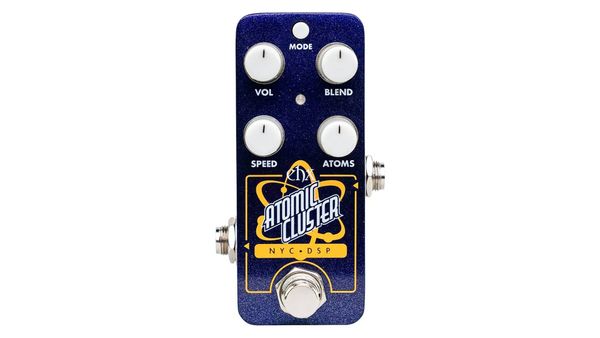
Before we get to what the Pico Atomic Cluster does in technical terms, it’s worth taking a minute to talk about what it’s like to make sounds with it using an intuitive approach. The controls themselves are simple: a mode switch (that switches between sharp and smooth envelopes,) and knobs for volume, blend, speed, and then the harder-to-define atoms control.
With most of the controls around noon, I heard warm, sustaining, analog synth-like sounds with some movement in them. Cranking the speed didn’t seem to make anything go faster in a modulation kind of way. Instead, I heard what I would call an increase in “activity.” Bubbles of sound spewed forth from whatever my guitar gave it, and the higher I cranked that knob, the more that went on.
The atoms control sounds like a low-pass filter that determines which frequencies are … atomized? The results are new notes that seem to develop from the overtones in the guitar signal. At the lowest atoms settings, they are more brooding, dark-basement, organ-like textures. At the highest settings, the output is harsh in a white-noise kind of way.
“At the lowest atoms settings, it gives a more brooding, dark-basement, organ-like texture. At the highest settings, it’s harsh in a white-noise-between-channels-interrupting-the-broadcast way.”
Hitting the mode button feels like it changes which frequencies the Pico Atomic Cluster interacts with. But the effect can be mellow, and in my experiments the full-blend mode created a textural bed that was ideal for sweet, cosmic, melodic overdubs. One important discovery I made was the difference between flat dynamics and full dynamics modes, which are activated by holding the mode button versus tapping it. Full dynamics mode is much more subtle, in a way that would make it useful for adding extra flavor to a cool lick. Flat dynamics mode, by contrast, enables you to go full-on space ranger.
What’s It Doing?
So far, I’ve discussed what the Pico Atomic Cluster sounds and feels like to me—and it’s important to know that you don’t need to know exactly what the Pico Cluster does to justify putting it in an experimental- and ambient music-oriented tool kit. But according to the engineers at EHX, the Pico Atomic Cluster synthesizes oscillations based on the input, effectively leaning into the digital artifacts created in that process. Those sounds were discovered while designing other pedals in EHX’s NYC DSP series, where they were unwelcome. The Pico Atomic Cluster was born when the engineers decided to build a pedal around them—resulting in the lo-fi glitch machine reviewed here. That the pedal is designed around sounds that were unwanted elsewhere tells you something important: this isn’t about precision. It’s a vibe machine—weird, wild, and fun.
This kind of imprecision—and the sense of not knowing exactly what’s happening—kept my hands and imagination active, prompting me to give the pedal more effervescent chord voicings and spicy intervals to synthesize and work with. Hearing the pedal react was rewarding enough to keep me engaged and wondering what kind of drone records the Pico Atomic Cluster could make possible.
The Verdict
It’s refreshing to find a pedal that does the unexpected. If you like to understand the mechanisms behind the sounds you make, the Pico Atomic Cluster is not an easy unit to unpack on an intellectual level. The controls could be more nuanced, too. But that gets us back to that thing about reality and perception. Who cares what’s going on under the hood if it sounds cool? And this pedal sounds cool, producing a particular, unmistakable flavor of warm glitching. The results you produce may be entirely different from what I found and used. But this is a pedal for the musically curious. And if you’re one of those players, you should try it out to see what unexpected results you can conjure. At just $129, it’s a nice price for a lot of fun, and so many creative possibilities.
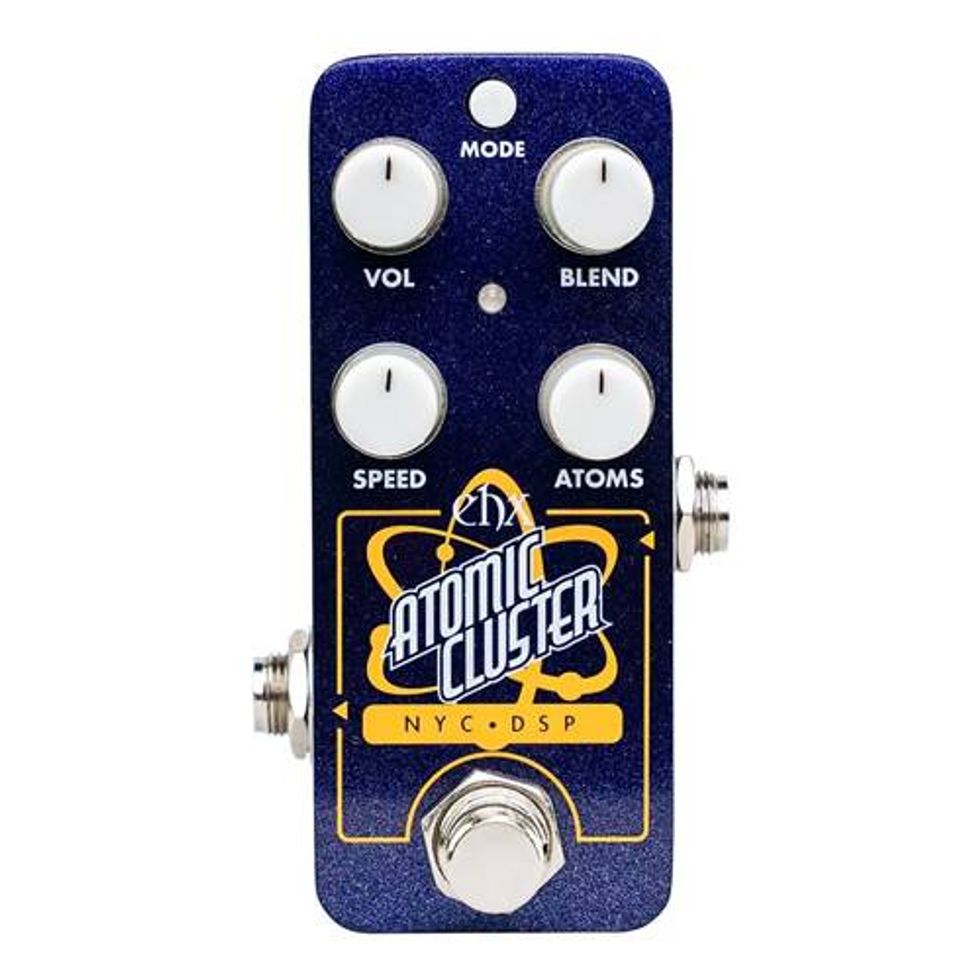
Pico Atomic Cluster Spectral Decomposer
Experimental, glitchy, and ambient, the Electro-Harmonix Atomic Cluster is a wholly unique experience. Dubbed a "Spectral Decomposer," this glitchy synth pedal breaks down your instrument’s signal, reducing the frequency resolution to create a spectrum of oscillating, pixelated rhythmic tones.