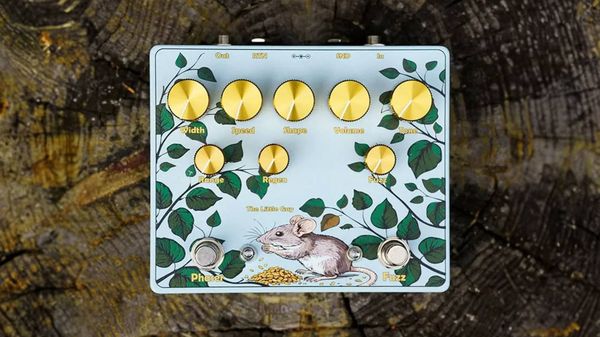

Looks can be deceiving. But there is something extra playful about the graphical subterfuge Monger Pedals employs to conceal the ferocity of their latest stomp, The Little Guy. Behind the Beatrix Potter/Timmy Willie-styled enclosure art depicting a wee country mouse and creeping vines, there lurks a beastly mash-up of op-amp fuzz and operational transducer amp (OTA)-based phaser. But The Little Guy’s roar is not just ferocious, it's also unconventional—making the most of the unusual phaser section to twist staple psychedelic sounds into many altogether weirder things.
Monger of the Mangled
Op-amp fuzz can take many shapes in the hands of a clever builder, but most players would consider the op-amp Big Muff and the Pro Co RAT as the archetypes of the effect. Of the two, The Little Guy aligns most closely with the Big Muff. I don’t have an op-amp Big Muff in my pedal collection, but the Little Guy (like a real op-amp Big Muff) has a sonic signature much like a raspier 4-silicon transistor Big Muff. Of the Big Muff types I used for comparison, a ram’s head-type sounded most similar to the Little Guy’s fuzz, and the two share a capacity for sizzly, buzzsaw-like tones that define the op-amp Big Muff. That said, the tone control in the Little Guy’s fuzz has enough range that I could dial in sounds nearly equivalent to those from a Sovtek Big Muff, which tends to be rounder and more bass-rich than an op-amp Big Muff.
Certainly, the Little Guy’s fuzz section is versatile. I may not be in the majority in this sentiment, but my favorite among the fuzzy, distorted sounds I coaxed from the circuit were those I derived when fingerpicking (using the flesh of my thumb, rather than nail or pick) and working with low-gain, treble-attenuated fuzz settings. This application is more consistent with Monger’s description of the fuzz as “lo-fi”—often evoking Steve Malkmus, Sonic Youth, and Graham Coxon in their hazier states. Yet it’s a combination that’s surprisingly sensitive to touch dynamics and yields more high-mid range detail and a much more oxygenated tone environment than you would expect. Just switching between neck and bridge pickups can reveal whole worlds of color with this approach. The Little Guy’s fuzz rips at the other end of its operational spectrum, too, and it rarely sounds lo-fi here. Settings in the latter third of the pedal’s gain and tone control range are searing but still massive in a way that suits Fender single-coils and PAF humbuckers alike.
Vexing Vortices
If the Little Guy’s fuzz section is agreeable and intuitive, the phase section is a tougher nut to crack. Familiar sounds in the fashion of a Phase 90 or Small Stone (the latter of which shares an OTA as foundation for its architecture) lurk among the interactions between the five controls, but tend to be more subtle. In fact, for all the phaser’s weirdo capabilities, in much of its range it generates super-subtle modulations. This isn’t a bad thing, especially if you like phase as a constant, backgrounded presence. The Little Guy excels at producing this mellow phase texture in a way that a Phase 90 or Small Stone cannot.
But there are many other low-key modulation colors here. You can dial in super-slow (and I mean slow) modulation rates, and then emphasize peaks in those lazy cycles by using feedback from the regen control and narrowing the frequency range with the range control. The LFOs width control is excellent for subtly backgrounding modulations so you don't mask tone nuances from elsewhere in your chain. That capability is enhanced by the effect send and return, which lets you situate pedals between the fuzz and phase effect.
"For all of this phaser’s weirdo capabilities, in much of its range it generates super-subtle modulations."
The Little Guy’s weirder phase voices are refreshingly unique. The pedal is able to generate a variety of rich, vowel-y, “wow”-type pulses more reminiscent of a vintage Mu-Tron or Ludwig Phase II. It’s also capable of fresh takes on lively auto-wah and filter sounds, and slow, sweeping versions of these tones can take on a sort of parked-wah-on-nitrous-oxide personality that I don’t encounter every day.
The Verdict
Monger’s The Little Guy sells for just less than $225. That’s a great price for almost any pedal that combines two wide-ranging effects. But it strikes me as an especially good deal when you consider the very high build quality, clear sense of craft, and thoughtful design execution. The Little Guy won’t be a great value for every player. Rather than aping canonical phase sounds, it inhabits many very idiosyncratic corners of the fuzz/phase tone realm. And if you just want a Big Muff and Phase 90, there are simpler, less-expensive, and less space intensive solutions. Consequently, you should consider my enthusiastic tone and value ratings on a sliding scale relative to your needs.
But if you’re on the hunt for variations on the fuzz/phase theme that can set a track apart and inspire new directions, Monger’s Little Guy is brimming with them—particularly if you’re willing to probe the sometimes complex and idiosyncratic interactions between its controls.