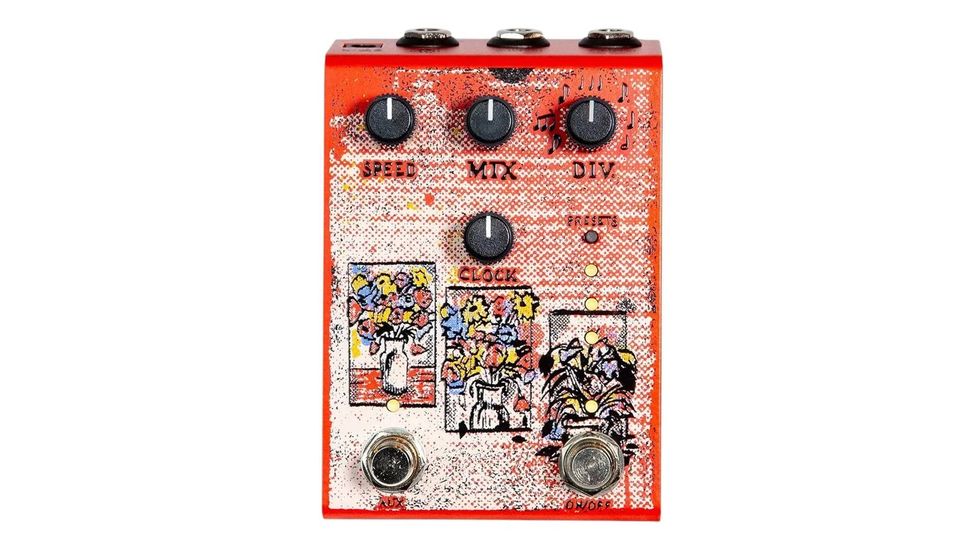
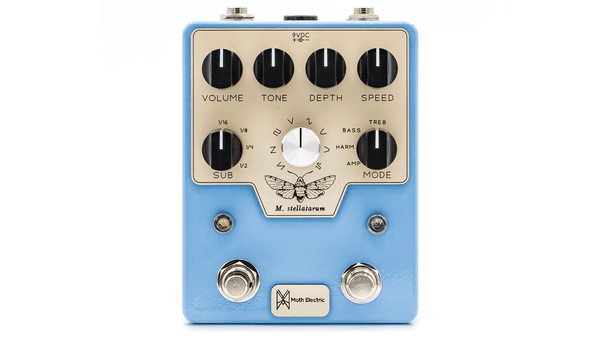
Moth Electric’s M. stellatarum analog tremolo is a riff machine. If you’re in a drifting, open, creative headspace, it’s a great guide and a deep well of ideas, especially if you follow its rhythmic lead. But it’s also a scalpel, capable of great precision, that carves along lines dividing vintage amp tremolo and more atmospheric and surreal colors. It isn’t the most straightforward tremolo. And the expansiveness that makes it alluring can also make it tricky to use, especially in live performance. But it can be a welcome companion when your playing feels stale. And on days when practice or a songwriting session sounds like work, it can make the guitar a playground again.
Modulation Mash
M. stellatarum’s copious potential for inspiration is made possible via seven very fluid controls that, while intuitive, are full of surprises. A few of these controls are relatively uncommon. While some tremolos feature the option to move between say, a harmonic and optical- or bias-style tremolo voice, the M. stellatarum offers these voices and two additional ones that modulate the bass and treble frequencies exclusively. The tone control is another one I rarely see on a tremolo. It’s a simple, straightforward idea, but as executed here, it’s a very effective tool for making the tremolo more or less prominent, or highlighting the complex harmonic tapestries you can weave in combination with the four voice modes.
Of the four voices, the amp mode is easiest to wrangle and the most familiar. Though that rule can go right out the window depending on the waveform, subdivision, depth, and speed you use with it. The harmonic tremolo mode is liquid and enveloping. Some slow-cycling modulations in harmonic tremolo mode even evoke a cross between a rotary speaker and a wah (Jerry Garcia’s swirly, unconventional pedal steel tones on American Beauty and Garcia are possible points of reference.) It works beautifully in service of mollassess-thick psychedelia, wobbly, chugging Lonnie Mack phrases, and more.
“Accenting pulses in the bass, meanwhile, enables contrasts between clear melodic passages on the high strings and throbbing, rhythmic modulation on the low ones.”
The bass and treble voices, meanwhile, are super-cool additions. Their utility might not always be apparent when chasing vintage tremolo textures, but they are powerful and practical creative tools, especially when arranging or shaping a riff to fit a band. Using the treble voice combined with treble-heavy tone control settings make it possible to fashion intense top-end pulses that are extra dramatic against a solid, steady, un-effected bass counterpoint (this effect can be extra striking when used with open tunings with detuned 5th and 6th strings.) Accenting pulses in the bass, meanwhile, enables contrasts between clear melodic passages on the high strings and throbbing, rhythmic modulation on the low ones. Even within the confines of these basic bass/treble modulation relationships there are many unique tremolo variations to explore, because the tone control can so radically reshape the intensity of the treble or bass peaks. And as you sweep across the tone control’s ample range you can shape these textures to suit very specific needs. I suspect many producers, engineers, and players that work in spare musical contexts will love the vistas opened up by these two modes.
Wave Parade
The tremolo variations made possible by the four voices grows exponentially when you factor in the eight available waveforms: sawtooth, reverse sawtooth, square, triangle, sine, hypertriangle, reverse hypertriangle, and random waveforms. Accounting for every possible combination of waveform, voice mode, tone, depth, speed, and subdivision would probably take a tome the size of Infinite Jest. And even the highlights are too numerous to document thoroughly here, but there are several I returned to many times.
The square wave in amp mode is one of the most effective, flexible takes on the hard-chopping Vox Repeat Percussion sound I’ve ever encountered. And at high depth and tone settings, fast speeds with eighth-note subdivisions throb like melodious, menacing helicopters, which sounds extra insane with a reedy fuzz. The unusual reverse hypertriangle waveform (which is a sort of combination of sine and triangle waveforms that softens the peaks in the latter) combined with the treble modulation voice, creates a woozy but steady foundation for fingerstyle passages. And combining harder-edged waveforms like the sawtooth and reverse sawtooth with the gooey, phase-like harmonic tremolo voice creates dreamy compound modulations that lend mysterious animation to otherwise pedestrian chord melodies. Not all combinations of this pedal’s very interactive controls are a breeze to work with. And if you have the time and creative leeway, it’s sometimes advantageous to bend to the M. stellatarum’s will than vice-versa. Thankfully, it’s easy to move between settings where you take control and those where you relinquish it. (The speed and depth controls, in particular, are great friends when you get too deep in the weird weeds.)
The Verdict
M. stellatarum accommodates many creative moods, and it’s overflowing with sounds spanning the very functional and the very bizarre. There is one downside to all this option abundance, though—specifically, the high likelihood that many players will long for presets to manage and recall the many possible tremolo colors at hand. If this pedal becomes a cornerstone of your sound and you utilize its varied personality to the fullest, you’ll have to tinker with the controls a lot onstage. That’s no problem for some, but it’s a nightmare for others. But, no matter your taste for adventure, it is well worth the time to get familiar with the M. stellatarum’s deeper functions and explore them as thoroughly as possible. It’s rich with possibilities and unexpected sonic gems. And even if you use just a fraction of them, the $219 you’ll spend for this fun, high-quality, thoughtfully designed, handmade-in-the-U.S. modulator is a great deal.