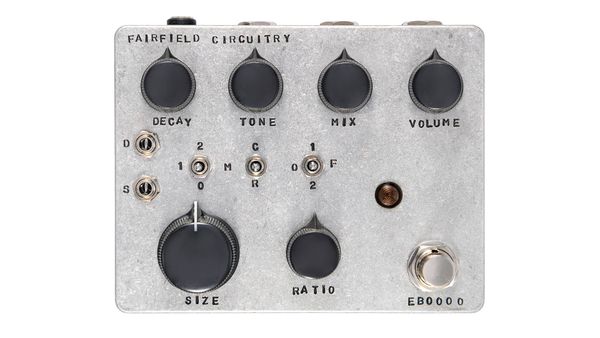

Analog reverbs built around bucket-brigade device (BBD) chips have been done before, but not often, and with good reason. BBD chips are noisy. The more chips you use, the noisier things get, and a proper reverb requires more BBDs than a delay does. They’re not an ideal way to simulate the complex reflections that make up reverberation, either. This is why Fairfield Circuitry’s Placeholder has made such a splash. The new effect pedal from the Hull, Québec-based builders uses a series of BBDs to create a truly one-of-a-kind reverb machine. And while most effects creators are trying to replicate analog sounds in the digital realm, Fairfield pulled a u-turn: They’re trying to recreate a digital reverb effect with analog technology.
Mapping the Mystery
It’s evident that the braintrust at Fairfield is making more than an effect pedal. They’re also making a point about analog’s enduring appeal with its challenging, algorithm-free topology. “There’s no denying the power of algorithmic representation of our daily activities,” the company’s website copy offers. “But let’s not forget that the complex system underlying our lived experience, the background noise and uncertainty, is intrinsic.”
The Placeholder design borrows from principles established by spatial-audio-tech guru Jean-Marc Jot and based on the Householder-reflection feedback matrix. The Placeholder essentially recreates Jot's digital algorithm in the analog sphere with BBDs. In more accessible terms, that means the pedal uses three independent analogue delay-lines and a feedback delay-network where every delay line feeds back only to every other delay line. That might not clarify much for the layperson, but you should read the fascinating literature Fairfield have produced for this pedal if you’re interested in the deeper concepts behind it. It’s marvellous.
The controls are easier to grasp than the principles that guide their function. The three principal keys to controlling Placeholder are the size, ratio, and decay knobs. As Fairfield describes it, size sets the initial delay line time, determining the size of the imaginary room in which the reverberation exists. Ratio sets how the following two delay lines relate to the initial one. Decay controls how many times the delayed signal is reflected in our imaginary room. What does this mean in practice? Well, when the decay knob is turned counter clockwise, it generates a tight, metallic slap. Dimed in the other direction, it self-oscillates in some truly bizarre ways. Two 3-way switches control the level of modulation present in the signal, and whether that modulation is cyclical, random, or both. A third switch selects between three low-pass filter presets.
The mix and volume controls on Placeholder are welcome additions. Mix can go from 100 percent dry to 100 percent wet. Volume hits unity around noon then boosts from there with a broad-spectrum level bump capable of pushing an amp to breakup. Combined with the tone control, this added utility means Placeholder can be an always-on weirding module or a blast of loud spaciousness of whatever size you prefer.
Space Molder
One of Placeholder’s many pleasant surprises is how intuitive it is to use despite the relatively murky control descriptions. It couldn’t be easier to dial in a reverb sound that’s either tight and zingy or broad and haunting. The essential tone is spring-like, complete with a classic reverb tank’s metallic, skittering response. Placeholder also feels like a genuine reverb effect in that it sounds more like a signal bouncing around and interacting with a space, rather than an indistinct wash.
Players like to say that a certain pedal “has a mind of its own.” That’s a nice figure of speech, but it’s not really true in most cases. In the instance of the Placeholder, the description seems more apt. Fairfield made a splash with the unpredictable modulations in their Shallow Water K-field modulator and their Meet Maude delay, but Placeholder takes the offkilter vibe generation in those pedals to a new level. Keep the modulations set to random and give your size, ratio, and decay knobs some leash, and you’ll find yourself in the hull of a rusting, decommissioned cargo ship. Tighten them up, and you’ve got a wickedly usable, gently demented spring ’verb. There are so many surprising spaces to explore here. There is some analog noise—there are three BBDs in the circuit after all—but it can be charming.
With the decay control maxed out, Placeholder didn’t require my input at all to create deeply inspiring sounds—it interacted with the pedals I situated around it to build a calming but scarred, post-industrial utopia. Put a versatile delay or other weirding device after it, and you can create an entire film score simply by tweaking knobs—no guitar playing necessary. There is a piece of this process, as a self-conscious user, that feels a bit lazy. It feels like cheating to be able to conjure such incredible, atmospheric sounds so easily. I suppose that’s why Fairfield are asking $450 for the privilege. But compared to flashy, feature-laden digital reverb units with similar or steeper prices, Placeholder simply felt more moving and real. It’s as much a thing I felt in my body as something I heard.
The Verdict
Placeholder is capable of producing alternate dimensions of organic, earthy sounds and modulation that will swallow your run-of-the-mill hall, plate, and spring reverb modules whole. I’ve never played through a pedal quite like it. Players often suggest that a pedal is a keeper if it encourages you to play more, but the Placeholder twists that argument: It’s a keeper because, in some applications, it encourages me to play more by playing less. That’s because it feels like its own instrument, a living, mutating analog alien that can communicate with its environment, and shape it



![Rig Rundown: The Black Crowes’ Rich Robinson [2026]](https://www.premierguitar.com/media-library/youtube.jpg?id=66952027&width=1245&height=700&quality=70&coordinates=0%2C0%2C0%2C0)