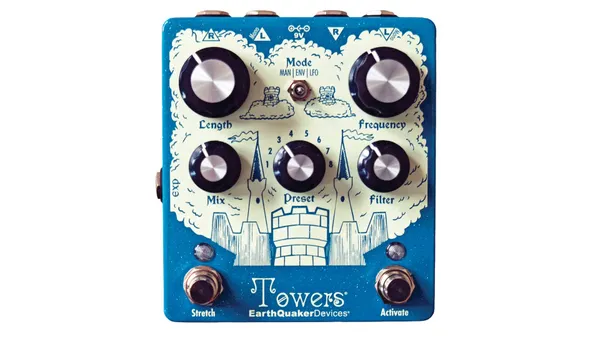

If ambient and experimental guitar sounds from the likes of Christian Fennesz, Eivind Aarset, Michael Brook, Stars of the Lid, and David Torn are your cup of mushroom tea, you owe it to yourself to experience the new EarthQuaker Devices Towers Stereo Reverberant Filter. The Towers’ unique signal path marries an infinitely repeating multi-tap delay with a cathedral-style reverb and a 2-pole resonant low-pass filter (much like you’d find on many synthesizers), along with a synth-like selectable low-frequency oscillator. The result is not only a pedal that offers a vast sense of space, but also a palette of warm, moving, high- and low-register stereophonic voices from angelic to sinister.
Soundscape Generator
Towers is not the first ambitious soundscape generator to which EarthQuaker founder and chief designer Jamie Stillman has applied his mad-scientist approach. Storied stomps like the excellent Afterneath, Astral Destiny, and Transmisser produced similar cascading timbres, sweeps, and voices, though it’s tempting to say that Towers—perhaps owing to its less aggressive 2-pole low-pass filter—is a warmer, more musical, and widely usable pedal. Simply by varying the mix level, you can veer from haunting, song-supportive stereo reverbs á la Jeff Buckley or Julien Baker, to the kind of cinematic, “where did the guitar go?” timbral windstorms of Christopher Willits’ “folding” audio techniques, or the expansive drone guitar colors of Medicine’s Brad Laner.
“LFO mode introduces a variably pendulating low-frequency oscillator into the sound, spreading chewy, spongey, oscillating flange-like effects across the lows and mids.”
The Towers features full stereo inputs and outputs—a first for EarthQuaker—plus an expression jack (TRS cable required) that’s assignable to any of the front panel’s main knobs: reverb length, wet/dry mix, center frequency, and filter cutoff. You play the Towers in one of three switchable performance modes: manual, where you set the filter frequency cutoff using the frequency knob; envelope, where your playing dynamics activate the sensitivity of the filter response; and LFO mode, which introduces a variably pendulating low-frequency oscillator into the sound, spreading chewy, spongey, oscillating flange-like effects across the lows and mids.
A Real Stretch
In addition to the footswitch used to engage the Towers’ effects, stepping on the stretch footswitch slows down the pedal’s internal processor, resulting in lower frequencies, doubled reverb length, randomized delay effects, and wicked filter smears. You can tap stretch as a momentary effect or hold to create fresh sounds. The length knob controls the duration of the stretch pitch-shift effects. (Fans of EarthQuaker’s Astral Destiny will recognize this feature.) And while the Towers is great for improvisational knob-tweaking on the fly, you can capture, keep, and call up eight of your favorite patches via the front panel’s preset selector.
Housed in a road-worthy steel chassis, and suited to most 9V power adaptors, Towers probably makes the most sense at the end of your amp’s send and return FX loop chain, or following your gain pedals and volume pedal in front of a cleanish amp. Why would you want a volume pedal with the Towers? Swells, in a word. While Towers is delightful with the mix at, say, noon, so you can hear your pick attack blended with the effect timbres, you’ll almost certainly want the option of sending Towers a smoother, longer attack from your guitar.
In this way, you can remove your pick attack entirely to emulate the kind of slowly building textures we’re accustomed to hearing from synthesizers and sound designers. While the volume pot alone is great for quick swells during more lyrical playing, you may find that using a volume pedal affords greater overall hands-free control and is conducive to overlapping textures. Volume pedal pioneers like John Abercrombie, Terje Rypdal, Bill Frisell, and others would probably have a blast with this set up.
The Verdict
The EarthQuaker Devices Towers may not be the kind of jack-of-all-delays/reverb pedal you’d opt to bring to a wedding gig, but it more than makes up for that with its almost painterly set of micro-echoes, filter cutoff sweeps, low-end LFO churn, and surprisingly warm ambiences. It will also affect your playing in unexpected ways—play too many dissonant notes, or just too many notes, period, and you may find yourself a bit seasick as the overtones clash and clang. Rather, the Towers rewards very slow arpeggios, motifs built from shell voicings, and single-note lines, especially wide intervals across a single string. Towers is designed to stretch and modulate time, so you’ll want to make sure you give it plenty of yours.
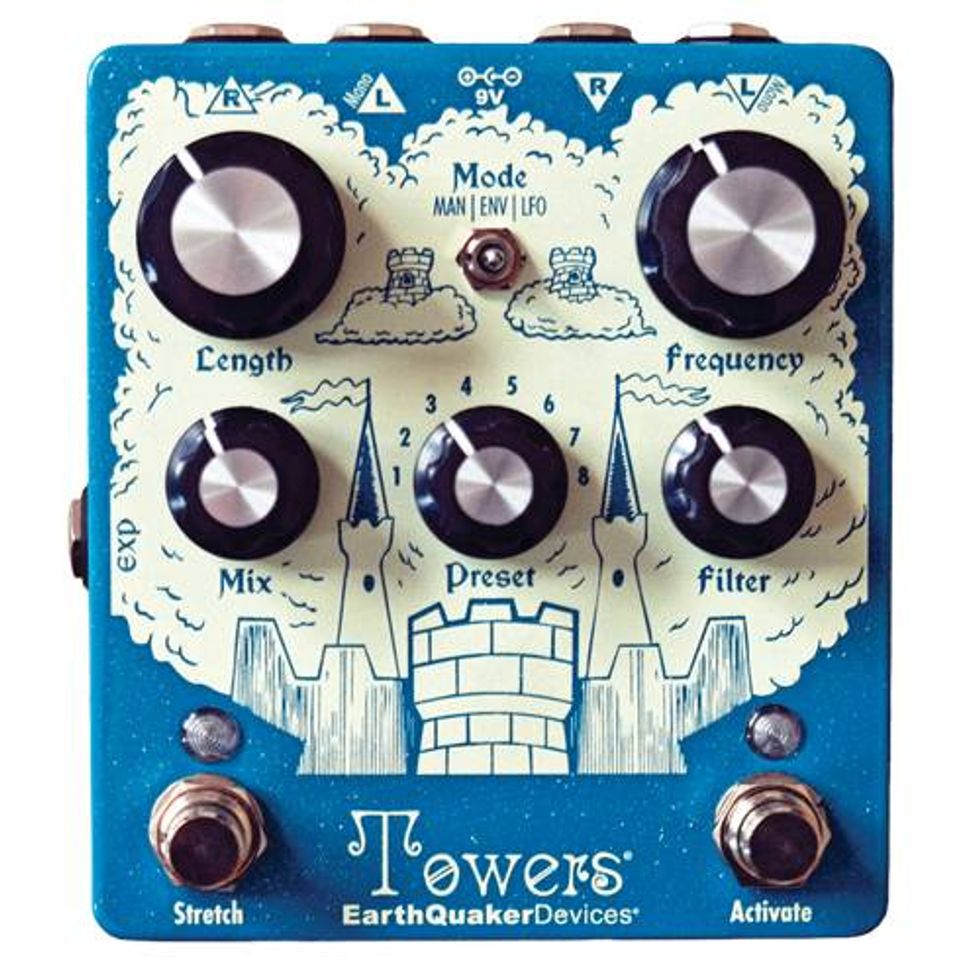
Towers Soundscape Generator
Stereo Soundscape Generator Reverb Guitar Pedal with Length, Frequency, Mix, Preset, Filter, and Mode Controls


![Rig Rundown: The Black Crowes’ Rich Robinson [2026]](https://www.premierguitar.com/media-library/youtube.jpg?id=66952027&width=1245&height=700&quality=70&coordinates=0%2C0%2C0%2C0)