
It’s easily among the most distinctive overdrive sounds in rock: Randy Bachman’s bold, blooming E7-based single-note melodies on 1970’s classic “American Woman,” by The Guess Who. Bone-dry in the mix, with an intensely vibrant midrange presence and a spongy, oboe-like sustain, the tone is a product of Bachman’s keen string vibrato and the obscure Garnet Herzog—a compact, all-tube amplifier-cum-preamp box designed in the mid-Sixties by late Canadian amp maker Thomas “Gar” Gillies.
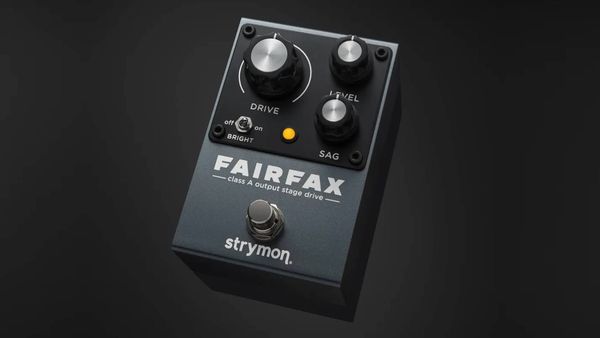
Inspired by Bachman’s early botched attempts to get more cello-like gain and sustain out of his guitar by running one amp’s output into another’s input, Gar’s lunchbox-sized Herzog—with its 6V6 power section, 12AX7 preamp, and output transformer—was meant to function more like a front-end overdrive pedal than a conventional amplifier. While numerous boutique fuzz units, amp simulators, and effects modelers have laid claim to capturing that elusive “Winnipeg Sound,” the new Strymon Fairfax is a very methodical recreation of the Herzog’s main tone components fashioned into a board-ready stomp, with dynamic onboard control of the Herzog’s sick, signature “sag.”
A Sag in the Market
The first launch from Strymon’s hotly anticipated, all-analog Series A pedals, the Fairfax uses a custom transistor-based class A power amp stage and high-input impedance JFETs in place of tube preamp stages. Another section of the circuit emulates the dynamics of an output transformer. What’s more, the pedal’s transformer-based power supply internally converts conventional 9V DC voltage to 40V to increase headroom and lend a more amp-like feel. With its extremely rugged and compact squarish steel chassis and its simple controls for drive and level (plus a bright switch to add sparkle to the essentially scooped-midrange, valve-style saturation) the Fairfax could have been just another character-rich old-school overdrive.
But it’s not. And the main reason for that is the dedicated sag control. What is sag, you ask? It’s a sound you’ve heard on records by everyone from BTO to Tom Waits to Rival Sons. But it’s very much a thing you feel as a player, and have probably encountered yourself countless times. It’s that sudden dip in voltage you hear in a transient when you really whack the strings at high gain—especially when a tube rectifier or pushed germanium fuzz is in the mix. That sudden attack demands more current than the circuit is ready to supply in the moment. The result is a squashed compression effect on the transient, and a characteristic long blooming arc in the sound envelope.
Rounding Up Transients
With the Fairfax you have way more say in your sag than you would even on a vintage Herzog, which boasted input and output level controls to manifest peak sag. On the Fairfax, sag works in conjunction with the drive and level controls. With drive set to low or medium levels, and the sag control at the bottom of its throw, the Fairfax delivers rich, smooth overdrive that gives the sometimes sterile sounds of modeled amps a genuine jolt of life and midrange detail that’s suitable for progressive blues, fusion, ’70s rock riffage, and more. As sag creeps up past noon, more noticeable effects emerge—most notably, an edgy choking and dampening of attack transients on both lead lines and rhythm riffs.
Increase the drive and push the sag up to the 3 o’clock range and that raspy choke not only strangles the tops of your notes but begins to mangle the decay as well, resulting in the kind of blunted note durations and squeaking trails associated with maxed-out germanium fuzzes. Pretty it ain’t, at least in some purists’ view. But this sound can open up serious creative territory for many players, especially if you tend to play it safe with warmer, smoother distortions. The Fairfax can do that, too. It’s not all about the sag, which is a big part of this pedal’s value. But its real mandate seems to be about daring you to get your hands dirty. Will those higher sag levels make your flowing legato leads sound clipped and tortured? Absolutely. Will they distress the crap out of your perfect chord voicings, and help produce spitting chopped rhythms you’d never play otherwise? Yup. Will they evoke dying pedal batteries, the sound of Tom Waits mumbling through a megaphone, and an AM radio on its last legs? You bet.
The Verdict
For all those reasons, some have suggested that the Fairfax is more of a “character pedal” than a go-to overdrive to cover all your OD bases, but I don’t agree: I think it can do it all. Sure, you can get downright filthy, funky, and experimental with this box, but again, the drive knob offers a terrific span of rich, grainy gains for any application, and when paired with a little push from the level knob and sober sag amounts, the Fairfax can be a top-tier, amp-like, valve-style overdrive that holds its own alongside pedals like the Bogner LaGrange and the Marshall Drivemaster. It also excels as a full-featured preamp in front of an amp modeler, transforming what can be fairly predictable tonal colors and response with something fresh, alive, unpredictable, and at times even dazzling.



![Rig Rundown: The Black Crowes’ Rich Robinson [2026]](https://www.premierguitar.com/media-library/youtube.jpg?id=66952027&width=1245&height=700&quality=70&coordinates=0%2C0%2C0%2C0)