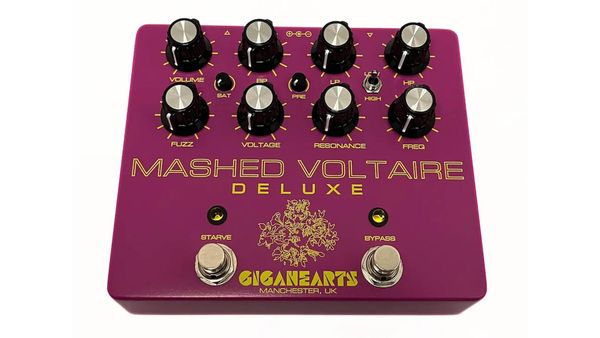

A few months ago we reviewed the Gigahearts Hyper Soup, a mindfully executed, UK-built Shin-Ei Superfuzz /Boss FZ-2 Hyperfuzz mutant that impressed with its performance, high quality, and, especially in light of those two factors, price. The recently released Mashed Voltaire Deluxe earns accolades on the same counts. And like the Hyper Soup, the Mashed Voltaire Deluxe design is rooted in a fuzz of some renown—the Electro-Harmonix Big Muff.
But the Mashed Voltaire Deluxe is a Big Muff in the same way beef bourguignon is just a few cuts of tough meat. With a filter section that can offer detailed EQ shaping, preamp control, and high- and low-gain modes, the MVD can move from Big Muff tones to mid-gain drive associated with RAT or Distortion + voices. It also features a “starve” mode that approximates low-battery voltage but can be shaped to create a wide variety of crispy fried lo-fi fuzz. There are fuzz sounds by the multitude here, which makes the MVD an exceptional bargain.
The Mighty Muff—Exploded and Expanded
As the Deluxe in the name suggests, this is not Gigahearts’ first bash at this circuit. But the first iteration wasn’t a simple Big Muff copy either. It came with the saturation control—a feature included here that reshaped the basic fuzz voice profoundly. It also featured the starve switch and the variable voltage knob that stars here. Those two additions to a traditional Muff circuit yield many extra colors. But when combined with the filter resonance and frequency controls, the low, high, and band-pass filter EQ section, and the preamp control here blow the Big Muff envelope wide open.
How you view the MVD’s utility might depend on your relationship with the keep-it-simple-stupid concept. In the strictest sense, the MVD is not simple. The knobs are sensitive and the controls are highly interactive, so you don’t have to fiddle much to end up in a tone zone much different than the one you were in two seconds earlier. A less patient user could get lost in the weeds pretty easily—or end up beat down by option fatigue.
Though the MVD doesn’t respond to guitar volume attenuation in a dirty-to-chiming-clean, Fuzz Face kind of way, backing off the gas still opens up many additional colors.
On the other hand, it doesn’t take a ton of homework to decipher the MVD’s workings. The pedal’s big vocabulary will be super useful to composition-, arrangement-, and mix-minded players and studio hounds. Its ability to carve very specific variations on a distortion theme makes creating counterweight to a booming bass, a wide drum image, or another guitar track satisfying and intuitive. The MVD also rewards a roll-the-dice-and-see approach when you need something, anything other than your same old distortion recipe.
Candy Fuzz Candide
Where does one start to describe the MVD’s range of tone moods? Well, it’s Muffy at its foundation, that’s for sure—big, weighty, loud, and assertive. But it only takes a few twists of the rangy EQ controls to turn that sound on its head. With the three filters wide open the pedal is predictably titanic and hot. But max the high-pass filter, dial the low and band-pass filters way back, add expiring-battery voltage levels via the starve switch, and cool it on the preamp, and the MVD could be a primitive, 2-transistor, 1966-vintage fuzz.
Together, modest settings for all three filters can sound warm and rich, and then made warmer or gnarlier with a shift in frequency or change in resonance. Switch the gain toggle to high and the same setup becomes even bigger, and much more aggressive. I suppose a clever mathematician could calculate the tone permutations made possible by this control array. But it seemed pretty close to infinite to me.
Though the MVD doesn’t respond to guitar volume attenuation in a dirty-to-chiming-clean, Fuzz Face kind of way, backing off the gas still opens up many more colors. If your guitar has pots with a smooth, long taper, you can widen the MVD’s palette even more. This is especially true with single-coils, and the thickness of humbuckers leaves you with less headroom. But I’m guessing the big, blooming sounds of an SG and the Mashed Voltaire will be consolation enough for a compromise in dynamics. Similarly, it’s at home with Marshall-style circuits or clean Fender-derived ones. Each amp style can coax countless tone variations from the MVD.
If the Mashed Voltaire Deluxe is intriguing as a more expansive Big Muff, it definitely impresses as a kind of greatest hits album. To my ear, the pedal’s essence leans more toward early Big Muffs like the triangle and ram’s head. I heard hints of Colorsound’s big, open, less clipped and compressed Big Muff variant, the Supa Fuzz. Perfect approximations of a Sovtek Big Muff’s thick and complex harmonic makeup were more elusive for me, but I would not be surprised if they were in there somewhere and I didn’t manage to uncover them. You come to assume that the MVD can deliver whatever fuzz tone you imagine.
The Verdict
Though it bets big on the patience and adventuring spirit of possible users, Gigahearts is doing something very cool here, at a fair price. If you get nervous in the absence of presets, the Mashed Voltaire Deluxe’s dense interactivity could cause panic attacks. And you’ll have to be fairly fearless or very confident to move through a wide cross-section of MVD’s voices onstage. But if you’re excited by a palette that moves beyond primary colors, you might blissfully disappear into the web of fuzz sounds the Mashed Voltaire Deluxe can weave.