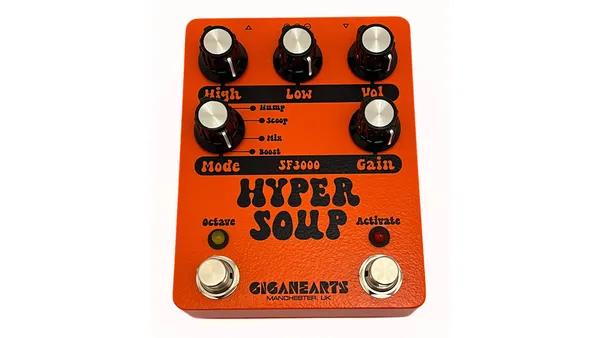

Usually, when I work on a fuzz review in my home studio, I wait until midday, take a peek out the front door to make sure that none of my neighbors are gardening or otherwise enjoying the peace of the outdoors, and then stomp away. But even these measures feel inadequate where the Gigahearts Hyper Soup is concerned. This Manchester, England, company’s take on the Shin-Ei/Univox Super Fuzz—or, more correctly, the Super Fuzz-inspired Boss FZ-2 Hyper Fuzz—is a beastly thing that thrives in high volume settings, just like its esteemed antecedents. But with a no-octave mode, as well as a mixed-voice mode that combines the mid-bumped and mid-scooped fuzz sounds, the Hyper Soup (what an excellent name!) achieves a malleability that the Super Fuzz, and even the FZ-2 with its EQ section, can’t touch. It even sounds superb with small amps at lower volumes that present little risk to the health and well-being of my kind neighbors.
Living Large, Sounding Larger
As a kid, the Super Fuzz was a ghostly mystery to me. The Who’s Live at Leeds was an outsized influence on my adolescent brain, and Pete Townshend loved his Super Fuzz around that time. He used it like a dagger on that record—peppering it into his solos judiciously, often in a blink-and-you'll-miss-it style that drove me crazy. What the heck was that bonkers high-pitched fuzz sound? It was like a flute sandpapered and squeezed through the nostrils of a dragon spewing fire and gravel. Infuriatingly, it took me years to find out. The Gigahearts possesses a fire that the young, boiler suit-wearing Townshend would have adored. My guess is that, as a notorious sound craftsman and studio hound, he would have loved the additional flexibility and range the Hyper Soup affords, too.
While folks that obsess over space might gripe about the slightly larger size, there are many practical benefits. For one thing, the low and high EQ knobs are well spaced and full-sized, unlike the small, stacked knobs used on the FZ-2. The mode switch is easier to use for being bigger, too—certainly more so than the side-mounted switch on a vintage Super Fuzz. Additionally, the footswitches are generously spaced and the jacks are top-mounted.
Ripped and Torn
The Hyper Soup’s Super Fuzz soul is sturdy and true. At most settings, it's a dead ringer for a Wattson FY-6 clone, which has held its own in shootouts with vintage Super Fuzz specimens. Next to an FZ-2, it shines even more brilliantly. At most equivalent settings the Hyper Soup was perceptibly, if slightly, rounder and more oxygenated. One of the most intriguing features on the Hyper Soup is the combined mid-scooped and mid-bumped modes. In some respects, the combined voices cancel out what is special about the individual ones. The mixed mode can even sound a little thinner than the single voices in some contexts, but only by a very relative measure. It’s still punchy and huge, and provides a useful alternative when slotting the Hyper Soup in an arrangement.
“The fact that you can switch between the no-octave mode for a verse and then kick on the octave for lead lines from a single pedal makes the Hyper Soup fearsomely flexible.”
The sans-octave fuzz voices—a feature neither the Super Fuzz nor FZ-2 offer—can feel like a letdown after being doused by the fractured fuzz shards of the octave fuzz. But it enables the Hyper Soup to do something Super Fuzzes do poorly, which is stay intact when you’re playing full chords. Even though you might perceive a slight drop in intensity relative to the octave voices, the Hyper Fuzz rips as a chord machine. It’s punky, thrashy, trashy, and very unique sounding. And the fact that you can switch between the no-octave mode for a verse and then kick on the octave for lead lines from a single pedal makes it fearsomely flexible. I’ve never had a ton of use for the boost mode that is derived from the FZ-2. Here it feels similarly superfluous, especially given that you cannot use it with the octave. But it still has its place, making for an interesting, non-transparent boost. And it is yet another tone multiplier in a pedal that’s already exploding with possibilities.
To my ears, the Hyper Soup is best suited to amplifiers with mid-scooped voices, no matter the mode. The mid-bumped and mid-scooped voices breathe more in the company of a 6L6-driven Fender Bassman with 2x12 cabinet than with the more mid-forward voice in an 18-watt Marshall-style Carr Bel-Ray—even when taking the extra moving air and 40-plus watts into consideration. (Pete Townshend, by the way, would not be surprised to hear that the Carr’s Hiwatt-style voice and the Hyper Soup were great friends.) I also preferred the way the pedal interacted with Telecaster single-coils to the PAFs in an SG. There is much to love, and I mean love, about an SG/Hyper Soup combination. But I heard more of the bizarre overtones that make the Hyper Soup so different and interesting with the Telecaster. Your results and preferences may well differ. But I suspect players on all sides of the Fender/Marshall/Hiwatt/PAF/single-coil divides will agree on the Hyper Soup’s capacity to rip.The Verdict
The Super Fuzz sound is more or less an essential ingredient in my tonal diet. It’s a sound I know well. But the Super Fuzz is also a pedal you feel. The way the octave-up generates an almost metallic sensation in your teeth. The strange, fractured sense of mass when played through a big amp. Save for minor sonic variations that you might hear in an assortment of vintage specimens, the Hyper Soup delivers these sounds and feelings in spectacular fashion. At $216, this lovingly hand-built pedal is also a screaming deal by contemporary standards. Say what you will about the relative value of inexpensive variations on this circuit. If you rarely use this kind of sound, and your pedals don’t leave your house too often, those will probably suffice. But the Hyper Soup is a beautiful option that I’d bet offers a lot more longevity on top of its very useful extra features.