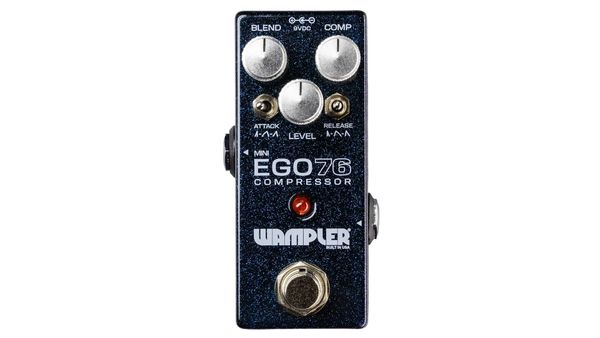

Pedal compression can make a flat guitar sound much more exciting. To many players, though, pedal compressors themselves are not very exciting at all. I understand why some folks feel this way. Pedal comps are not sexy, and they won’t instantly, overtly transform your tone the way a fuzz or delay will. This dilemma makes mini compressors a cool proposition—you reap the sonic benefits without allotting much floor space. Wampler’s new Mini EGO 76 compressor certainly does a great job of being small. But it does a better job of being interesting to use. It’s certainly not boring. And even comp averse players may want to take note.
Inspired by the sound and circuitry of the Urei/Universal Audio 1176 studio compressor, the FET-based Mini EGO 76 is an attractive alternative to simpler OTA-based Ross/Dyna Comp circuits. And the extra features that make the Mini EGO 76 look a little cluttered on the surface are far from superfluous. Besides the wet/dry blend control, which opens up tone and tactile frontiers all by itself, the Mini EGO 76 compressor also features two 3-position switches that shape the attack and release. Simple pedal compressors often lack attack and release controls, and here, they make the Mini EGO 76 more functionally aligned with the 1176. They might not make the Wampler sound or respond exactly like a real $3K studio 1176 (or a $15K blue-stripe vintage version, for that matter). But they give the Mini EGO 76 range to cover both adventurous compression applications and the most pedestrian ones.
Comps for Comps
When a company compares a floor compressor to a real 1176, it’s important to keep a few grains of salt on hand. A more useful benchmark for the Mini EGO 76 might be Origin’s much more expensive Cali 76 comp. Both compressors make use of a wet/dry blend, both employ a FET-based circuit, and critically, both offer control over attack and release. Space constraints mean the Mini EGO 76 does not feature rotary knobs that sweep the whole attack and release range, like the Cali 76 and the Mini EGO 76’s big brother, the EGO 76.
Instead, the Wampler uses clever 3-way switches. The attack switch moves between fast attack (10ms,) medium (105ms,) and slow (166ms.) The release switch features settings for fast (297ms,) medium (579ms,) and slow (1770ms) release. In general, the medium attack and release switch positions correlate with common guidelines for setting up a real 1176 like the “Dr. Pepper” 10-2-4 setting (10 o’clock attack, 2 o’clock release and 4:1 compression.) The medium settings sound great without any dry signal in the blend. And just as on a genuine 1176, they make the Mini EGO 76 a reliable tone sweetener even at very modest compression ratios. Next to a Ross-derived mini comp, the Mini EGO 76 in medium attack and release modes had a roughly equivalent compression effect but sounded more alive in the high-mid range. The Wampler feels less grabby than the Ross-derived comp at these settings too, but the Wampler’s extra air and immediacy don’t make it any less effective at taming spikes from a distortion or fuzz.
The Mini EGO 76 distinguishes itself in another way: it’s quiet. And when you want to push the output or situate gain pedals in front of it, you won’t hear a wall of hiss.
Blooming Along Other Trajectories
While the Mini EGO 76 excels at the most basic compression tasks, it shines in less conventional applications. The streamlined design makes it easy to integrate sounds from the radical end of the pedal’s envelope, and the wet/dry blend knob, in particular, is an asset when exploring more aggressive compression. Players generally like wet/dry blends because they can add compression in very specific amounts—like a chef adding a touch of finishing salt. The Mini EGO 76’s blend control is great for summoning more naturalistic guitar tones in this fashion. But it also enables you to be fearless about using weird ones. For example, chasing super-compressed 1966 Byrds 12-string tones made me fall in love with the Mini EGO 76’s fast attack and long release functions. In contexts other than “Eight Miles High,” such settings might feel suffocating. But the clarity added via the wet/dry control provides contrast that can actually highlight the lag and otherworldly bloom of the fast attack/slow release effects while restoring the body and air that goes missing at extreme comp levels. It’s a lot like slightly shifting a photo transparency on top of an identical one—you don’t lose a lot of clarity in the image, but you gain a very arresting sense of extra dimension.
The Verdict
There’s no wanting for choice when it comes to mini compressors these days. There are some good ones. But while the $149 U.S.-made Mini EGO 76 can leave you longing for some features—most notably the tone control on its big brother the EGO 76—the little Wampler’s features feel complete, well balanced, and accommodating, whether you’re a player who relishes squishing tones to strange artificial ends or one that prefers their compression to be nearly inaudible.



![Rig Rundown: The Black Crowes’ Rich Robinson [2026]](https://www.premierguitar.com/media-library/youtube.jpg?id=66952027&width=1245&height=700&quality=70&coordinates=0%2C0%2C0%2C0)