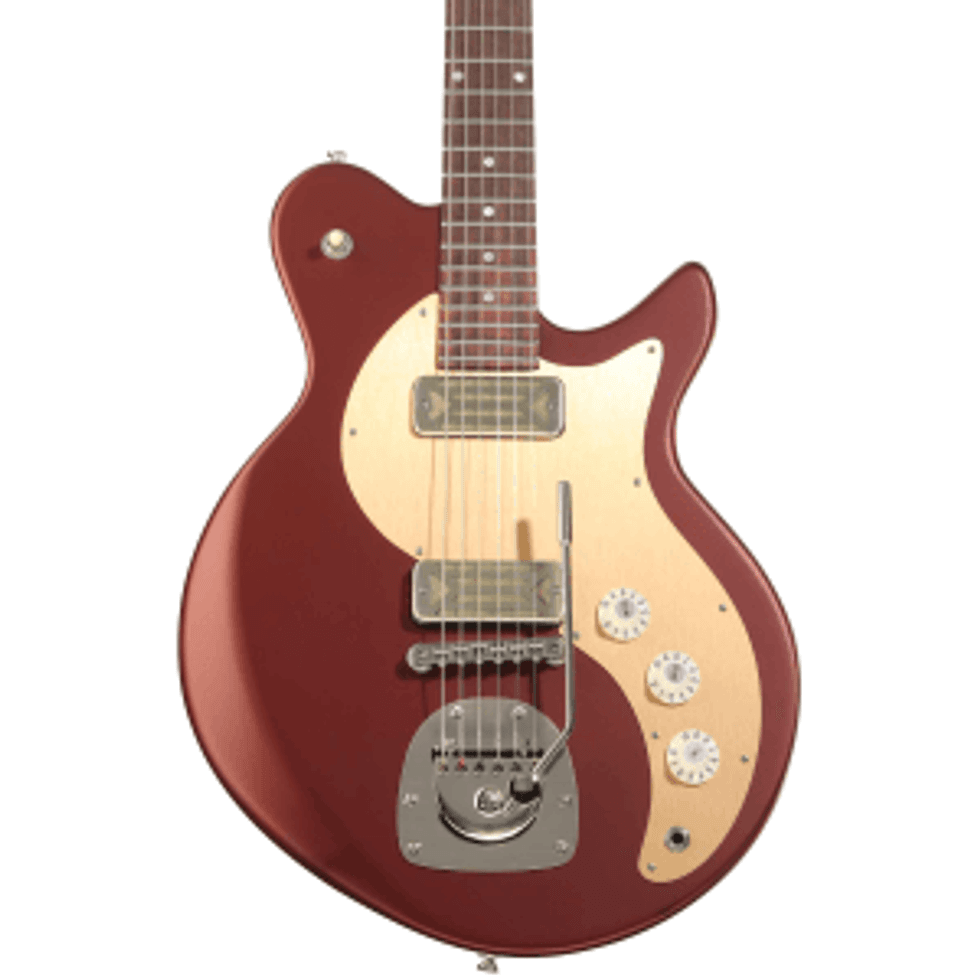
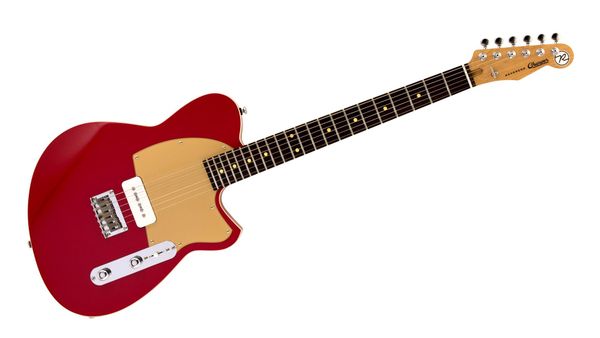

As a single-pickup, hardtail guitar, the Reverend Charger Jr. wears simplicity as a badge of honor. But thanks to excellent execution of practical design updates and a basic player friendliness, it’s not as limited as one might suspect.
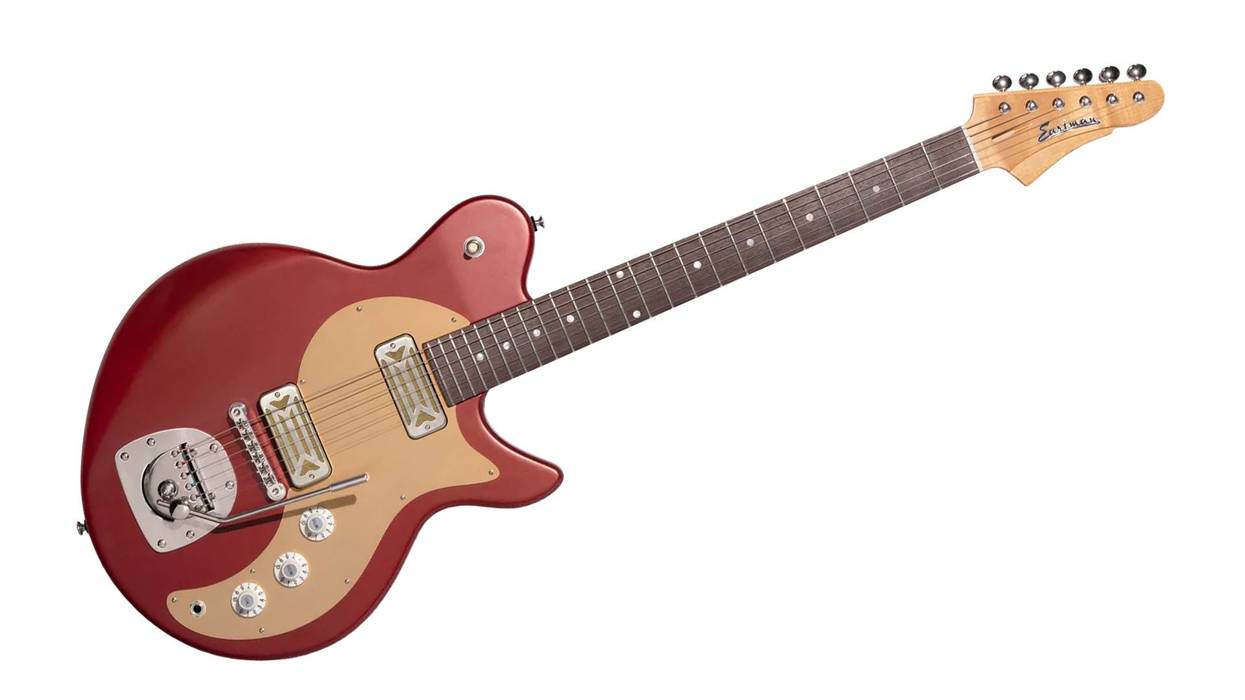
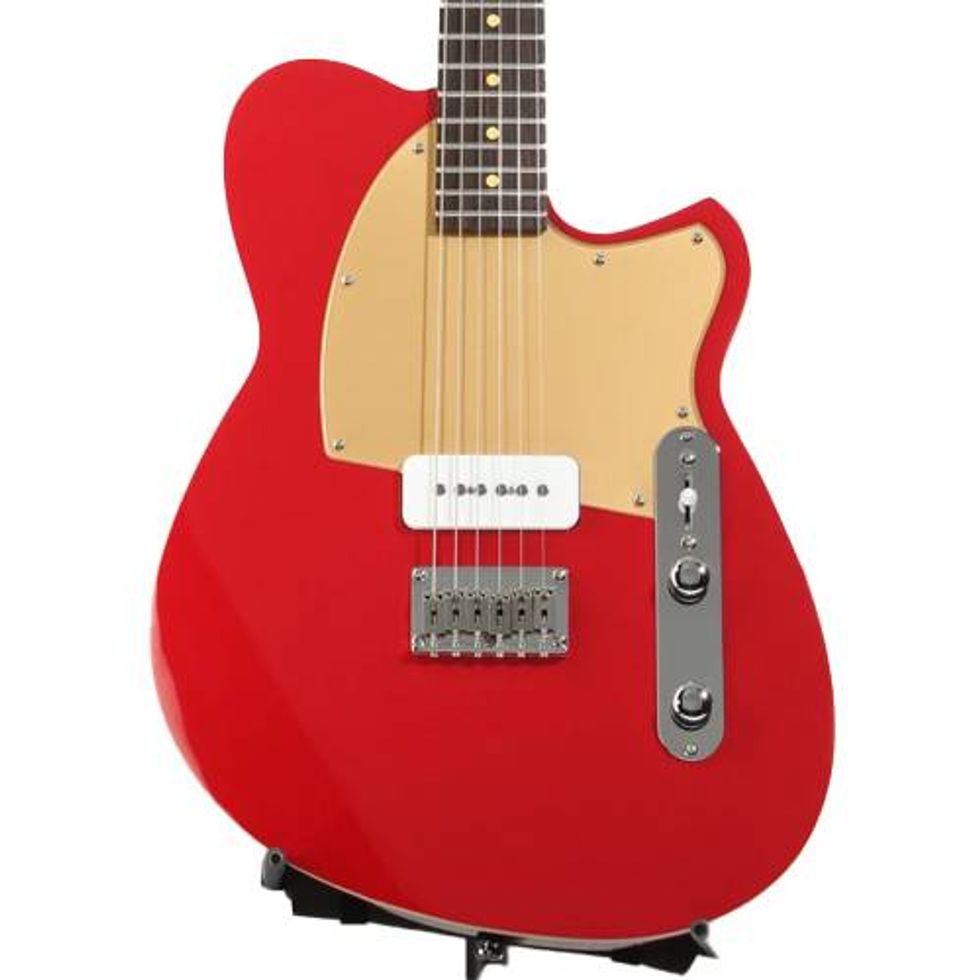
Its combination of a single-cutaway body, bolt-on neck, Steelhead P-90-style pickup (designed in-house,) and string-through hardtail bridge brings to mind a cross between a Fender Esquire and a Les Paul Jr. But part of what makes that marriage work is originality that lets the Charger Jr. hint at those two classics while staking out its own territory.
Hot Rod Heart
The solid Korina body (beautifully finished in metallic cherry, with cream binding and a back-sprayed gold pickguard) produces an unplugged tone somewhere between ash and mahogany—warm, but with plenty of snap. The roasted maple neck, topped with a rosewood fingerboard, has a comfortable medium oval profile. It’s a little chunkier than a typical C shape, but far from baseball bat territory.
This review was my first go with roasted maple, and I’m a convert. Smooth to the touch and pleasing to the eye, the wood stood up to very dry New York winter heating that had me refilling my acoustic guitar humidifiers at an alarming rate and finding jagged metal on electrics I’ve had for years. Not the Charger Jr.’s medium-jumbo (.110 x .050) frets, though. They’re fine.
“The Charger Jr.’s Steelhead P-90 delivers purity that’s hard to resist, while offering enough variety to cover roots, punk, and even metal.”
Reverend is great at effectively updating familiar design elements. The bolt-on neck, for instance, attaches with six screws rather than the traditional four—and it is a tight joint. The strings pass through an aluminum ferrule block, up to a Bonite (synthetic bone) nut, and under a cleverly designed 3-string tree, before terminating in Reverend Pin Lock locking tuners. High build quality brings the best out of these intelligent upgrades, making the Charger Jr. a pleasure to play and listen to, with solid tuning stability and consistent tone up, down, and across the neck. The guitar came out of the case with good intonation and low, buzz-free action, too.
At 43 mm (1.69 inches) at the nut and sporting a 12-inch fretboard radius, the 25.5-inch, 22-fret playing surface is a great platform for chords, runs, and bends. Even after deep bends, the guitar stays true and in tune.
Rocks In the Head
While the Jr. has only one pickup, the 3-way switch combines with a very effective treble-bleed volume control and a wide-range tone control to offer an impressive array of tones. The forward switch position (what you would otherwise call the “neck” setting) rolls off treble but preserves more of the Steelhead’s grindy personality than you get by simply turning down the tone knob. At times, it’s almost like a fixed-position wah. The back position offers more cut and spank, and a lot of upper-mid emphasis—reminiscent of a hot Telecaster pickup but with a hint of combined bridge-and-neck jangle. The middle position is my favorite of the three and the most P-90-like. There’s plenty of top-end bite, beefy lows, and a little scoop in the midrange that makes single notes jump and chords fill space.
The Steelhead pickup seems made for my modded Fender Vibro Champ, which can switch between a Bandmaster-style EQ and a raw, tweed Champ-like signal path (no EQ, higher gain). With the Champ’s EQ active, and treble and bass maxed, the Charger’s switching offered three distinct but totally compatible voices. Overdriven, the middle and bridge settings worked best together, and thanks to the treble-bleed volume control, you can mellow the tone out for rhythm without getting lost in a mix. The Champ’s snarly raw mode favored the brighter bridge pickup position alone, with the middle, unadulterated Steelhead sound a close second. Rolling back the Charger Jr.’s volume yields very nice clean tones.
Through an uber-clean SWR bass amp, the switching system still offers impressive variety. The front rhythm position is more effective in this kind of super-clean signal path, and ranges from darkness to twilight depending on the guitar’s tone control position. Where the other two positions scream through the Champ, they pop and chime through the SWR. What’s more, the Reverend’s natural sustain lends these super-clean single notes plenty of presence and body.
In a way, I was most impressed by how the Charger Jr. sounded with my Universal Audio Apollo interface while I was sitting in front of a computer, because the guitar’s low noise floor is remarkable. Noise can make single-coil pickups—and P-90s in particular—a nightmare when running into an interface. But not here. Factor in the guitar’s comfort and tuning stability, and you can imagine why I used the Charger Jr. for composing and recording sessions a lot in recent days.
The Verdict
From the moment it came out of the case, the Charger Jr. felt as comfortable as a broken-in pair of leather gloves. At just less than $1,100, it boasts the materials and build quality of a considerably more expensive instrument. If one pickup seems limiting, the Charger platform is available in other guises with different pickups and different bridges. That said, the Jr.’s Steelhead P-90 delivers purity that’s hard to resist, while offering enough variety to cover roots, punk, and even metal. If you crave simplicity that deviates from Esquire and Les Paul Jr. templates, this Charger is highly recommended.

![Rig Rundown: The Black Crowes’ Rich Robinson [2026]](https://www.premierguitar.com/media-library/youtube.jpg?id=66952027&width=1245&height=700&quality=70&coordinates=0%2C0%2C0%2C0)