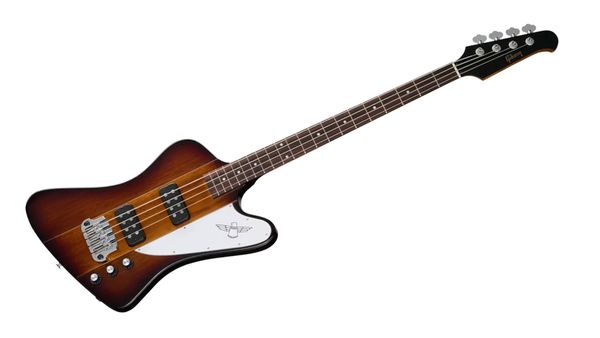
Innovation in instrument-making can lead to beautiful, and unusual, results. Sometimes a challenge to an industry standard ushers in a whole new musical age. Other times, the gamble doesn’t pay off. And sometimes an instrument opens up an evolutionary branch that may not change the game, but becomes something compelling in its own right. Gibson landed in that last category when it introduced the Thunderbird bass in 1963.
Back then, Gibson wanted an alternative to Fender’s Precision and Jazz basses. A tough market to crack, but Gibson aimed high. They brought automotive designer Ray Dietrich out of retirement to help, and he lent a daring sense of style and symmetry to the drawing boards in Kalamazoo, Michigan. The resulting Firebird guitar and Thunderbird bass probably ended up a little too radical to unseat Fender’s less polarizing shapes. But over the long haul, the Thunderbird became something of a middle finger to the bass establishment. Since it first saw the light of day, it’s turned up in the hands of John Entwistle, Lemmy Kilmister, Nikki Sixx, and Jethro Tull’s Glenn Cornick, to name just a few. The cult of the Thunderbird remains a dedicated one. And it’s fun to see Dietrich’s design gracing stages 60 years later while his cars sit in museums.
The Phoenix-like Thunderbird
Gibson’s latest version of the Thunderbird projects the same attitude, fury, and distinction as the original. And the changes on this newest edition bring a measure of extra reliability, and a different tone palette, while retaining most of the original design. Ray Dietrich’s car designs were largely products of the 1920s and ’30s, which is an interesting thing to consider when you first lay eyes on a Thunderbird, which is much more like watching a 1960s-vintage muscle car drive by.
“How much thunder is in this Thunderbird? Clearly, a lot.”
Since my eyes are drawn to shiny things, the first change I noticed from past models is that Gibson tossed out the chrome-covered mini humbuckers for large-pole piece pickups borrowed from Gibson’s EB Bass. Other upgrades include lightweight Hipshot cloverleaf tuners (so long neck dive?), and a Hipshot Supertone bridge, which is more substantial than a traditional Thunderbird bridge, but doesn’t upset the economy of the lines. Another vital design change, and one you may not notice at first, is that this newest Thunderbird uses a set neck rather than a neck-through-body configuration. It's hard to say how much this affects the instrument's tone, but vintage purists will want to take note.
Fun, Fun, Fun...
At first, second, and third impressions, the Thunderbird is a beast of an instrument. The elongated headstock (which is “flipped” here in the “platypus” style of a later non-reverse Firebird or Thunderbird) and the offset body with its substantial wings make the instrument look as long as one of Dietrich’s cars. Yet when you play the bass seated, it doesn’t feel big. In fact, the Thunderbird is very comfy to maneuver around. The mahogany body is neither especially heavy nor cumbersome, which makes it a great candidate for long sets. The slim taper neck is a joy too, and actually compelled me to play a lot of jazz licks—wildly counterintuitive for such a rocking bass.
The power that drives the Thunderbird comes from two EB large-pole humbuckers. They’re wired to a simple set of controls—a volume for each pickup, and a master tone control. The pickups are wired in similar fashion to a Fender Jazz Bass, which means that the relationship between the two volumes does as much work shaping the tone as the tone control does. Plugged into an Ampeg Mini SVT, I started with a full-bore, all-10s-on-the-top-hat-controls setting. As their appearance suggests, both pickups are powerful and well-suited to a pedal-to-the-metal setting, bringing a punchy, big bass tone with lots of clarity. The neck pickup on its own is especially pleasing, and lives in round, vintage-style tone space. The soloed bridge pickup, meanwhile, delivers the mid boost you would expect. This setting will certainly cut through a mix without being too biting.
The tone from these new pickups is distinct. But I found that dimed isn’t where the sweet spot lives. Roll the volume pots back just a notch and the pickups dance in a whole new way. The effect is similar to pulling a Les Paul’s volume back to 9 for a tone change—the output gets clearer and less thick. My favorite setting tended to be both master controls on 9 and the tone on 7 or so. That delivered a combination of punch, attack, and articulation that suits my fingerstyle approach. You do have to take care with the tone control, though. Rolling it all the way down makes the bass sound like it’s in the next room, so keeping it above 2 is critical if you don’t want to vanish in a band mix.
Some of you who know the Thunderbird by its more aggressive rock reputation may wonder what I was doing messing around with such modest tone settings. But I did plenty of playing while leaning into the bridge pickup with a plectrum. When I have the option, I’ve always used bridge pickups as a tone sweetener rather than soloed. The Thunderbird’s, though, sounds detailed, defined, and punchy on its own. For rock tones, I also had success adding rumble with the neck pickup and grit with an overdrive. And if you use a flatpick to generate a little more power, the Hipshot Supertone bridge is a fine place to rest your hand, as well as a great source of overall stability.
The Verdict
How much thunder is in this Thunderbird? Clearly, a lot. Its fundamentally powerful personality won’t be for everyone. Compared to many basses, the taper in the controls can be less than nuanced, which limits the tone options. But I don't sense that Gibson designed this newest Thunderbird for players chasing endless tone variations. The sound is as bold as the design, and that's probably the point. At $2,399, the cost is pretty lofty, especially if the widest possible palette of tones is your goal. But most potential Thunderbird buyers drawn in by the look will love the sound—and find the price easy to swallow as a result.
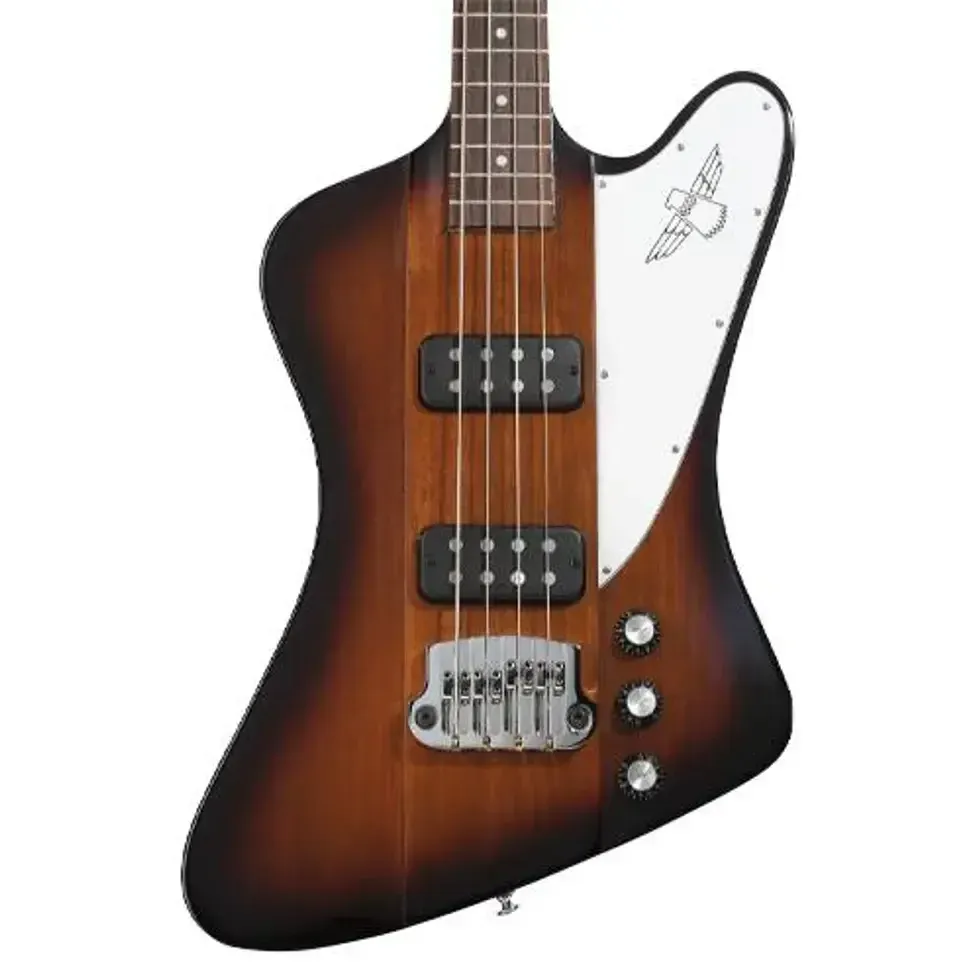
Thunderbird
Electric Bass with Mahogany Body, Mahogany Neck, Rosewood Fingerboard, and 2 Humbucking Pickups - Tobacco Sunburst Perimeter