

Michael Anthony still hits the high notes. That fact alone feels slightly supernatural.
Inside a Las Vegas rehearsal space earlier this year, the longtime Van Halen bassist was effortlessly sailing through harmonies that most singers half his age wouldn’t attempt without a warm-up coach, oxygen tank, or minor act of divine intervention. Anthony, now in his seventies, shrugs off the achievement with the same blue-collar modesty that has defined nearly every phase of his career.
“I think I’ve just been blessed with my voice,” he tells Premier Guitar, then laughs. “I can still pretty much sing everything I sang way back in the day.”
That voice—bright, tensile, instantly recognizable—helped define Van Halen’s sound almost as much as Eddie Van Halen’s guitar. Yet for decades, Anthony’s contributions have often been overshadowed by the larger personalities orbiting him: Eddie’s revolutionary playing, David Lee Roth’s acrobatics, Sammy Hagar’s swagger, Alex Van Halen’s cannon-fire drumming.
But listening back now to the classic Van Halen records, it’s apparent that Michael Anthony wasn’t simply singing the high notes while holding down the low end. He was one of the musical anchors that made the band work.His bass playing gave Van Halen weight and swing. His harmonies widened the band’s sound into something massive and anthemic. And perhaps most importantly, he helped translate Eddie and Alex Van Halen’s famously unconventional rhythmic instincts into grooves audiences could actually feel in their bodies.
“I always felt my place was to hold back and be more of a solid, foundation-type player,” Anthony says. “I grew up listening to blues players and old walking bass lines. I always gravitated more toward being locked in with the drummer.”
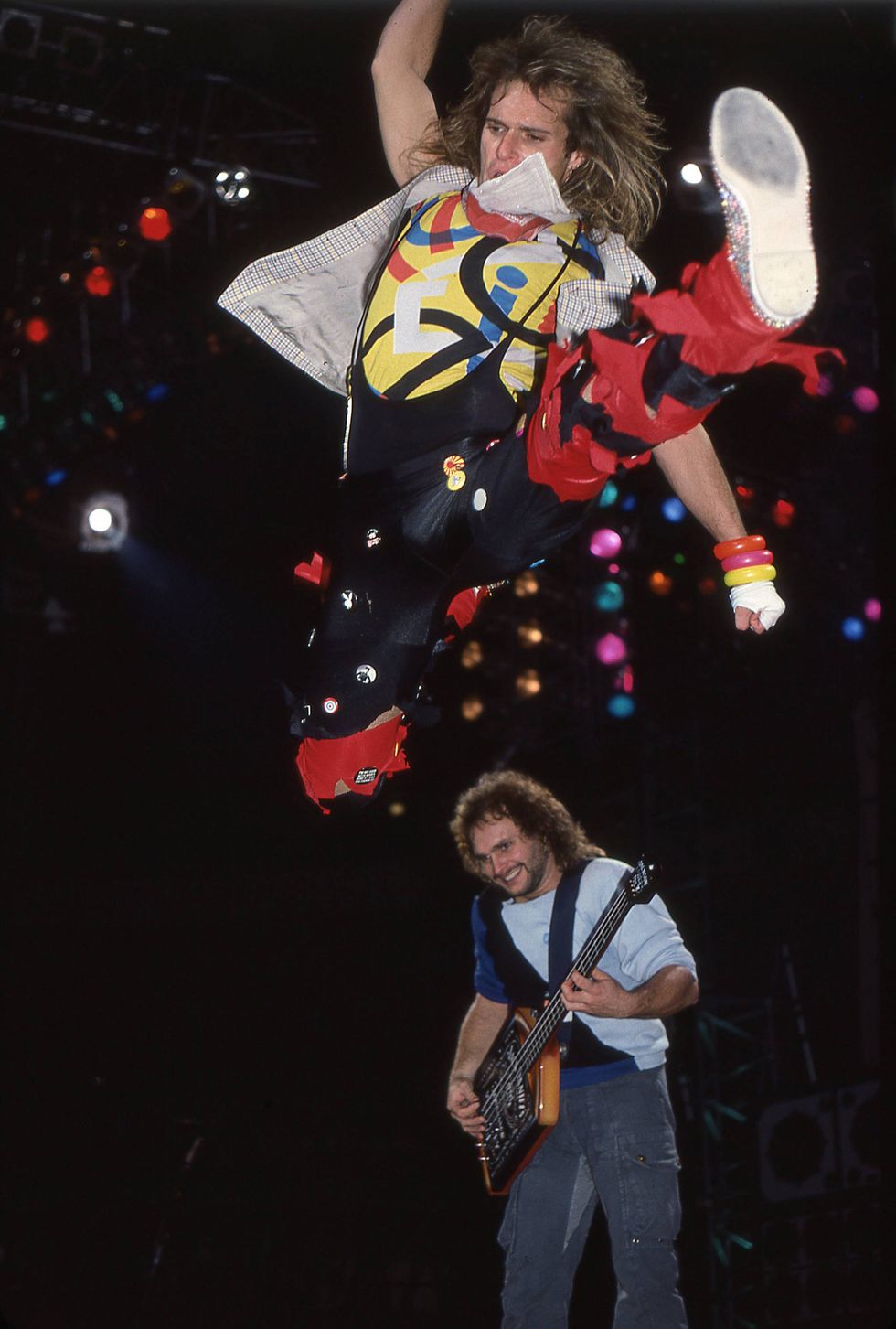
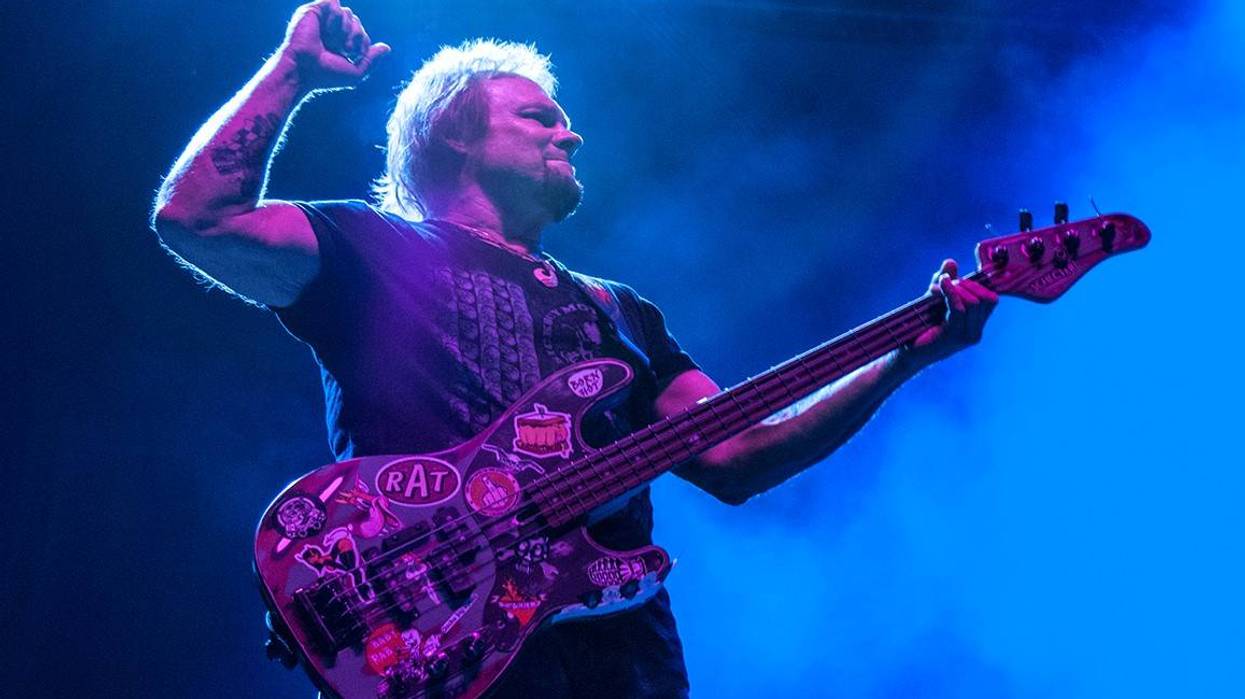
Roth kicks and Anthony, with Jack Daniel’s bass, grins, onstage at Madison Square Garden in New York City, March 1984.
Photo by Frank White
That philosophy became crucial inside Van Halen, where songs often moved like controlled collisions. Eddie frequently approached rhythm backwards, while Alex heard beats from strange internal angles of his own. “Ed would stand next to me tapping his foot on my foot going, ‘No, it goes like this,’” Anthony recalls. “And I’d be thinking, ‘Where the fuck is the one?’”
Meanwhile, Alex might hear the same riff differently entirely. “Al would hear it backwards sometimes,” Anthony says. “That’s why some of the stuff sounded so cool. I’d kind of flip-flop between following Ed or listening to Al.”
That unusual chemistry became the engine behind Van Halen’s signature rhythmic elasticity—the push-and-pull that gave songs like “Dance the Night Away,” “Unchained,” and “Somebody Get Me a Doctor” their peculiar blend of looseness and precision. Anthony’s role inside that machine was less flashy than stabilizing, but no less essential.
Born in Chicago and raised in Southern California after his family relocated when he was 12, Anthony grew up around music. His father, a semi-professional trumpet player who had performed in big bands and military ensembles, filled the house with jazz and swing records by artists like Maynard Ferguson, Stan Kenton, and Al Hirt.
Rock music arrived later, courtesy of Anthony’s older sister, who began bringing home records by Love, the MC5, and other late-’60s underground bands. “She came home with that first MC5 album and suddenly ‘Kick out the jams, motherfucker!’ was echoing throughout the house,” Anthony says, laughing. “Dad wasn’t too happy, but I thought it was great—and that’s when I decided I wanted to play in a rock band.”
“I always felt my place was to hold back and be more of a solid, foundation-type player.”
Soon Anthony was playing bass in Pasadena-area garage bands with names like Poverty’s Children and Black Opal. Like countless teenage musicians of the era, he learned mostly by trial and error. In fact, for nearly a year he tuned his bass incorrectly because nobody had shown him how a bass guitar was actually supposed to be tuned.
“I had my guitar player play an E chord and I tuned the strings to the notes of the chord,” he says. “That’s how I played for almost a year.”
Despite the awkward beginnings, Anthony soon discovered that bass players occupied a uniquely valuable position in the ecosystem of young garage bands. Unlike guitarists, they were always in demand.
“Everybody wanted to be a guitar player or drummer,” Anthony says. “Nobody wanted to play bass. So guys were always asking me to join their band.”
His earliest influences reflected his role-first mentality. He admired the melodic invention of Jack Bruce and the explosive aggression of John Entwistle, but Anthony never became interested in treating bass like a lead instrument.
“I can do some of that tapping stuff, but I never wanted to turn it into a lead guitar thing,” he says. “I liked bass players that really supported the song.”
That instinct served Van Halen perfectly. By the time Anthony joined the band in the mid-’70s—after his previous group Snake opened for Van Halen at a Pasadena gig—Eddie and Alex were already generating enormous musical energy. What they needed was someone capable of grounding it. Anthony provided exactly that.
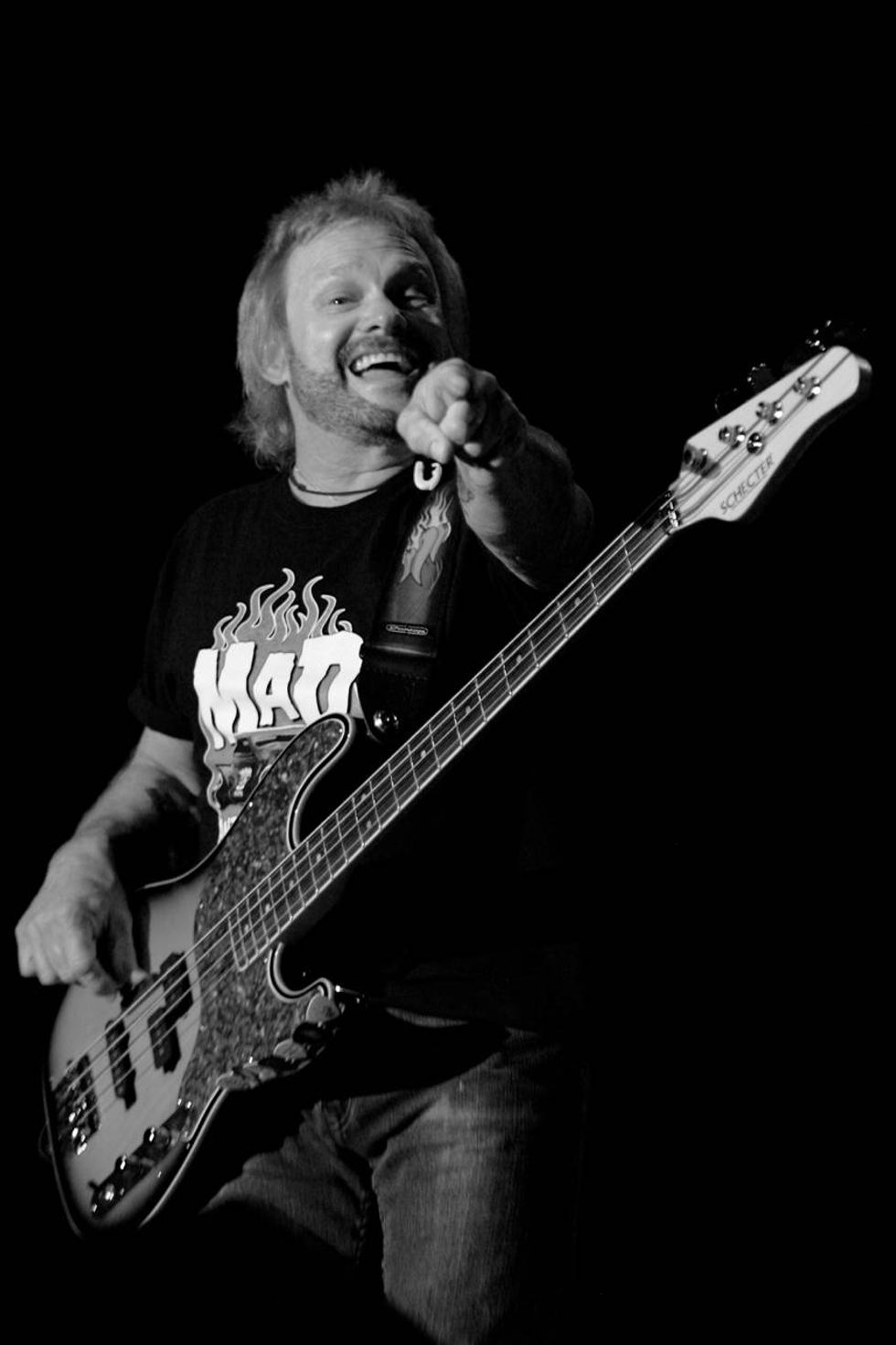
The early Van Halen albums were largely recorded live in the studio, with minimal overdubs and very little technological polish. Producer Ted Templeman quickly recognized that Eddie Van Halen was a once-in-a-generation talent, but he also understood the importance of shaping the band’s sprawling club material into tighter, more focused songs.
“Ted would say, ‘Let’s cut this part down, shorten this intro, tighten this chorus,’” Anthony recalls. “A lot of those early songs were eight minutes long when we played them live.”
For Anthony, the studio became a crash course in discipline and tone. “When I first heard my bass tracks back, I was cringing,” he says. “Live, I’d just bang away on the bass. Then you hear it isolated in the studio and it’s all ‘click-click-clank-clank.’”
Still, those early recordings captured something undeniable. Anthony’s bass tone on Van Halen’s debut—muscular, warm, slightly overdriven—became an essential component of the band’s sound. The opening heartbeat pulse of “Runnin’ with the Devil” remains one of hard rock’s most recognizable bass intros.
At the time, Anthony was using a ’64 sunburst Fender Precision Bass through an Ampeg SVT rig. Like many players of the era, he briefly embraced active electronics and EMG pickups before eventually returning to more traditional passive setups.
“After going through a period of playing basses with active electronics, I realized all I needed was a good-sounding passive pickup, and an amp that delivered good power and great tone without using extensive EQ or parametric controls,” Anthony says. “That way the amp provided the power, while the combination of the bass and amp created the tone.”
“I can do some of that tapping stuff, but I never wanted to turn it into a lead guitar thing.”
Anthony’s gear evolved constantly through the band’s classic era. He cycled through Fender Precision and Jazz basses, Charvels, Sandovals, B.C. Rich instruments, and eventually Yamaha signature models, before eventually settling on Schecter in more recent years. His amp choices similarly evolved from Ampeg to Mesa/Boogie, SWR, and Peavey. His current favorite? A Fender Rumble 800 transistor head. [see sidebar]
But Anthony’s larger philosophy remained remarkably consistent: simplicity over excess. That mindset mirrored Eddie Van Halen’s own famously direct approach to signal chains and tone.
“Ed was always about stripping stuff down,” Anthony says. “People would tell him, ‘You’re supposed to do it this way,’ and he’d go, ‘Who says?’”
As Van Halen progressed through albums like Fair Warning and 1984, the recording process became more elaborate and experimental. Eddie’s newly built 5150 studio allowed the band greater freedom, but it also subtly changed the group’s dynamic. The earlier records largely captured four musicians reacting to one another in real time. But during the later years, songs increasingly evolved through late-night studio experimentation between Eddie and Alex. “It became less about the whole band working together in the studio,” Anthony says carefully.
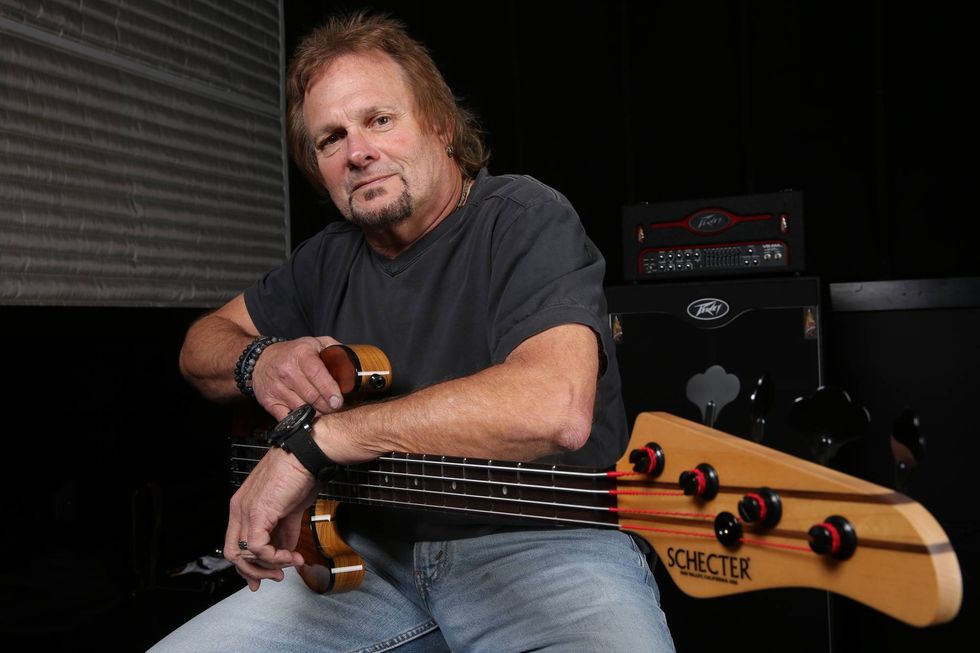
Still, even as synthesizers and layered production entered the picture, Anthony’s bass continued serving as connective tissue between Eddie’s widening tonal palette and Alex’s increasingly enormous drum sound.
One thing that becomes obvious when revisiting Van Halen’s catalog today is just how central Michael Anthony’s harmonies were to the band’s identity. Eddie Van Halen’s guitar may have supplied the fireworks, but Anthony’s voice often provided the lift—the bright, soaring counterweight that transformed the band from a great hard rock act into something distinctly Californian, and almost impossibly exuberant.
Listen to “Panama,” “Why Can’t This Be Love,” or “Dreams,” and those harmonies are everywhere—widening choruses, softening edges, and creating the kind of melodic release that separated Van Halen from the darker, heavier hard rock bands surrounding them. Without Anthony’s upper register, many of those songs lose the sense of sunlight and motion that became part of the group’s signature.
“When I joined Van Halen, I thought, ‘Great, now I can just play bass.’ Then Dave heard me sing harmonies once and that was it.”
That dimension became even more important because of the unusual contrast at the center of Van Halen’s music. Eddie’s riffs were often rhythmically jagged and harmonically dense. Alex Van Halen’s drumming swung hard but also pushed aggressively against the beat. Roth and Hagar brought chaos, humor, and theatricality. Anthony’s harmonies helped glue it all together emotionally.
“I never had a problem singing and playing at the same time,” Anthony says casually, understating a skill that was far rarer than he makes it sound. Playing intricate bass parts while simultaneously delivering high harmonies—especially inside Van Halen’s stop-start rhythmic structures—required an unusual degree of coordination and musical instinct.
Ironically, Anthony originally thought joining Van Halen would free him from singing altogether. “In my old bands, nobody wanted to sing,” he says. “So, I ended up doing it. When I joined Van Halen, I thought, ‘Great, now I can just play bass.’ Then Dave heard me sing harmonies once and that was it.”
The result was one of the most underappreciated elements of Van Halen’s sound. Anthony’s voice gave the band a melodic sophistication that balanced its rawness. It also helped explain why Van Halen could write upbeat, celebratory songs without losing their power. While many hard rock bands of the era leaned toward menace or machismo, Van Halen’s music often sounded joyful. But Anthony believes the band’s deeper roots mattered, too.
“I always think of us as more of a ’70s band than an ’80s band,” he says. “That’s where all our influences came from—Cream, Zeppelin, the Who, Deep Purple, Humble Pie.”
That lineage helps explain why Van Halen’s music retained such a strong sense of swing, even at its most polished. Beneath the pyrotechnics, there was still a band that fundamentally operated like a live rock ’n’ roll unit: bass, drums, guitar, and voices locking together in real time.
By the time Sammy Hagar joined Van Halen in 1985, Anthony had become even more integral vocally. His soaring harmonies not only helped bridge the transition between singers, but also preserved a crucial piece of the band’s sonic identity. Songs like “Why Can’t This Be Love” and “Right Now” may have showcased a more polished incarnation of Van Halen, but Anthony’s harmonies still connected them to the same musical DNA that powered classics like “Jamie’s Cryin’” and “Runnin’ with the Devil.”
“Mike and I hit it off the second I walked into 5150 studios in 1985,” recalls Sammy Hagar. “It was almost like we had been friends for years. I always thought his background vocals were a huge part of the Van Halen identity, and I love singing with him. Very few people have the range to sing above me with that kind of power.
“As a musician, I was immediately so impressed by how quickly he learned. I don’t know anyone who learns faster. Eddie could play a riff that would take me hours to comprehend, and Mike would have it after one or two passes. Songs like ‘Amsterdam,’ ‘Can’t Stop Loving You’—some of those complicated riffs Eddie would peel off—Mike would nail them almost immediately.”
Hagar continues, “I can't imagine playing 14 Van Halen songs in a set without Michael Anthony on bass and background vocals. He brings it, loves it. He is 100 percent my partner in crime. We’ve been doing it a long time.”
“I’ll pull out Fair Warning or the recent reissue of 5150 and listen again. And now I hear it differently.”
These days Anthony occasionally revisits the old albums after hearing a song on the radio or stumbling across concert footage online. “I’ll pull out Fair Warning or the recent reissue of 5150 and listen again,” he says. “And now I hear it differently.”
He pauses. “But damn,” he says finally. “We were fucking good.”
It’s difficult to argue otherwise. Yet Anthony’s musical life hardly stopped with Van Halen. If anything, projects with Hagar like Chickenfoot and the Circle seemed to reconnect him with some of the spontaneity that first drew him to music as a teenager playing backyard parties in Southern California. Working alongside drummers like Chad Smith, Jason Bonham, and Kenny Aronoff pushed him in new directions rhythmically while rekindling the loose, live interplay he always loved most.
Anthony speaks especially fondly about Chickenfoot, the hard-rock supergroup he formed with Hagar, Chad Smith, and Joe Satriani in 2008. After years of increasingly layered and fragmented studio processes during Van Halen’s later era, the band’s chemistry felt immediate and alive.
“The first time we got in the studio together, it was like, ‘Oh my god, there’s some crazy shit happening here,’” Anthony recalls. “It felt exciting again. Playing with Chad was crazy. He’s probably one of the most unorthodox drummers I’ve ever played with, but in a cool way.”
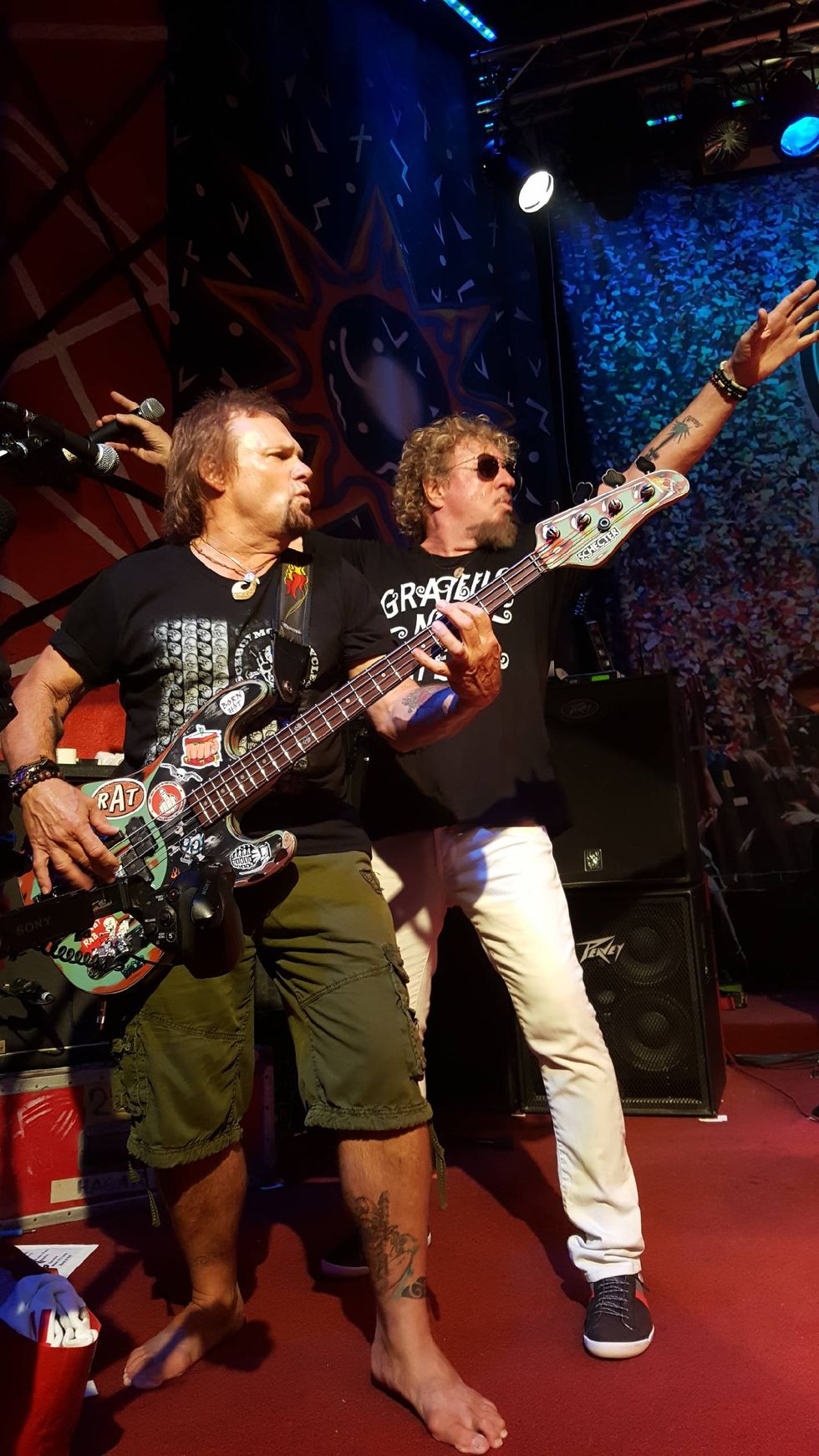
Onstage at Cabo Wabo Cantina with Sammy Hagar.
That sense of rediscovery continued with Sammy and the Circle, where Anthony’s harmonies and bass playing once again became central to the music’s identity. These days, Hagar and Anthony’s Las Vegas residency with the Best of All Worlds Band—rounded out by Satriani on guitar and Aronoff on drums—allows them to perform classic Van Halen material while adapting it gracefully to age and endurance.
Aronoff, one of the most in-demand session and touring drummers in rock, whose résumé includes everyone from Paul McCartney to Stevie Wonder to the Smashing Pumpkins, is quick to praise Anthony. “Mike has impeccable time and feel, and great, aggressive sound,” he says. “He’s just a gifted musician. He would probably be great at any instrument. His maturity is very high, and he always seems to play exactly the right thing.
“I’m a parts player. I like to figure out what I’m going to play and perform it the same every night, and Mike makes me feel whole. And hands down, he is the greatest rock ’n’ roll background singer I have ever performed with.”
Coming from a musician who has played with just about everyone, the compliment carries weight. But Anthony remains characteristically humble. “I’m just happy to sing and play anything Sammy needs to help carry the load,” he says with a laugh.
After all these years, Anthony is still doing what he has always done: holding down the low end, singing the high notes, and making the whole thing feel a little bigger than the sum of its parts.