

Dave Mustaine didn’t think he’d make it this far. Not the 40 years, not the 17 albums, certainly not the moment he’d be sitting down to talk about Megadeth’s final studio record. But here we are, more than four decades removed from that first gig at Ruthie’s Inn in Berkeley, California (February 17, 1984, to be exact), where the ceiling was so low “you could touch it from the stage,” and Mustaine was still figuring out if he even wanted to be a singer.
Could he have imagined that, in 2025, Megadeth would still be his band? “I didn’t think I was gonna live this long, honestly,” Mustaine admits during a video call, his voice still recovering from a bout of bronchitis that plagued him throughout a recent tour of Europe and the U.K. with Disturbed. Now 64, he’s dealing with health challenges that would have sidelined most musicians years ago—throat cancer, a “fused” neck, radial nerve damage in his arm. But he’s still here, still playing, still shredding. And that first Megadeth show is etched in his memory with remarkable clarity. “The history of that band was, we liked to party,” he recalls. “Ruthie’s was also a jazz club, so we had that temptation running through the band.” They played with drummer Lee Rausch—“I don’t know what happened to Lee, he was a good kid”—that night, and the lineup was still in flux. On guitar alongside Mustaine was Kerry King, on loan from Slayer, and Mustaine hadn’t even fully committed to singing yet. That decision didn’t come until bassist Dave Ellefson asked him why he wasn’t handling vocals. “I said, ‘Because I don’t want to—and that should be good enough for you,’” Mustaine recalls with a laugh. “But I also didn’t wanna hurt the guy’s feelings, ’cause Dave was younger and looked up to me. So I said, ‘Okay, I’ll try it.’ In a weird way, I have David Ellefson to thank for my singing career.”
Fast forward through the decades—through 1986’s Peace Sells... But Who’s Buying?, through 1990’s Rust In Peace, through 12 Grammy nominations and one win, through lineup changes and personal demons conquered—and Mustaine finds himself at an unexpected crossroads. The band’s latest album, simply titled Megadeth, will mark their 17th and final studio effort.
The decision wasn’t made lightly, and it wasn’t made in a single moment. “I would still keep going if I was not battling these things,” Mustaine explains, referring to his ongoing health struggles. “But I just don’t want to go out onstage when I’m not my best. There were many nights on the Disturbed tour where I was in full-blown bronchitis, hopped up on antibiotics and steroids to get rid of the inflammation. That doesn’t feel good. I’m not a guy that likes being sick.”
“I didn’t think I was gonna live this long, honestly.”
The recording process itself proved physically grueling. Working with producer Chris Rakestraw at various points throughout 2024, Mustaine and his current lineup—virtuosic Finnish guitarist Teemu Mäntysaari, Belgian drummer Dirk Verbeuren, and bassist James LoMenzo—did sessions in marathon stretches. “We did about four weeks straight, 12-hour days,” Mustaine recalls. “And I told my management, ‘I don’t know how much longer I can do this.’ My hands were throbbing and my back was hurting from sitting up for that long. What I remember during some of those sessions was torture, when they make people sit for long periods of time.”
Yet despite the physical toll—and the weightiness of knowing this would be Megadeth’s final statement—there was an openness and fluidity to the sessions. The songs were numbered rather than titled during recording—“Tipping Point,” the album’s explosive opener, was “song number nine”—because Mustaine changed titles so many times. “Going into the studio, I don’t really ever have a plan,” he says. “I have songs and we go in to record them, but I think open-mindedness going into the studio has been really good for us. A lot of times you’ll be working on a song and you’ll get an idea, and then you’ll have a completely different song come out of it.”
STUDIO GEAR
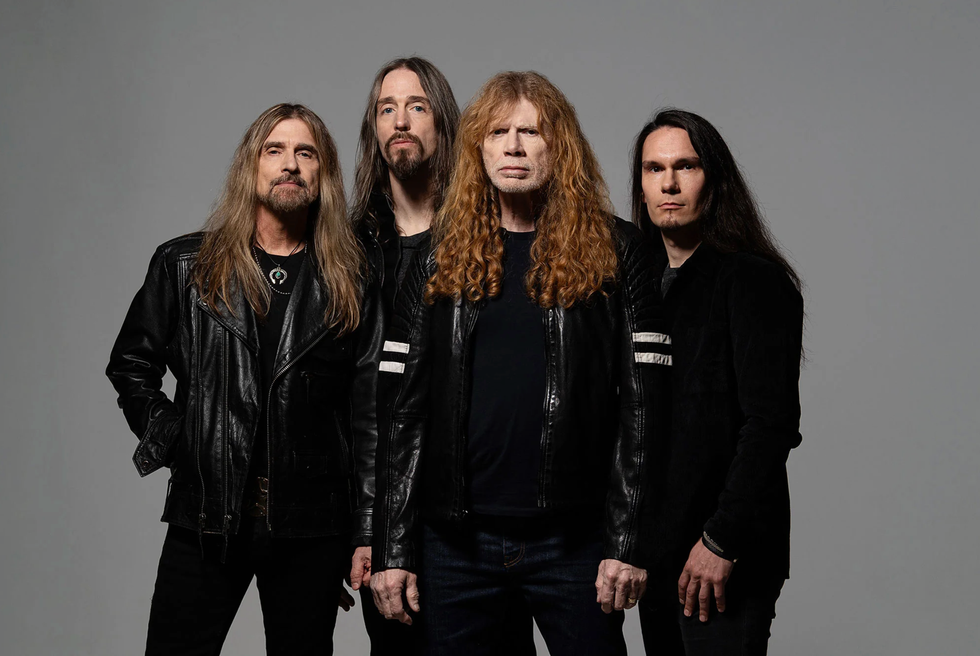
Megadeth 2025 (l-r): James LoMenzo, Dirk Verbeuren, Mustaine, Teemu Mäntysaari
Ross Halfin
Guitars
- Gibson Dave Mustaine Flying V EXP
- Gibson Flying V with Evertune bridge
Amps
- Marshall JVM410HJS Joe Satriani Edition
- Marshall 1960DM Dave Mustaine 4x12 cabinet
- Mesa Boogie 4x12 cabinet
- Neve Brent Averill 1272 preamp (no EQ, no FX)
Effects
- TWA Chemical Z overdrive
- MXR Phase 90
- MXR Flanger
- Fortin ZUUL+ noise gate
- Source Audio EQ2
- Peterson StroboStomp HD tuner
- Peterson StroboRack tuner
- Korg DTR-1 rackmount tuner
Picks & Strings
- Dunlop medium picks
- Gibson Dave Mustaine strings, signature gauge (.010-.052)
That openness extended to his bandmates. “Dirk wrote music. James wrote music. Teemu wrote music,” Mustaine notes. “Even our producer chimed in a couple times. Good producers are supposed to do that.” The democratic approach reflects both his confidence in his current lineup and his recognition that fresh perspectives keep the music vital. “I believe with James and Dirk and Teemu’s ideas, this record had a lot of really fresh ideas. Obviously I have my fingerprints on it, but we’re a band.”
The album’s 11 tracks find Megadeth operating with deadly precision—economical, direct, savage. “Tipping Point” kicks off with a blistering guitar solo that gives way to Mustaine’s unmistakable snarl. “I Don’t Care” channels punk fury into defiant aggression. “Let There Be Shred” celebrates guitar virtuosity with mythic, apocalyptic imagery about thrash metal’s birth—a “Mount Olympus kind of thing,” as Mustaine puts it—while cuts like “I Am War” and “Made to Kill” deliver the technical thrash assault the band has honed across four decades.
For Mustaine, the division of labor between himself and Mäntysaari came down to serving the song. “If the rhythm’s really difficult, I’ll usually play the rhythm and let my guitarist do the solo,” he explains. “And if the rhythm’s really easy, I’ll let them do the rhythm and me solo. A lot of that is because these guys are all virtuosos and I’m self-taught, so there’s a limit to what I know how to do. A lot of what my soloing is, is just statements. We could be listening to a really beautiful solo, and then I’m gonna come and stomp through your gardens with combat boots.”
He points to the solo in “Let There Be Shred” as an example. “It’s kind of a hippie solo,” he says. “Teemu’s shredding, and then you go into this kind of slow-motion riff in the middle of the song. And I felt that having a burning solo over that part would be wrong because the rhythm was a really cool rhythm. A lot of times when people play solos, they think the solo’s more important than the song.”
It’s a philosophy Mustaine has carried throughout his career, one rooted in his identity as what he calls “a guitarist that sings” rather than a rhythm player or lead guitarist. “The term ‘rhythm guitar player’ seems a little diminishing for me,” he says. “I love the riff.”
And how committed is he to that principle? When asked what he sees as Megadeth’s main contribution to metal over the decades, he doesn’t hesitate: “Riffs.” It’s the riff—more than the solos, more than the hooks, more than even his distinctive snarl of a voice—that defines the band’s legacy in his mind.
“Sometimes you just want to hear something that makes you wanna kick trash cans over.”
That riff-centric approach announced itself the very first time Mustaine plugged in with his pre-Megadeth band, Metallica. “When I went to Norwalk [California] the day that I met James Hetfield and [original Metallica bassist] Ron McGovney, I didn’t know what was gonna happen,” he reflects. “Nobody did. But I had my style, and it was based around the riff.”
That style made an immediate impression. “I went in there and I didn’t have any Marshalls yet because I was just starting to get serious. I had these Risson amps—they were tan, so from the moment I set up my stack, I was different. I plugged in my guitar and I started warming up, and I kept warming up and warming up. And I finally said, ‘Where the fuck are these guys?’ I set my guitar down and switched my amp to standby. And then I went out there and I said, ‘Man, where’s my audition?’ They said, ‘You got the gig.’ So I got my job just by warming up.”
That period of time proved to be the crucible when thrash metal’s DNA was forged. When Hetfield picked up a guitar at a subsequent rehearsal—they’d been working with a second guitarist who showed up to a gig at the Whisky a Go Go, “in Def-Leppard-circa-’86 clothes, with a giant feather in his ear”—Mustaine was floored. “It blew my mind because he was so good. I kind of thought, where were you when we were auditioning a second guitar player? He was as good as he is today. James is a masterful guitarist.”
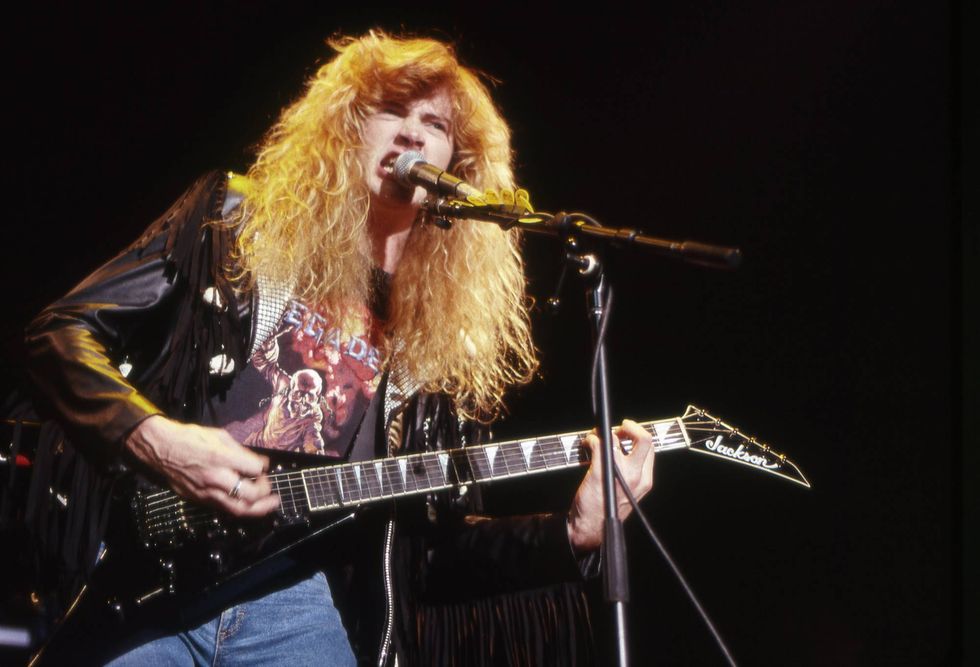
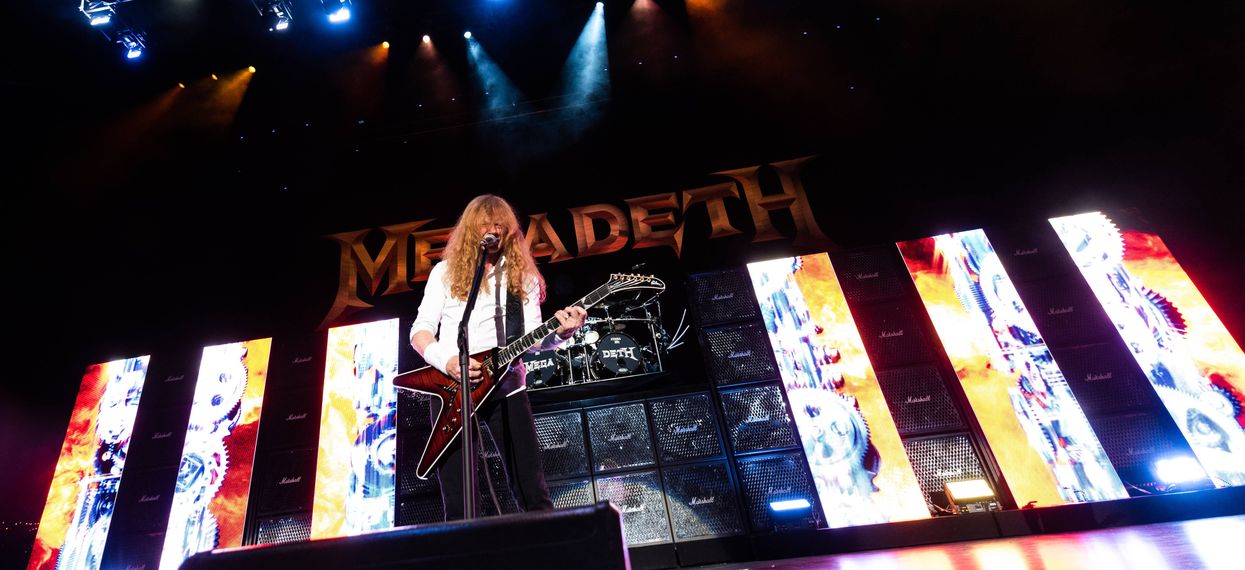
Mustaine onstage with Megadeth at Queens Hall in Leeds, England, on December 13, 1987
Frank White
The fact that two musicians who would essentially define thrash guitar—the palm-muted down-picking fury, the intricate riffing, the speed and precision—were sitting in the same room together as teenagers remains remarkable. “I hear influences on everything,” Mustaine says. “I’ll be listening to a TV show and somebody will be playing the soundtrack, and it’s either copying a lick from me or from Metallica. I just take it all in stride. I feel very honored to have been able to make a name for myself.”
That history—and Mustaine’s complex, decades-long relationship with Metallica following his dismissal in April 1983—informs one of Megadeth’s most surprising inclusions: a version of Metallica’s “Ride the Lightning,” which Mustaine co-wrote with Hetfield, Metallica drummer Lars Ulrich, and late Metallica bassist Cliff Burton.
“As I come full circle on the career of a lifetime, the decision to include ‘Ride the Lightning,’ a song I co-wrote with James, Lars, and Cliff, was to pay my respects to where my career first started,” Mustaine explains. “It showcases the spider riffing and the grunting fretting—you fret a G flat power chord and you slide up into the G—technique that I brought [to the band]. I thought it was just a great way to pay my respects to James and Lars and to close the circle.”
Does he consider his take on “Lightning” a cover version? “No, because I wrote the song too. I think other people will say that, but if you’re asking me, I don’t think it’s a cover song. When we played it for people who are fans of that band and that song, the consensus has been that we did a fitting homage. I think we did it at least as good.” He pauses. “It’s a little faster.”
The album closes with “The Last Note,” perhaps Mustaine’s most introspective song—a reflection on career’s end that acknowledges both the cost and the glory. “They gave me gold, they gave me a name / But every deal was signed in blood and flames,” he sings, before delivering a final testament: “I came, I ruled, now I disappear.” Yet Mustaine insists he’s not dwelling on endings. “I’m at a place in my life right now where I’ve been reflective, but not too much,” he says. “I do have days full of satisfaction, a lot of contentment with everything that’s going on.”
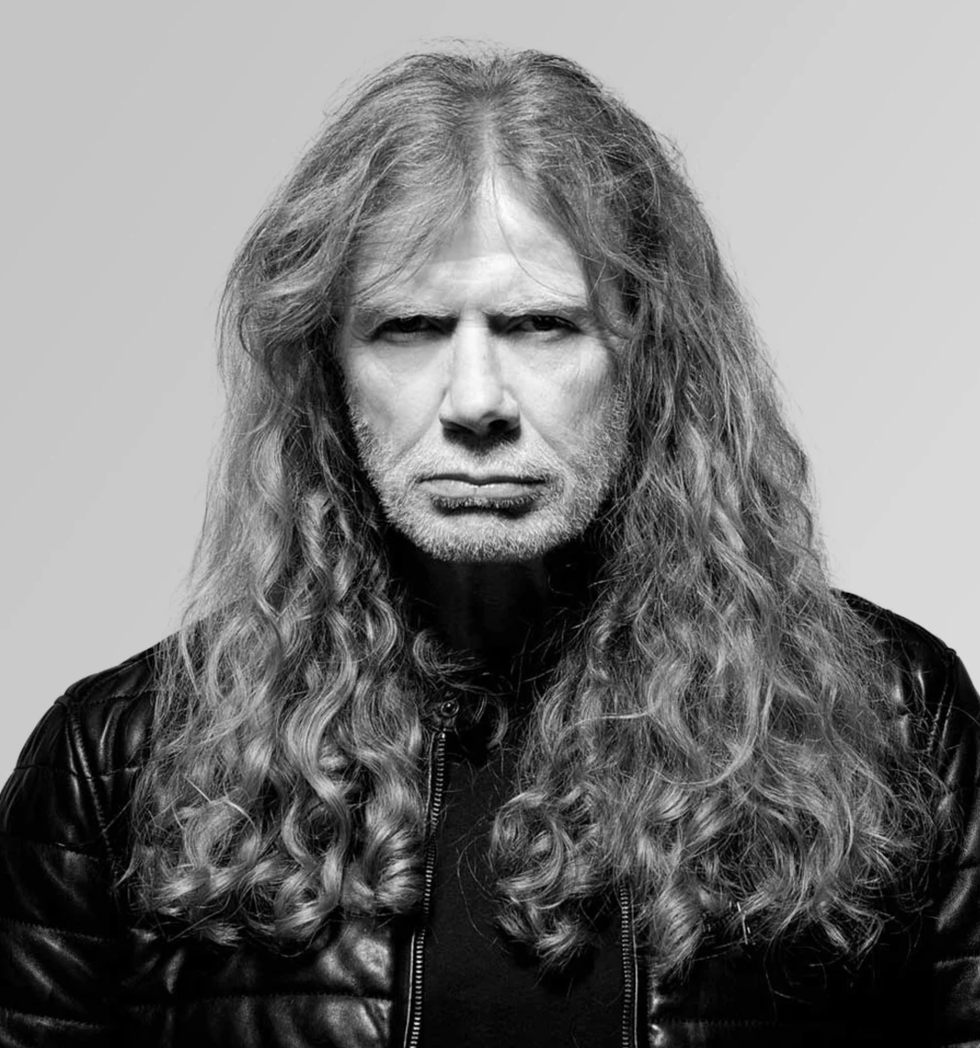
Ross Halfin
As for the tools that helped forge this final statement, Mustaine has come full circle. After years playing various Flying Vs, he’s now a Gibson ambassador, wielding a signature model that he describes with genuine reverence. The collaboration, he says, enabled him to dial in exactly what he desired—the right pickup configuration, the electrical schematic for his knob placement, a neck that’s very different from the standard Gibson Flying V. “Flying Vs are the most popular guitar in music,” he notes. “When people think of rock bands, they always draw one guy with a Flying V. I grew up loving the V, and to be [Gibson’s] number-one guy right now with it—the guitar is a monster.”
That monster will get plenty of use in the years ahead. Megadeth’s farewell tour will extend well into the future—Mustaine estimates three to five years of dates to properly close out Megadeth’s legacy, including runs supporting Iron Maiden and headlining with Anthrax and Exodus in support. “[Exodus guitarist] Gary Holt and I are like this,” Mustaine says, holding up crossed fingers. “Blood. He’s actually my oldest friend in the music business besides the guys in Metallica.”
“The term ‘rhythm guitar player’ seems a little diminishing for me. I love the riff.”
But he’s already gaming out how to handle that final show. “I was joking around and I said to my management, you should book the tour and then have a couple fake shows listed at the end. So I’ll do the last show thinking there’s still a few more to go, and then you’ll tell me that was it. And I’ll punch you in the face instead of breaking down and sobbing on stage.”
End it in anger instead of sadness? “Yeah,” he says with a laugh. “It’s more ‘Dave.’”
It’s quintessential Mustaine, wrapping emotion in, to use his words, a combat boot. From that first show at Ruthie’s Inn (where Mustaine wielded a pretty killer natural-finish BC Rich Bich that was later stolen) through countless tours and lineup changes, through personal and professional battles, he’s persevered. Does he wonder if younger musicians understand his place in metal history, the role he played in shaping thrash? “I don’t really know how much modern musicians know,” he admits. “If they’re influenced by a band that was influenced by a band that was influenced by me or Metallica, do they know the story? But I’m okay with myself, so I don’t feel the necessity to have people sing my praises. I’m really comfortable with who I am.” He laughs. “A freckle-faced redhead. You don’t think I was picked on growing up?”
For now, though, Mustaine is very much still here, and still vital. The hands may throb and the voice may rasp, but the fire that drove a red-haired kid to pick up a guitar and create a sound no one had heard before still burns. Megadeth delivers on that fire. “Sometimes you just want to hear something that makes you wanna fuck or fight, you know?” he says with a laugh. “Something that just makes you wanna kick trash cans over.”
As for that final show, whenever it arrives, Mustaine will walk offstage knowing he gave everything he had. And whether or not his management actually pulls off those fake extra gigs he joked about, there likely won’t be anger or tears—just gratitude for what was. “I’m really blessed,” he says. “And I’ve loved every moment of this.”