
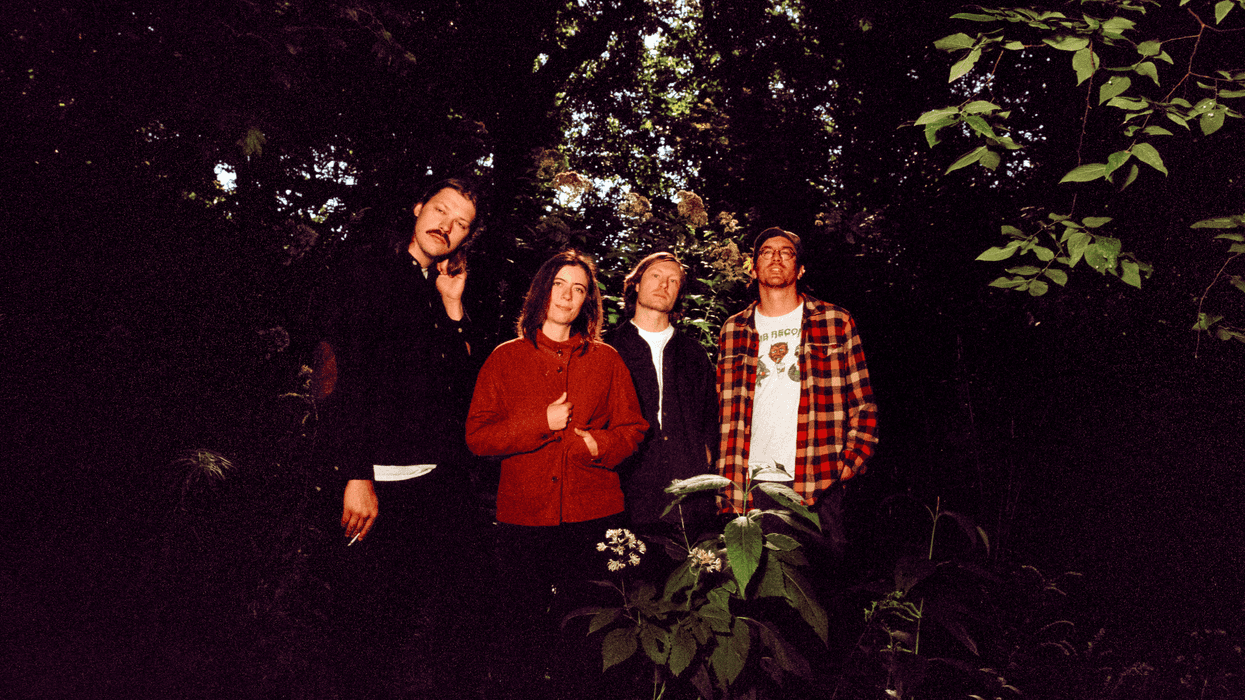

Julia Steiner describes the song “Just Want You to Know the Truth” as the emotional centerpiece of Ratboys’ new record, Singin’ to an Empty Chair; it’s the “earth’s core of this little planet of songs,” she explains. The Chicago band’s upcoming sixth full-length, releasing on New West Records, took its name from a line in that song. Steiner, the band’s principal vocalist and one half of their twin-guitar configuration, wrote the phrase after literally doing what it suggests during a therapy session.
“It’s exactly what you would think,” Steiner explains. “It’s basically this exercise where you sit in a room with an empty chair and, a person who isn’t physically there, you imagine they’re sitting in the chair, and you speak aloud all of the thoughts and feelings that you might otherwise not feel empowered or ready to share. It can be a really radical thing to do in any context of loss.”
“Looking something in the face can actually be so rewarding and musically satisfying.”—Julia Steiner
When Steiner first tried it, it helped unlock something—a new perspective that revealed the mental and emotional keys of her band’s next work. “Maybe it sounds hippie,” she says with a shrug, “but it worked for me, and I have to imagine that it could be cool for other people to try, too.” Steiner always loved the gut-wrenching vulnerability of Sufjan Stevens; Singin’ to an Empty Chair became her chance to follow in his footsteps. Producer Chris Walla, who spent 17 years playing guitar in Death Cab for Cutie, encouraged “unflinching eye contact” with the things Steiner wanted to write about. “Looking something in the face can actually be so rewarding and musically satisfying,” she says. “Just full steam ahead, leaning into a feeling.”
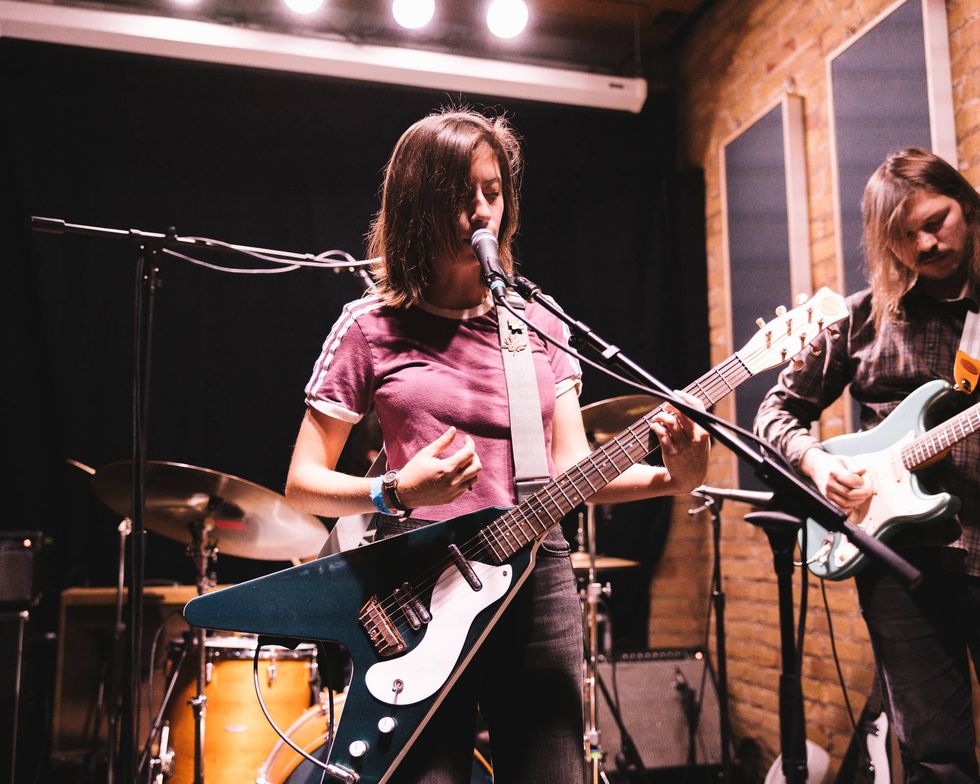
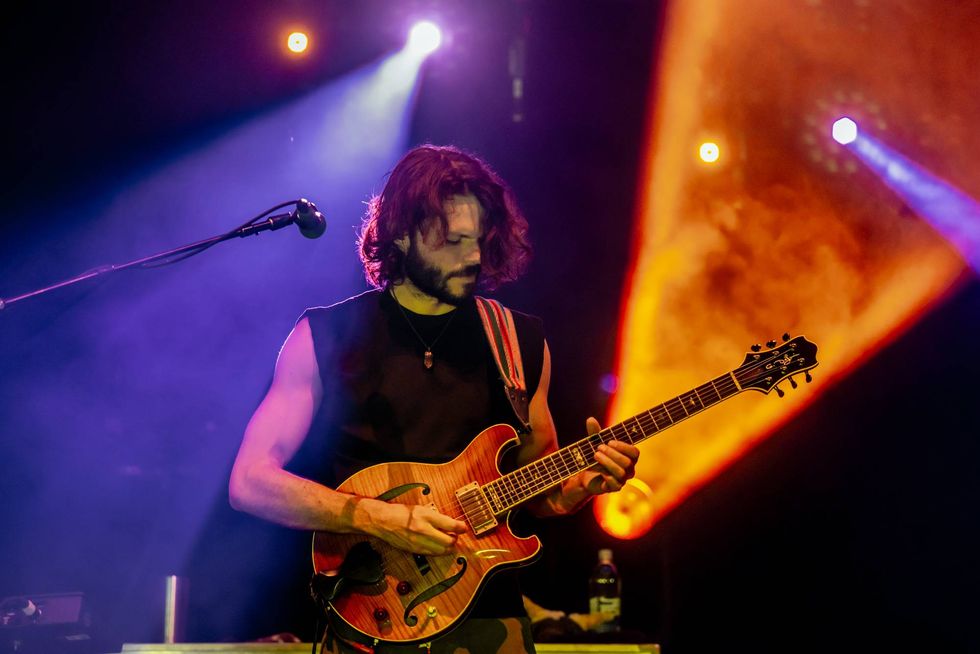
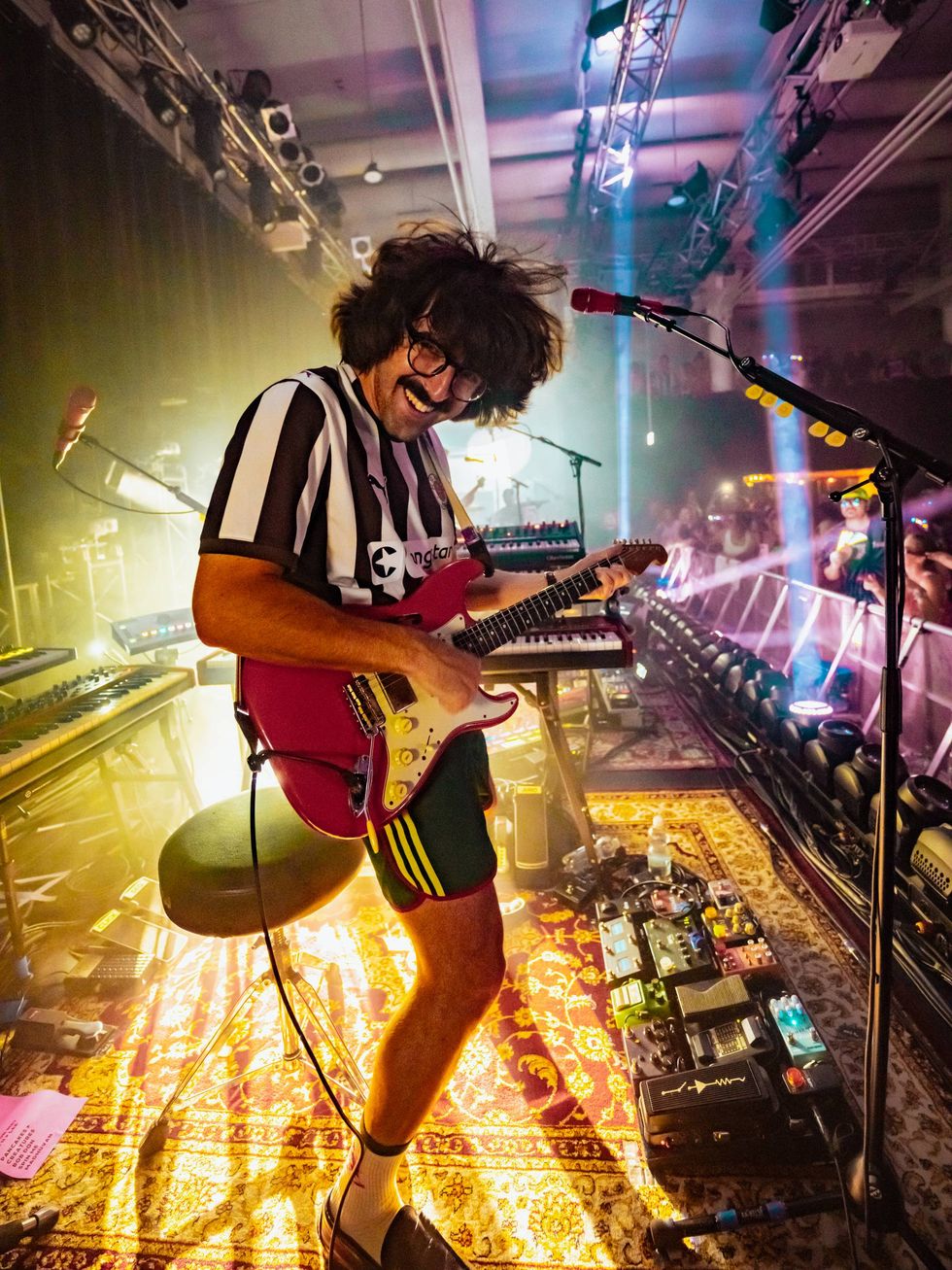
Ratboys perform at Minneapolis venue Cloudland for The Current’s MicroShow concert series on November 18, 2025. Steiner is playing her Nepco electric, a unique V-shaped 6-string with Danelectro-inspired appointments, including a genuine Dano neck.
Juliet Farmer for Minnesota Public Radio
The songs on Singin’ to an Empty Chair were written across a years-long period; some had been around in demo form since before Ratboys’ previous record, The Window, was released. “We’ve all been keeping up with the story of these songs,” says guitarist Dave Sagan. “It’s kind of like an old group getting back together and picking up where it left off. I feel like that brought us a lot of comfort and joy.”
The music on Singin’ often radiates with those two qualities. Save for a few moments of pandemonium, Ratboys’ distinctly midwestern indie rock feels friendly and cozy, like a mug of tea in a snowstorm. There’s a kind of patience in the slow-building, cinematic opener “Open Up,” which does eventually bloom into fully saturated rock ’n’ roll, in the alt-country sway of “Penny in the Lake,” and especially on the eight-and-a-half-minute “Just Want You to Know the Truth.” But that calmness is upended by the headbanging slacker-rock chorus of “Know You Then,” and the crackling, hyper thrill of “Anywhere,” an ode to an anxious dog. One of the greatest gifts Ratboys have given us is a place where fans of Weezer, Pavement, the Replacements, and Lucinda Williams can hear all of those favorites in one place.
To prepare the record’s 11 songs, Sagan, Steiner, bassist Sean Neumann, and drummer Marcus Nuccio rented a cabin on 20 acres of land in Wisconsin. Perhaps inspired by Steiner’s journey toward honesty, the band embraced directness: If a section sounded like an epic rock part, they called it “the epic rock part.” Walla joined them at the Wisconsin hideaway for some tracking, with the rest mostly completed at the late Steve Albini’s Electrical Audio in Chicago.
“We’ve all been keeping up with the story of these songs. It’s kind of like an old group getting back together and picking up where it left off.”—Dave Sagan
Sagan recorded primarily through his Music Man 212-HD One Thirty, and Steiner used her beloved Fender Hot Rod DeVille. It was broken when she purchased it, and in the course of having it repaired, a friend made a mystery mod that lends extra dirt and attitude. But working at Electrical Audio gave them access to plenty of special gear, like a 1959 Fender Vibrolux (heard on “Burn It Down”), Bob Weston’s Traynor TS-50B, and a Samamp VAC 40 (which Steiner and Sagan call an “MVP guitar amp”). On the percussion side, Nuccio crafted a tambourine staff so he could shake five of them at the same time, and they sometimes tracked on crumpled-up tape for a warped feel.
Julia Steiner’s Gear
Guitars
Nepco V-style custom-built by Ian Williams
Lindert Locomotive T
Steve Albini’s EGC 500 (studio)
’60s Framus Texan
Eastman and Larrivée parlor guitars
Amps
Fender Blues Deville 410
Effects
Paul Cochrane Timmy overdrive
EarthQuaker Devices Tone Job EQ
Boss TU-2 chromatic tuner
Earthquaker Acapulco Gold (studio)
Interfax Harmonic Percolator (studio)
Strings & Picks
Ernie Ball Rock and Roll Classic .010s
No picks “except for super thin 50 mm picks on acoustic overdubs in studio”
Sean Neumann’s Gear
Basse
Fender American Standard Jazz Bass
Amps
Fender Super Bassman head
Fender Studio Bass head
Fender 1x15 cabinets
Effects
Mask Audio Electronics Civil Math
Darkglass Alpha Omega
MXR Carbon Copy
Boss TU-2 chromatic tuner
Picks
Dunlop Tortex 1.0 mm
Dave Sagan’s Gear
Guitars and Basses
Fernandes MIJ Strat copy
1976 Ibanez PF200
Amp
Music Man 212-HD One Thirty
Effects
Foxx Tone Machine fuzz clone
Badcat Siamese Drive overdrive
Electro-Harmonix Freeze
MAE Neck Brace phaser
Earthquaker Space Spiral delay
Earthquaker Ledges reverb
Boss TU-2 chromatic tuner
Benson Storkn Boks (studio)
Electronic Audio Experiments Dude Incredible (studio)
Boss DD-7 (studio)
Strings & Picks
Ernie Ball Rock and Roll Classic .011s
Dunlop Tortex .88 mm picks
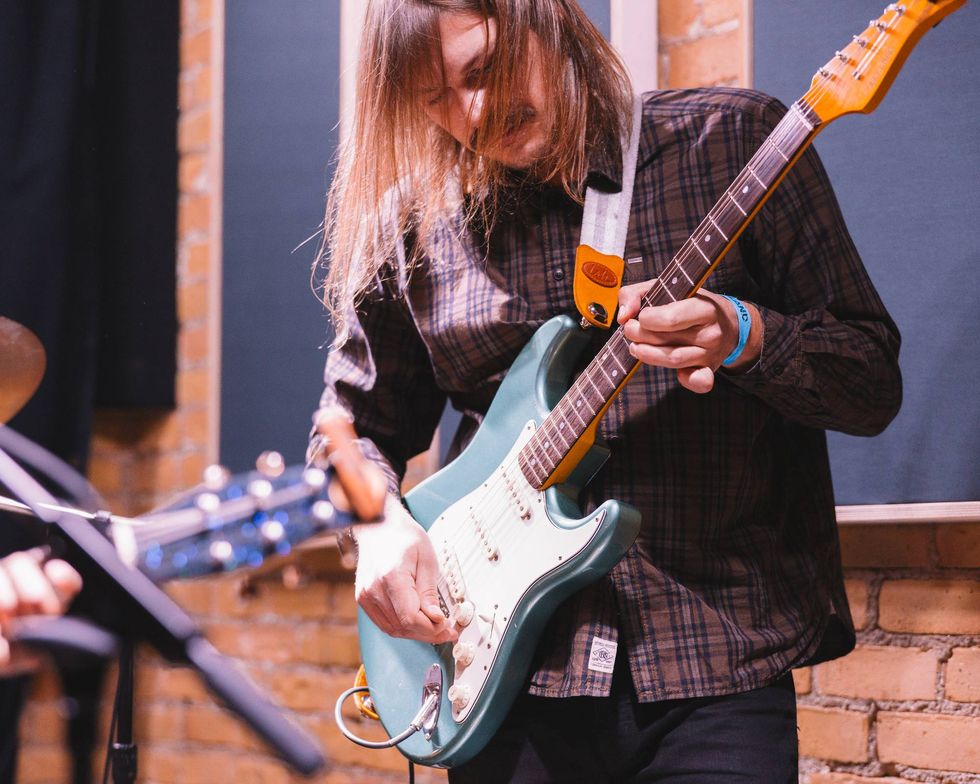
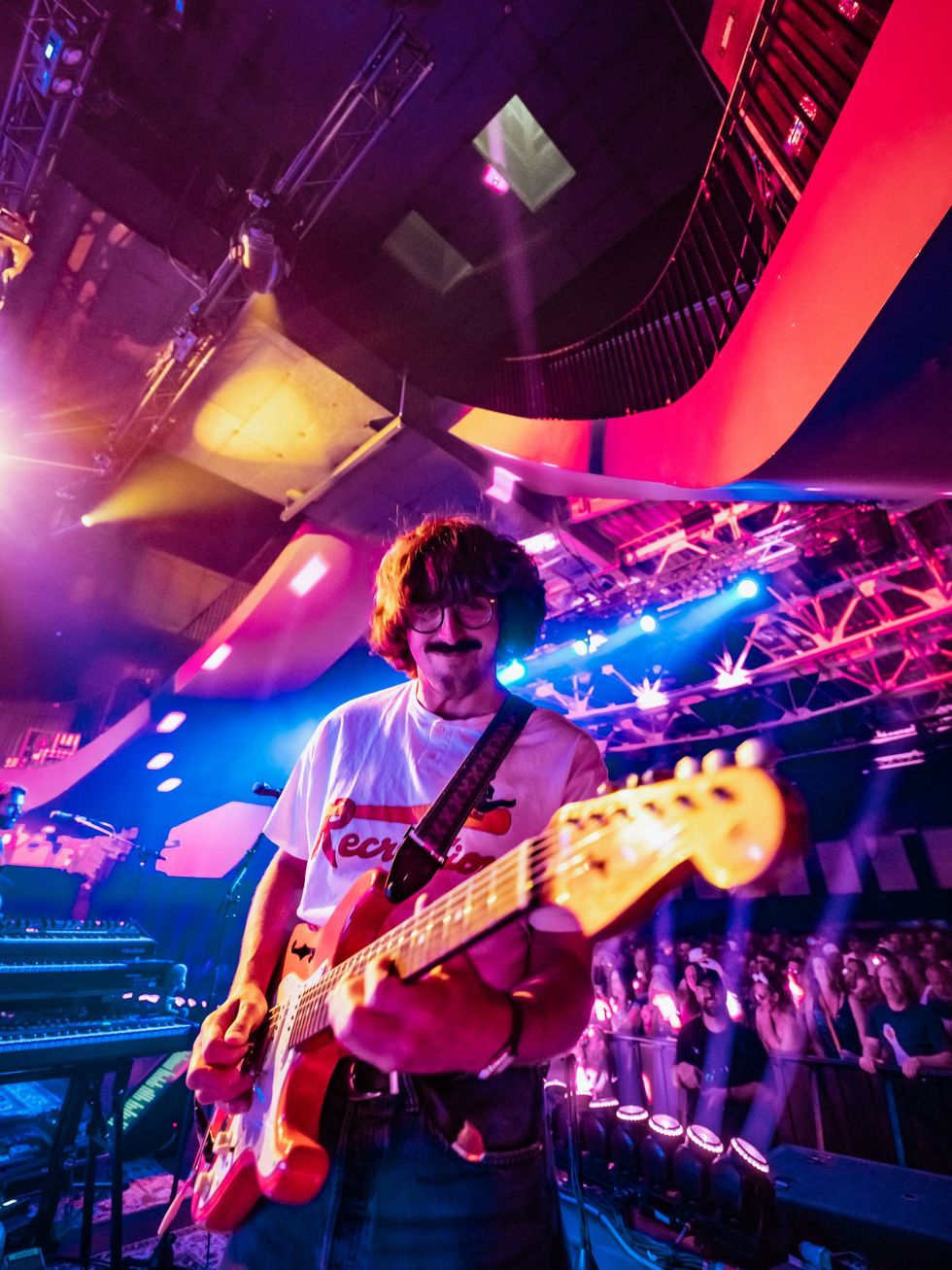
Sagan plays his Fernandes Strat at Ratboys’ November 18 performance.
Juliet Farmer for Minnesota Public Radio
Steiner’s main guitar is her Nepco V-style, a Danelectro-inspired 6-string electric built by Ian Williams in Des Moines, Iowa. Williams sourced the necks from a Danelectro factory in Korea, used masonite for the body material, and handwound the lipstick-style pickups himself. Steiner and Sagan also used Albini’s Electric Guitar Company aluminum-neck guitar (“The tuning pegs were so smooth, I felt like I was at a spa,” Steiner recalls with a grin. “It was such a privilege to play that instrument”), and Sagan even played Albini’s 16-string “guitar from hell,” on which each string is tuned to the same note. It makes an appearance on the mid-album meltdown “Light Night Mountains All That.” “The guitar does one thing, but it’s really satisfying, and you can make some very, very scary noises,” Sagan says. Benson’s Storkn Boks pedal, paired with an analog and then a digital delay, also came in handy for the cacophony conjured in “Light Night.” Albini’s iconic Interfax Harmonic Percolator was in the mix, too.
Steiner and Sagan are fans of gear that’s both vintage and “player-grade.” Sagan’s primary instrument is a Japan-made Fernandes Strat copy—he was trying guitars at a store one day, and the Fernandes was the best one he picked up. Another highlight is his Lindert Locomotive T, purchased from Atomic Music in Baltimore. The T-style has tweed finishing on the body that looks like a speaker grille, and a distinct thumbs-up headstock. One gets the sense that Sagan and Steiner could grab any plank of wood off a wall and coax something out of it that would expand Ratboys’ vocabulary.
That ethic of openness to the off-kilter and potentially weird seems, at this point, to be foundational for Ratboys. Steiner captures it perfectly on “Just Want You to Know the Truth,” a song addressed to an unnamed, estranged relation: “It’s not that I don’t miss you or the way it used to be / It’s that I can’t live my life without sayin’ anything.”