

“Let’s define ‘music’ for a second,” says Deftones guitarist Stephen “Stef” Carpenter. “To me, music is the performance of sound. That sound could be anything, and it becomes musical if I can recreate it. So if there’s a sound I can make, and I can do that with intent every time—to me, that's music.”
This ethos essentially sums up how Carpenter has helped shape Deftones’ densely heavy and alluringly atmospheric music over the past 35 years. Because for Stef, it’s always been less about playing blindingly fast licks or complex riffs and more about coming up with unusual sounds, textures, and chords that enrich and intertwine with the songs that he and his bandmates create together.
“I’m not a technical player,” he says. “I play guitar, and I play it very simplistic; I’m not complicated at all—I leave that for all the players that want to do that. That’s not to say I don’t love math-y, complicated guitar riffs; I absolutely do. It’s just that none of that has been my focus. I absolutely love players that can do phenomenal things. I’m just not interested in doing that myself.
“As a band, we are all very interested in how it sounds,” he continues. “When it comes to why it sounds that way, we don’t talk about it or go into all those things in any great depth. But the thing I think we would all agree on is that we want the sound; we are all about listening for and hearing the little nuances. We’re very much into all the little nuances of things.”
Those “little nuances”—as well as Carpenter’s gigantic power chords—can be heard throughout Deftones’ catalog, including last year’s Private Music, their 10th album. The band’s first new studio full-length since 2020’s Ohms, the effort, co-produced by the band with Nick Raskulinecz, was released in August, 2025, to massive critical acclaim and commercial success, giving Deftones their first-ever #1 on Billboard’s Top Rock & Alternative Albums chart. “My mind is a mountain,” the album’s lead single, also became the band’s first song to reach #1 at U.S. radio, topping Billboard’s Hot Rock Songs and Mainstream Rock Airplay charts.
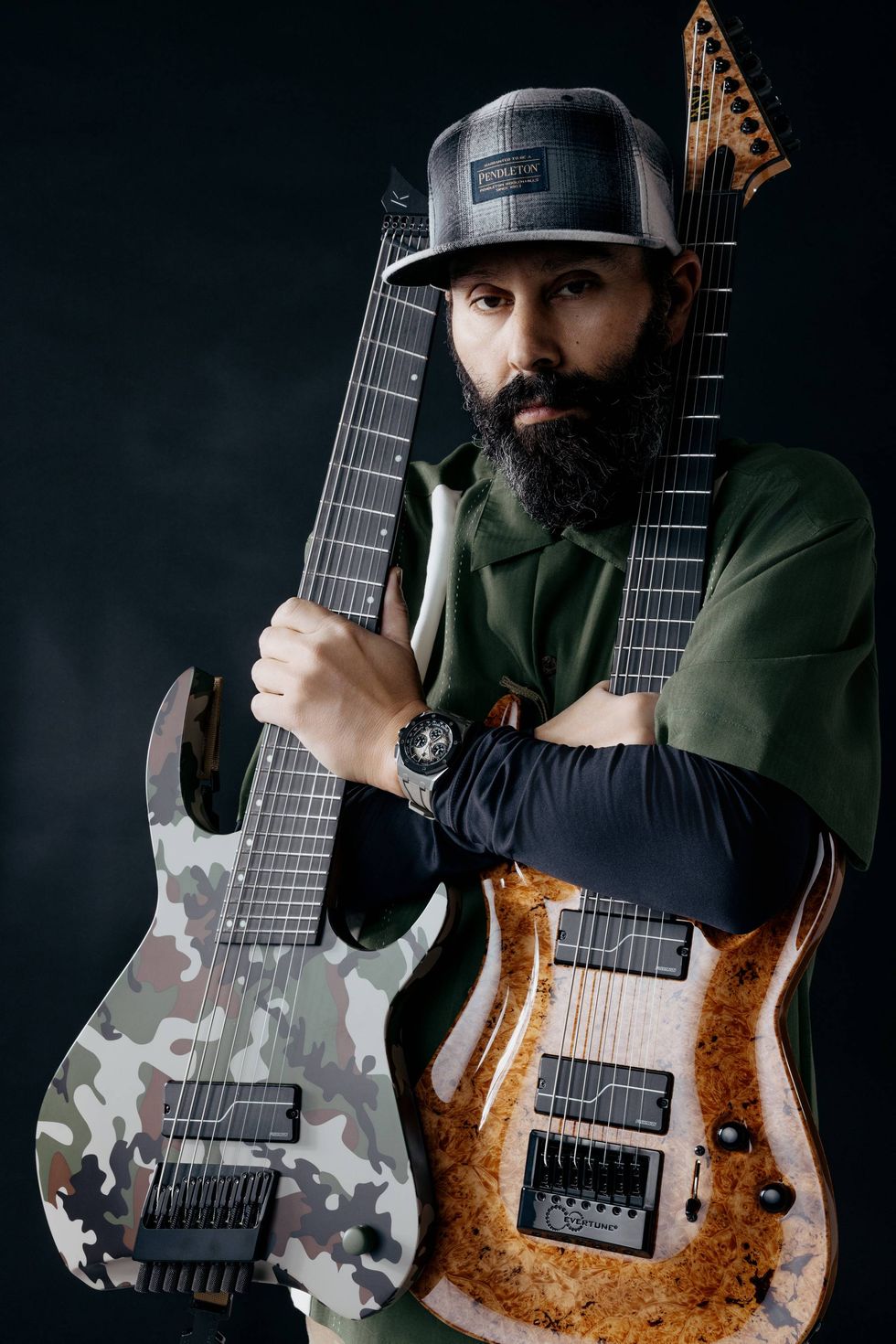
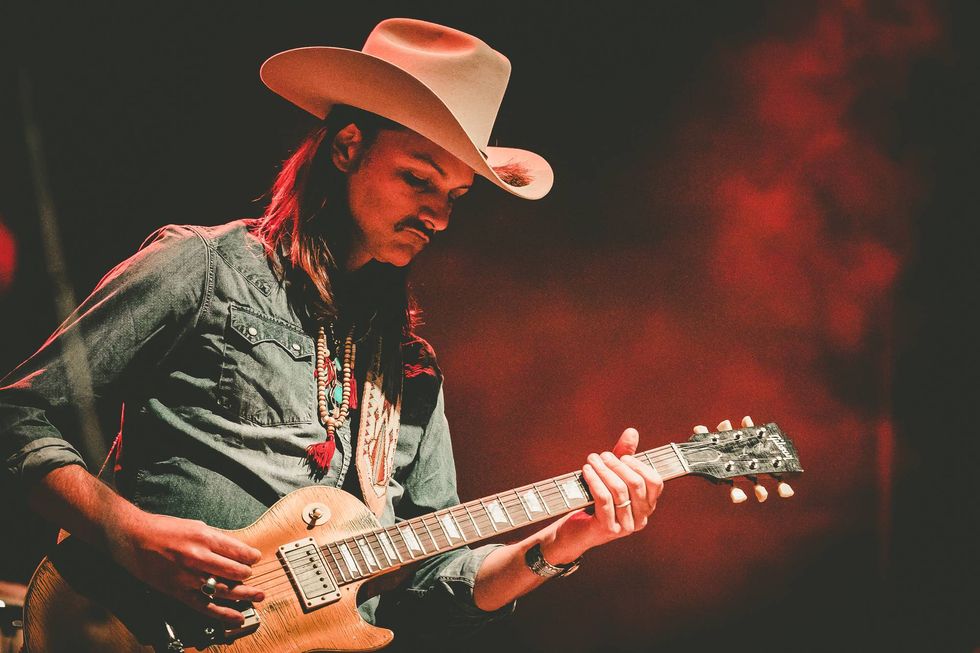
Stef with his Kiesel Stef Carpenter Camo Edition 8-string (left) and ESP Stef Carpenter signature 7-string
Photo by Clemente Ruiz
Stef Carpenter’s Gear
Guitars
- ESP LTD SCT-607B Stephen Carpenter Signature 7-string Baritone
- ESP LTD Stephen Carpenter SC-608 Signature 8-string Baritone
- Kiesel Vader 8-string Baritone
Amps, Cabs, Emulators, Routers, & Receivers
- Bogner Uber Ultra
- Bogner 2x12 UberKabs
- Bogner 4x12 UberKabs
- Soldano SLO-100 Super Lead Overdrive
- Fractal Axe-Fx II
- Rivera Mini RockRec Power Attenuator
- Radial JX44 V2 Guitar & Amp Signal Manager
- Shure AD4Q Digital Wireless Receiver
Effects
- Boss FZ-1W Fuzz
- DigiTech Whammy Ricochet Pitch Shift
- Dunlop DVP4 Volume (X) Mini Pedal
- Eventide H9 Harmonizer
- Line 6 Helix
- Pigtronix Gatekeeper Noise Gate
- Strymon BigSky Multidimensional Reverb
- Strymon Mobius Multidimensional Modulation
- Strymon TimeLine Multidimensional Delay
- TC Electronic 2290 Dynamic Digital Delay
- TC Electronic PolyTune 3 Noir
- Voodoo Lab HEX True Bypass Audio Loop Switcher
- Xotic SP Mini Compressor
- ZVEX Fuzz Factory
- ZVEX Machine (custom)
Stef’s signature 7- and 8-string ESP baritone guitars, long a central element of the Deftones sound, lent significant sonic heft to Private Music tracks like “milk of the madonna,” “cut hands,” and “i think about you all the time.” But the album also marked the first time that Stef employed headless Kiesel Vader 8-strings in the studio, which he acquired shortly before the sessions began.
“We have a friend, Chrys Johnson, who’s the A&R person for Kiesel,” Stef explains. “He’s done A&R for other companies as well, so we've known him through other endorsers throughout the years. And he had asked if I was interested in trying a Kiesel. At the time, I had just received one of their guitars from Marc [Okubo] of Veil of Maya; I had randomly asked him about why he switched from Jackson to Kiesel, and I guess he was having some guitars made at the time, so they sent me one of his guitars that he was getting made. I was very shocked and blown away by that—I had never received a guitar from anybody.” Carpenter laughs. “And then I was talking to Chris after that, and he’s like, ‘If there’s anything on the website that you’re interested in, just let me know, and I’ll have something put together.’”
“I absolutely love players that can do phenomenal things. I’m just not interested in doing that myself.”
Stef found himself especially intrigued by the company’s headless Vader model, which was available in 6-, 7-, and 8-string editions. “I wasn’t even seeking out a headless guitar,” he shrugs. “I’d never played one, but there was something about the Vader that really attracted me. And I wasn’t trying to get with a different guitar company; that had never been anything I was ever interested in. But I decided I really wanted a headless guitar, and ESP doesn’t make one.”
Stef continues, “It turned out that Jeff Kiesel was already a huge Deftones fan, and he built me a Vader himself. He’s super dope, just an awesome person, and he’s become a friend. I was moved by their generosity—and, well, it’s a headless guitar!” (Kiesel has since released a limited-edition 8-string Stef Carpenter Signature Model in all-white and all-black iterations, both outfitted with the same Stef Carpenter Signature Fishman Fluence pickups used in his ESP signature models.)

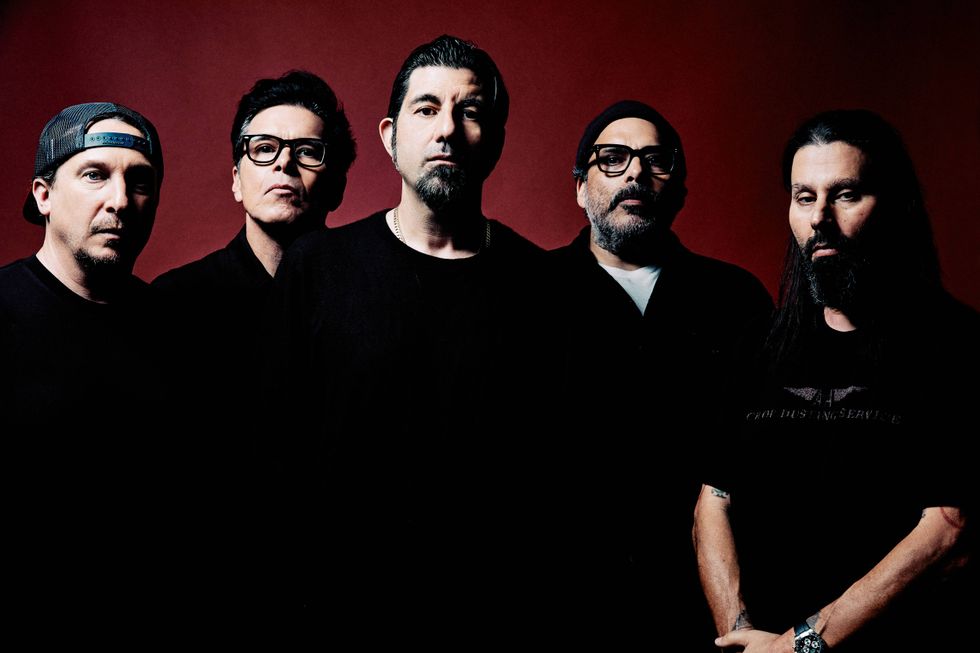
Deftones (l-r):, drummer Abe Cunningham, touring bassist Fred Sablan, singer Chino Moreno, keyboardist and turntablist Frank Delgado, Carpenter
Photo by Jimmy Fontaine
The Kiesels have become an integral part of Stef’s live arsenal as well. “When it comes to performing most of our songs, I can use either my ESPs or my Kiesels to play them,” he says. “It won’t make a difference.” The band’s 2000 effort, White Pony, he says, “is our only record where I have to use my ESPs versus using my Kiesels, because there’s some songs from that where I play the little bits above the nut on the headstock, as well as below the bridge on the strings as they’re going into the body.”
Of course, Stef always brings a veritable platoon of 7- and 8-string guitars with him on the road, due to the various alternate tunings that he began using on the second Deftones record, 1997’s Around the Fur. “Had I not done all that in the past, I could learn all the old songs on the 8-string, which I didn’t start playing until [2010’s] Diamond Eyes,” he says. “But they would be new versions of the songs—they wouldn’t sound the same, and keeping everything consistent is what I go for.
“Every day, I was just shy of crying from pain that was in my right arm; I couldn’t even move it.”
“On this record, I went back to what I was doing on the Koi record [2012’s Koi No Yokan], which is standard 8-string tuning—F#–B–E–A–D–G–B–E—with the top [low] string dropped to E [low to high: E–B–E–A–D–G–B–E]. And I did that because, at the time, I had met Tosin [Abasi] from Animals As Leaders, as well as the guys from Periphery and the Contortionist. They were all amazing dudes and amazing players, and they were all like, ‘We’re playing drop E!’
“So I went to drop E for the Koi record, and I went back to that for this record, because Koi is our record that I enjoy playing the most; I have the most fun playing those songs, physically speaking. But whether it’s the F#-standard tuning or the drop E, they inspire me to do different things on the 8-string; I feel like I can get things out of each one that I can’t get out of the other.”

Stef also switched things up, amplifier-wise, on Private Music. An early adopter of amp modelers, he’s unfortunately had some well-documented difficulties with his digital equipment over the years. “That’s when my struggle began, really, when I left the analog world,” he reflects. “When I initially started using the Fractal Axe-Fx Ultra, I didn’t have any problem with it, because I was just kind of treating it like a preamp. And then I got the Axe-Fx II when they became available. What had really drawn me to them initially was the tone-matching capability; that’s why I got really sucked in. Because, for me, I was like, ‘Oh man, I’m gonna be able to get all the sounds from all the records, so I’ll be able to bring that kind of audio to the live sound, where I can have each song sounding similar to how the record sounds!’ I was so excited about that.”
He continues, “It wasn’t until we got out of the studio, and we started actually living in the real world as a band again, that I started having all the problems with trying to make the digital world sound like it did to me in the analog world. Sitting in front of some recording monitors, you can do that a lot easier, but in the jam room, where we’re actually performing as a band, I did not understand how to make that become a reality, and it never did, the way I had it set up. The thing that I was lacking was just simply the thing that a real amp gives. There’s a certain feeling; you just play on them enough and you’ll feel it. It’s not an audio thing, it’s not something my ears were recognizing. It was just the way it feels, the overall experience. A tube amp is alive, just as you are, but we don’t often recognize—or we take for granted—the fact that there’s this living piece of machinery that’s interacting with you, as well as you with it.”
“I wasn’t even seeking out a headless guitar. I’d never played one, but there was something about the [Kiesel] Vader that really attracted me.”
To reconnect with that feeling, Stef had his collection of high-gain tube heads brought into the studio when it came time to record his parts on Private Music. “I’ve been collecting them over the last 10 years,” he explains. “I didn’t know how they would sound or anything, but I decided I’d at least throw them in the mix and see what happens. I’ve got an entire collection of Bogners; those are my preferred and my favorite, but they weren’t the only ones I brought down. I brought Fryettes, I brought out my Orange amps, my Rivera, my Diezel, my Soldanos. The Soldano SLO-100, man, that amp is amazing! We busted that thing out on many little bits throughout the record.”
The experience of recording with the tube heads inspired Stef to have his live rig entirely rebuilt by Dave Friedman and Greg Dubinovskiy, Stef’s guitar tech, with his Bogner Uber Ultra heads at the center of his setup. “There’s nothing wrong with the digital equipment, whatsoever,” Stef insists. “I mean, for what it does, what it has to offer and what it provides people? That shit’s amazing. But ultimately, I just had so much fun in the studio with the tube amps. My guitar tech, Greg Dubinovskiy, set all my gear up; he was dialing shit in as I tracked. I didn’t turn a knob—I didn’t even plug in,” he laughs. “I was just playing, and enjoying the moment of being there and being able to actually contribute physically.”
Indeed, there were points during the creation of Private Music where Stef’s ability to contribute seemed worryingly limited, largely due to the physical and psychological effects of what was finally diagnosed as Type 2 diabetes. “I had no clue what I was going through,” he says. “I’d just been so out of it for the past four or five years—all the things that go with poor diet and poor exercise, that’s what I experienced.
“During the whole writing process, I was just tired, but I was not connecting how I felt to what I was doing,” he recalls. “When we went in to start tracking the music, thankfully we got all of our scratch tracks done, because shortly after that, something had got me all messed up. Like, every day, I was just shy of crying from pain that was in my right arm. I couldn’t even move it. I did what I could to just take care of myself—at least as best as I understood what I was going through. And thankfully, when it was time to actually track my guitar parts, my body was feeling better, and I was able to physically do what I had to do.”
But rather than get to the root of his physical challenges, Steph simply chalked it up to the aging process. “I just thought it was old-man life shit,” the 55-year-old guitarist says now. It was only after experiencing more difficulties while performing with Deftones at Coachella in 2024 (“I was just trying not to fall over,” he says) that his bandmates successfully convinced him to seek medical help.
“I was self-medicating, hoping I was doing the right thing, and always hoping things would get better so I wouldn’t have to do any of that,” he admits. “But unfortunately, you can only kick a can so far down the road before you run out of road.”
“The sounds those [MRI] machines make are so wild. The techs were like, ‘You can listen to music while we’re doing it.’ And I'm like, ‘No—I want to listen to the machine!’”
Now markedly slimmed down after changing his diet, Carpenter seems to be doing much better, both physically and mentally. “I’m very glad I got help,” he says. “Type 2 diabetes was affecting me on a number of levels for a long time, and I’m grateful to have that information now and be able to deal with it. I’m also really grateful to everyone else in the band—their positive energy really carried me through that period of time, and really carried us through the making of the album.”
If there’s a silver lining to Stef’s medical odyssey, it’s that his health challenges may have inspired him to chase some new sounds for the next Deftones record. “I’ve had two MRIs in the last year,” he says, “and each time, I found myself thinking, ‘Man, how can I bring a recorder in here and record it?’”
Carpenter laughs. “The sounds those machines make are so wild. The techs were like, ‘You can listen to music while we’re doing it.’ And I’m like, ‘No—I want to listen to the machine!’”