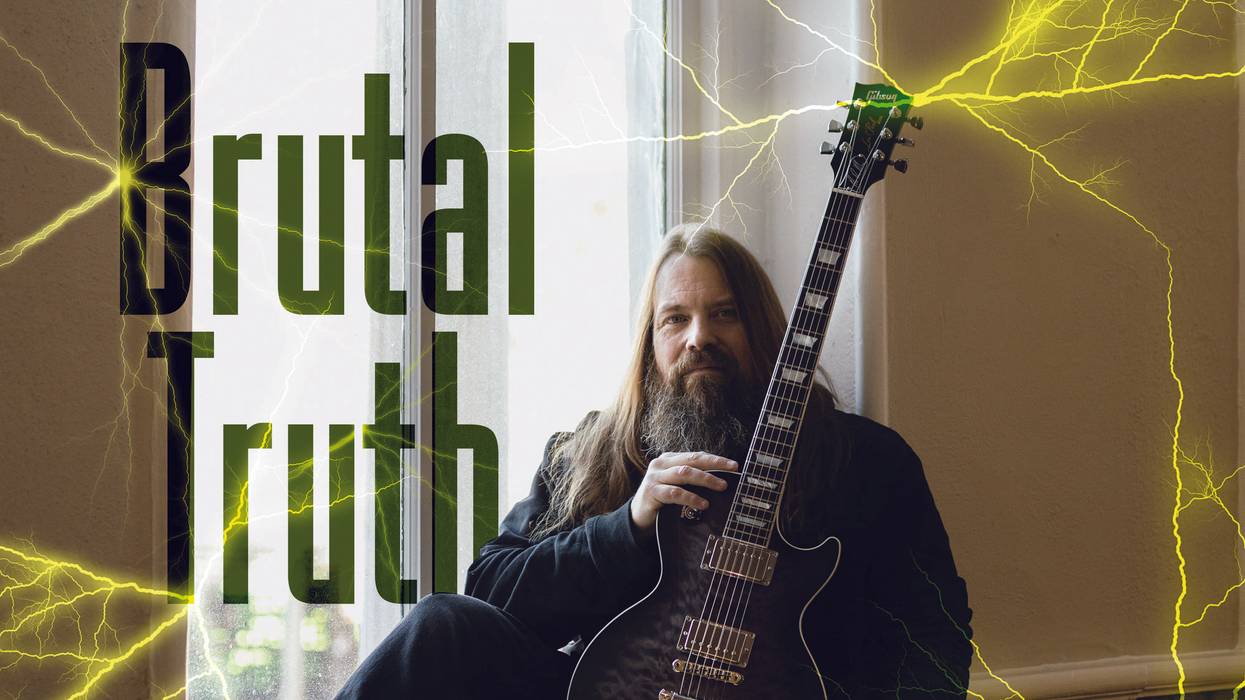
“Any time we make a record, it’s like we’re taking a snapshot of where we’re at that particular time,” says Lamb of God guitarist Mark Morton. “I think it’s inevitable that over the course of your career you start to understand what people respond to and what they don’t. But we’ve never chased the approval of anyone—not critics, not even our fans. We’ve always rallied very strongly around the idea that we’re making music for the five of us in this band. I mean, if we can’t get excited about what we’re doing, how can anybody else?”
For Morton, the process of gearing up for Lamb of God’s 10th studio album, Into Oblivion, involved a period of reflection. After the band (which also includes guitarist Willie Adler, bassist John Campbell, drummer Art Cruz, and singer Randy Blythe) finished their 2024 Ashes of the Wake 20th anniversary tour, he went through the group’s catalog and listened to a number of songs they had never performed live. “That kind of spun me off into thinking, ‘Who was I back then? Where was my head at when I was writing those songs?’” he says.
Morton decided to investigate further, and went down the rabbit hole of bands he listened to some 25 years ago, like Meshuggah, At the Gates, and the Haunted. But he didn’t stop at early 2000s Swedish death metal; he also reconnected with records by local bands from Lamb of God’s hometown of Richmond, Virginia. “I’m talking about Breadwinner and Sliang Laos and some other bands that never got the kind of notoriety they deserved,” he says. His listening binge then segued to old favorites like Fugazi and the Jesus Lizard. He notes, “We have a new song called ‘Sepsis’ that’s like the Jesus Lizard and Sliang Laos spun together in a modern metal song.”
Before hitting the studio with Lamb of God, Morton issued his second solo album, Without the Pain, an engaging and thoughtfully crafted Southern rock-tinged set that featured collaborations with Cody Jinks, Charlie Starr, and Jason Isbell, among others. Coming out the other side, the guitarist felt ready—refreshed and rejuvenated—to reconvene with Lamb of God. “I think longtime bands can only survive if there’s room for members to pursue other opportunities,” he says. “I can get other music out of my system and still allow Lamb of God to maintain its character and personality.”
He doesn’t beat around the bush as to the nature of the band’s identity. “We’re a heavy metal band,” he says. “We make heavy metal records. It’s what I want us to do, and it’s what we want to do. We’re really good at it, and we keep trying to get better. I respect what we’ve done in the past, and I feel obligated to honor our history and help us make something that’s worthy of that body of work.”
Which wasn’t always a walk in the park. The band went through an intense vetting process while writing material for the album, weeding out anything that sounded like reworked versions of songs from their past. “That was the challenge,” Morton says. “If you want to get to a new place, you’ve got to be willing to put the work in, and it can be hard. You listen a lot, rewrite a lot, try new ideas. If something sounded fresh or out of the ordinary, we ran with it. Even if it didn’t pan out, at least we were out of our comfort zone.”

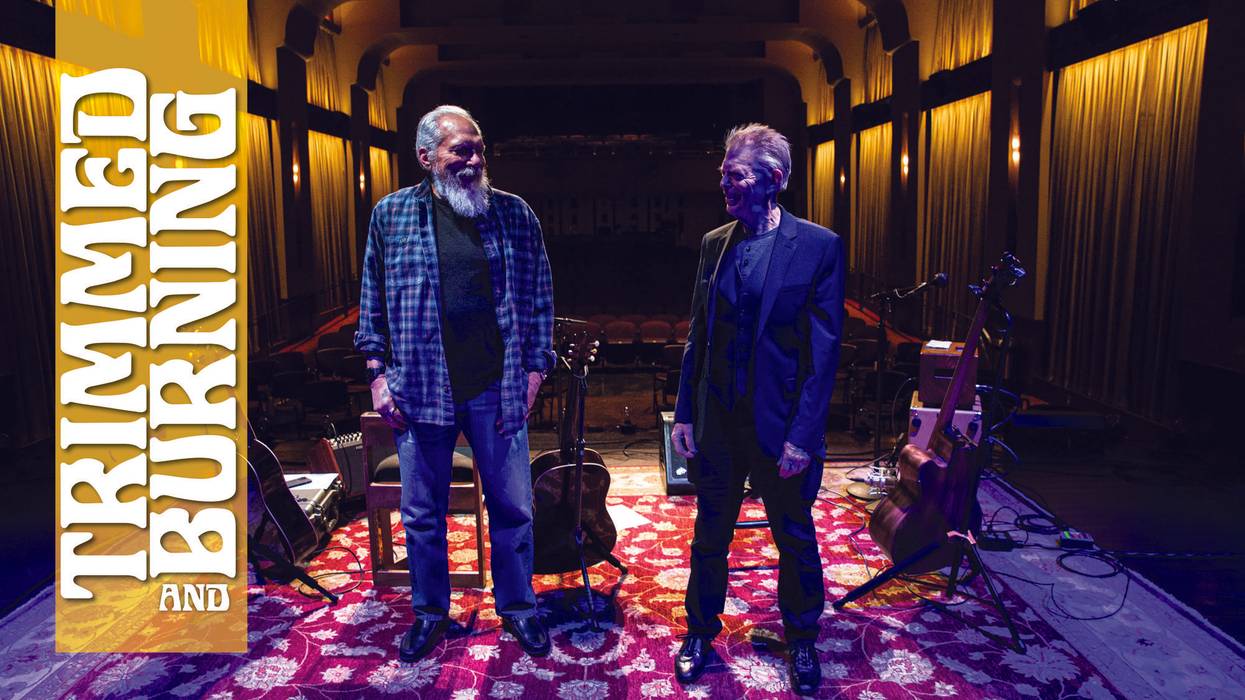
Lamb of God guitarists Willie Adler (l) and Mark Morton
Photo credit: Joey Wharton
Mark Morton’s Gear
Guitars
- Gibson Mark Morton Les Paul
- 1969 Gibson Les Paul Custom
- Fender Custom Shop Stratocaster
Amps
- Mesa/Boogie Rectifier Badlander (rhythms)
- Mesa/Boogie Mark IV (solos)
Effects
- Vintage Ibanez Tube Screamer
- Klon Centaur
- “Any delays, choruses, or phasers are done with outboard gear in the mix.”
Strings, Picks, and Cables
- Stringjoy Mark Morton Artist Series
- Dunlop Tortex 1.00 mm
- Mogami cables
The guitarist recalls each band member using a certain word throughout the writing and recording period: stock. “We said that over and over,” he says. “It became our touchstone. We had to be brutal. If something felt stock—a riff, a song, a performance—we’d toss it. You keep listening, and you go, ‘It’s not bad. It’s not broken. There’s no mistakes. But it feels stock.’ Good enough wasn’t good enough. Regular-schmegular wasn’t gonna cut it. It had to be great. So you keep going till you get there.”
Morton embraced self-scrutiny when it came to his own guitar playing. If he found himself playing the same patterns as a result of muscle memory—it’s as typical among musicians as it is with athletes—he sought a new approach. He credits longtime band producer Josh Wilbur for his unsparing, pull-no-punches approach in the studio. “Josh has been with us for close to 20 years, so he knows the work in and out,” the guitarist says. “I’ll play something and he’ll go, ‘How many times have we said this already? This riff feels like it’s been on two other records. Can we say something else?’ A lot of other guitarists would have their pride hurt, but I don’t mind. You have to rally around the perspective that you’re trying to do something of value.”
Morton calls himself a “card-carrying tone chaser,” and to that end, he found what he was looking for years ago and stuck with it. Into Oblivion is brimming with his two-tone approach: For rhythm tracks, he ran his go-to guitars (either a signature Gibson Mark Morton Les Paul or a 1969 Les Paul Custom) through a Mesa/Boogie Rectifier Badlander with a vintage Ibanez Tube Screamer in front (“I put the gain all the way up and the overdrive all the way down”), and for solos he used a Mesa/Boogie Mark IV with a Klon Centaur boost pedal in front. “I didn’t feel the need to try to change my sound for the sake of changing it,” he says. “The self-editing I felt I needed had more to do with my actual playing.”
“If we can’t get excited about what we’re doing, how can anybody else?”
Any band that gets to their 10th album might sound as if they’re coasting, but Lamb of God are full of frenzy on Into Oblivion. As they have from the beginning, they serve up a vicious mix of sledgehammer heavy metal and metal-adjacent subgenres (metalcore, thrash, post-metal, death metal, doom metal), but the beauty of it all lies in their seemingly indefatigable ability to make each song’s wicked grooves and way-out licks sound like inspired bits of improvisation. What’s even more remarkable is that, unlike on their previous album, 2022’s Omens, which was recorded live in the studio, Into Oblivion was tracked in sections, with various band members operating in different locales (Morton cut his guitars at his home studio).
“I don’t think recording live off the floor is the standard anymore, for any band,” the guitarist says. “We enjoyed doing it on the last record, but this time we did things individually, and cool stuff came from it. It’s fun to open up the files and listen to tracks one of the other guys did. It’s like opening presents on Christmas. That’s not to say that everything is a total surprise—we’re all very involved with the writing and pre-production. These are just steps along the way when we’re working independently to bring material in.”
The album’s title track is fiery stuff, built around a pile-driving, high-velocity riff that Morton kicked around in pre-production. “It was one of the last songs we worked on,” he says. “Josh and I were sitting in my studio, and I had a riff that we started building into a song. We actually did speed that up about four bpm,” Morton remembers, “which isn’t huge, but we have to be careful about that kind of thing because tempos have a huge impact on the song.”

For Into Oblivion, Lamb of God stepped outside their comfort zone. “If something sounded fresh or out of the ordinary, we ran with it,” Morton says.
Photo credit: Joey Wharton
“Sepsis” comes on like a volcanic beast from hell. Blythe howls and hollers like he just laid his hand on a smoking cast-iron skillet, and a pummeling guitar-and-bass riff adds knockaround punishment. Mid-song, Morton goes weird and wonderful, ramming the message home with jarring dissonant chords that evoke the styles of the Jesus Lizard’s Duane Denison and indie producer Steve Albini. “I love both those guys,” Morton says. “The Melvins, too—they were huge for us. When we talk about Lamb of God, we have to talk about punk and alternative, but also Slayer and Pantera. All that stuff is vital for us.”
The award for Naming Songs For Exactly What They Sound Like goes to Lamb of God for “Blunt Force Blues,” an overwhelming nod to Vulgar Display of Power-era Pantera that asks the musical question: Why have just one corrosive metal riff when 20 will do? “We all have a hand in the songwriting, but that one is a clear example of Willie Adler’s train of thought,” Morton says. “He has this incredible stream of consciousness that sometimes we have to roll back and sometimes we don’t. It can be a wild ride interpreting what’s inside his head.”
When asked if the band has yet tackled the song live, Morton laughs and says, “No. I might need to bring some notes if we do get to that one.”
“Regular-schmegular wasn’t gonna cut it. It had to be great.”
The band hits the brakes on their high-speed tempos for the somber and atmospheric “El Vacio,” a mini-epic of sorts that’s distinguished by layers of gorgeous, echo-drenched, clean-toned guitar textures. “That one began as a bit of an assignment given to me,” Morton says. “Josh and Randy were out in L.A. doing some vocals and writing, and I got a text from Randy: ‘Hey man, send us something weird. We’ve got great songs, but we need to shake the snow globe. Even if we don’t use it, give me something super out of the box.’”
Morton accepted the assignment as a challenge and came up with “something that feels a little like the Cult from their Love period. It was really different for us, and the band loved it.”

Not every song on Into Oblivion features a guitar solo (Morton has never presented himself as a particularly self-indulgent player), but “Parasocial Christ” is a standout. Amid rugged rhythms, the guitarist shoots lead fireworks, abusing his instrument like it owes him money and even tossing in a heaping helping of old-fashioned dive bombs. “It’s nothing I’ve ever done in my professional career, but I did all that stuff when I was younger,” he says. “I did all the tapping and dive bombing that everybody else was doing. There’s actually a lot of whammy bar stuff on the record, which is entirely attributable to Josh Wilber. Every time we cut a solo, he’d say, ‘Why don’t you do a dive bomb?’ I was like, ‘Did you just discover whammy bars or something? I play Les Pauls, so what are we gonna do?’ He just went, ‘We’ll figure something out.’”
Ultimately, the producer got his wish, and to that end Morton utilized a Fender Custom Shop Stratocaster “super-Stratted” by master builder Mike Shannon. “Whenever you hear a dive bomb, that’s me playing the Strat,” Morton says.
“I didn’t feel the need to try to change my sound for the sake of changing it. The self-editing I felt I needed had more to do with my actual playing.”
Whether he’s detonating dive bombs or digging deep into earth-moving rhythms, Morton burns through it all with the zeal and youthful stamina of someone making his first album. For guitarists seeking pre-album training tips, Morton says simply, “By the time we start tracking a record, we’ve spent months doing pre-production, running through the songs and trying different ideas. At that point, I’m ready to go.”
Pressed further, he admits that there is a bit of a science to the art of capturing the perfect guitar performance. “It can come down to all sorts of things, or even just one thing,” he says. “Am I in a good mood? Am I excited about what I’m doing? Do I feel good physically? Am I undercaffeinated or overcaffeinated? It rarely takes me two days to track a song, but if we have to do something again to get it right, we will. The bottom line is, I try to stay in a good mental space.”
Asked if he has any special tricks for that one, Morton cracks a grin. “Yeah—I turn off social media.”