

Matteo Mancuso doesn’t like to think too much—not when he has a guitar in his hands, which seems to be most of the time. “The less I think, the better,” he says. “I like to be instinctive, especially when I improvise. Most of my music is centered around improvisation, so I need to feel very free. Otherwise, I’ll be second-guessing each move I make and I’ll be judging myself.”
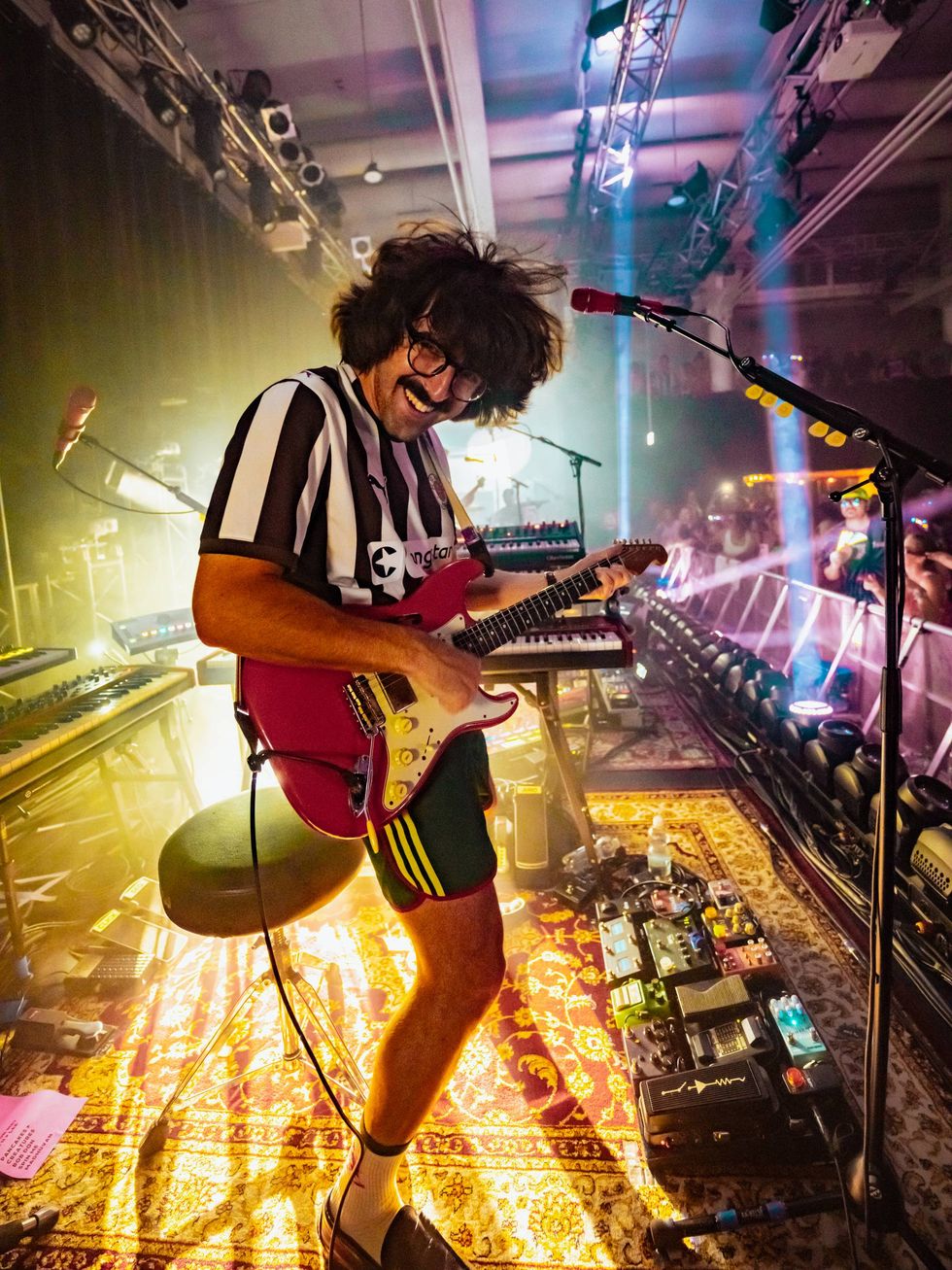
He cites one of his favorite quotes, this one from drummer Vinnie Colaiuta: “Thought is the enemy of flow.” “I agree with that 100 percent,” he says. Which isn’t to suggest that Mancuso can blank his mind entirely. There are times when he’ll stop and listen to where his nimble bandmates—bassist Riccardo Oliva and drummer Gianluca Pellerito—are going, and if they’re headed in a cool direction, he’ll take right off with them. “That’s the beauty of playing with some very creative musicians,” he says. “They’ll usually present you with some good ideas if you just give yourself a moment to listen.”
Conversely, he reasons, should he ever find himself headed down the wrong musical path or boxed in a corner, he can always lay the blame on his bandmates. “That’s the most important part—the band leader never makes a mistake,” he says with a laugh. “It’s always the rhythm section’s fault.”
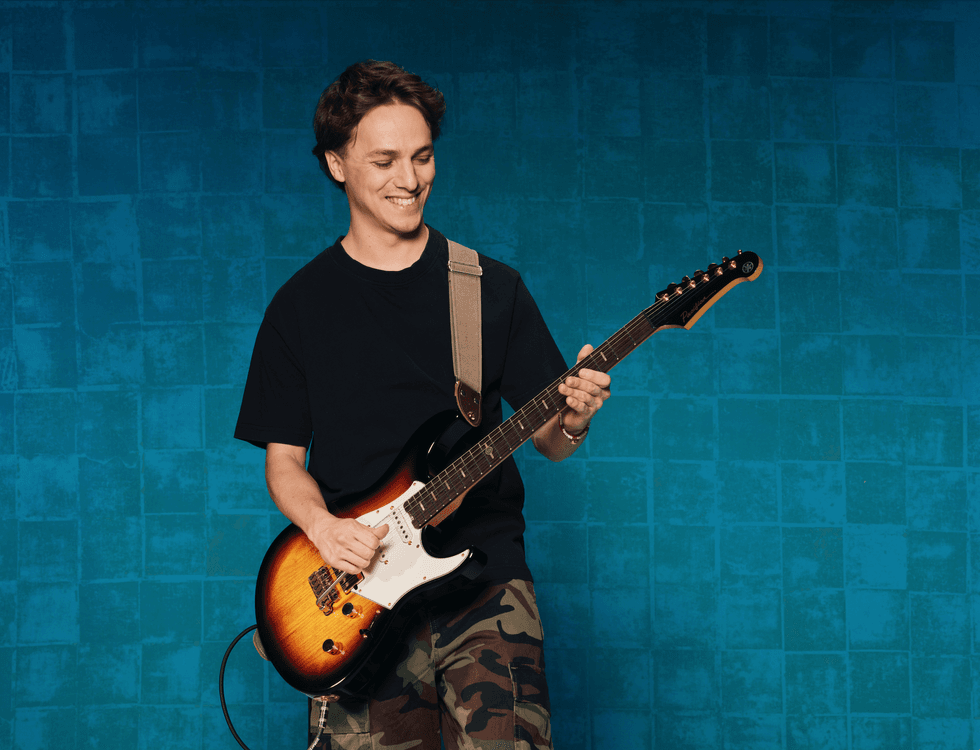
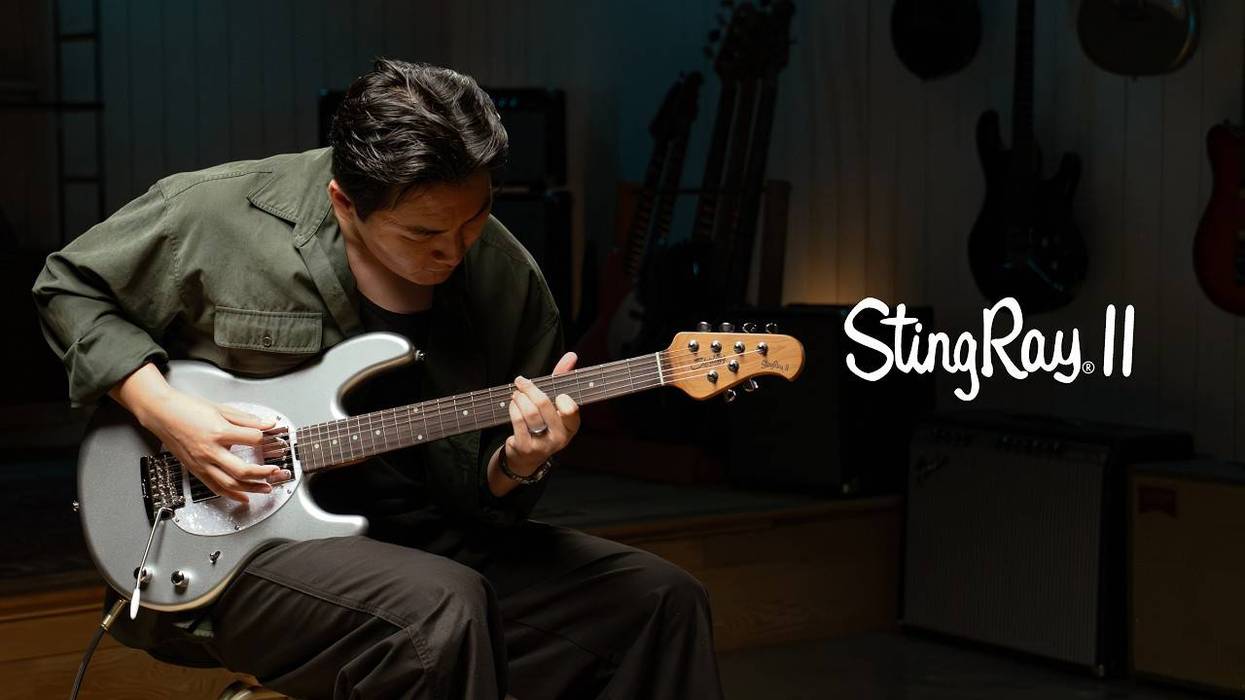
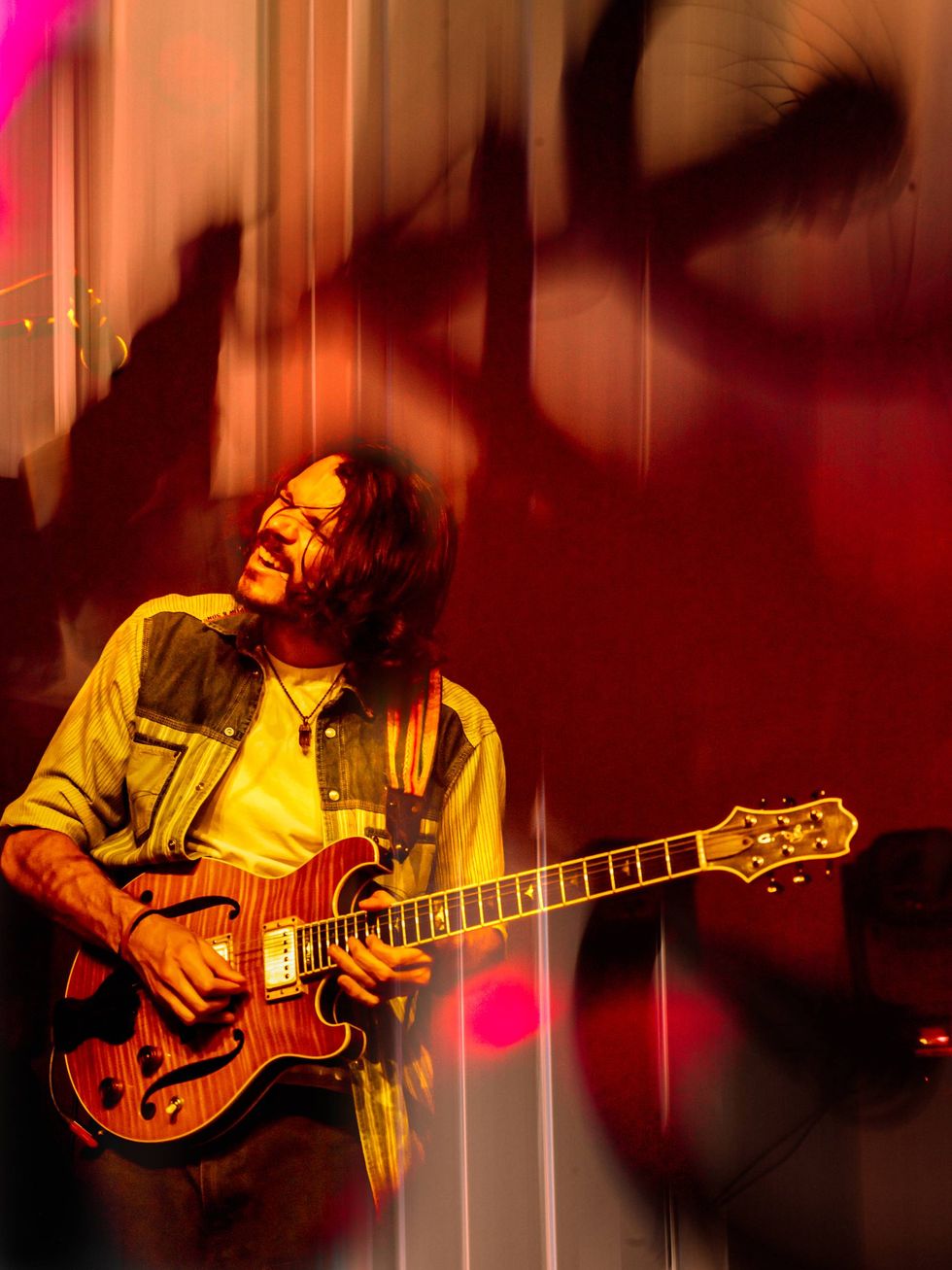
Mancuso with his custom Yamaha Pacifica.
Photo by Larry DiMarzio
Matteo Mancuso’s Gear
Guitars
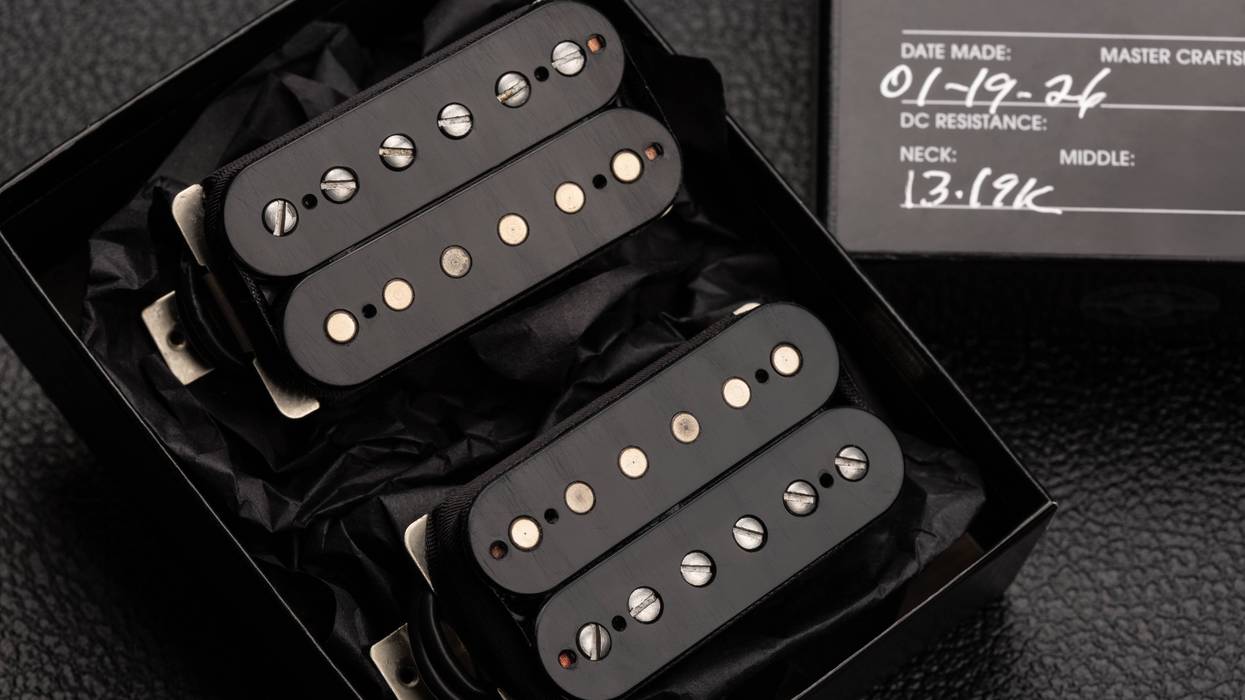
- Yamaha custom Revstar (with DiMarzio PAF 36th Anniversary humbuckers)
- Yamaha custom Pacifica (with DiMarzio PAF 36th Anniversary humbucker and two DiMarzio Area 61 single-coils)
Amps & Modelers
- Line 6 Helix Stadium XL
- Fractal FM9
- Marshall JCM800
- Mesa/Boogie Mark IIA
- Marshall 4x12 cabinet
Strings, Picks, & Cables
- Dogal strings (.009–.042, for electrics), (.010–.046, for acoustics)
- Fender medium picks
- LAB Audio Technology cables
Things have been moving pretty fast for Mancuso since the release of his knockout 2023 debut album, The Journey, and they’re bound to accelerate even faster now that he’s finally gotten around to issuing a more-than-worthy follow-up, Route 96. His development and swift rise are already becoming the stuff of legend: Born in Palermo, Italy, he picked up the guitar at age 10 and was mentored by his musician father, Vincenzo. His rapacious musical appetite—everything from Angus Young to Django Reinhardt—was equaled by his preternatural skills, and it wasn’t long before he refined a lightning-fast, pickless fingerstyle that left many in the guitar community speechless.
Even before he graduated from music school (he studied jazz guitar at Palermo Conservatory of Music), videos of Mancuso and his one-time trio SNIPS signaled that something big was afoot. The band’s breakneck, chops-a-plenty cover of Pee Wee Ellis’ “The Chicken” went viral (it’s now at over three million views), and soon he was receiving huzzahs and hosannas from some of his idols. Steve Vai called him “the future of electric guitar.” Joe Bonamassa weighed in, saying that Mancuso had “reinvented the instrument.” And Al Di Meola went so far as to write him personally to say, “Matteo, what are you doing? You’re killing us!” In time, the young guitar star would jam—and hold his own—with all three admirers.
The praise has continued from all corners, but Mancuso is doing a good job of keeping his feet on the ground and his head on his shoulders. “I try not to pay too much attention to that stuff,” he says, adding, “but you know, I’m human. The point is, the best judge of what you’re doing is you. Whenever I see people saying these things, I try to keep everything in perspective. I don’t consider myself the best guitar player in the world. Believe me, I know what my strengths and weaknesses are.”
“Most of my music is centered around improvisation, so I need to feel very free.”
Asked to name a few of those weak spots, he answers without hesitation: “I’d like to follow my ear more during improvisations. Sometimes that can be hard if you know a lot of things on the guitar, because you’re relying on muscle memory. Another thing is timing—I always like to work with a metronome. It’s not necessarily a weakness, because I think I have a good feel for time, but it’s something I need to do every day. If you don’t keep up with it, your skills can degenerate pretty quickly. I also like to keep up with comping. I’m soloing most of the time, so it’s good to be able to comp with people.”
Whatever his perceived shortcomings, Mancuso is still operating at a vertiginously high level. He understands that there’s a portion of his audience looking to have their minds blown at every turn, but it hasn’t become a burden. “I guess there’s that ‘wow factor’ in my music, and I know when I’m doing that sort of thing,” he says. “The point is to express myself in a genuine way. I try to catch myself, like when I’m playing a solo and I’m doing everything I know—here’s a crazy tapping section, and here’s an alternate picking section—because I know people will go, ‘Whoa, that’s great.’ The temptation is to force myself to do complicated things, even if there’s no need to. I’m aware of it.”

The title of Mancuso’s new album, Route 96, refers to the year of his birth, as well as the 96kHz audio sample rate Steve Vai suggested he record at.
Photo by Paolo Terlizzi
Because he’s such an accomplished instrumental virtuoso (he can hit ferocious speeds like Di Meola or Van Halen, but also slip into violin-like legato phrasing like Eric Johnson at the drop of a hat), Mancuso’s compositional skills can go overlooked. The Journey offered heavy-duty prog-rock with a classical edge (“Silkroad”), supple-smooth jazz-swing (“Polifemo”), groove-filled jazz blues (“Blues for John”), and metallic rock (“Drop D”). The beauty of it all, and this is one of Mancuso’s greatest strengths, is how he managed to keep each song accessible but not predictable. There seemed to be an unsettled quality in one musical passage to the next, just long enough to keep you on the edge of your seat wondering where he would go next.
“That’s what it’s all about,” he says. “My goal is to always have an element of surprise, that feeling where you don’t always know how a song is developing, but it keeps heading toward something new. That’s what keeps things interesting. I think it’s very hard to achieve, but that’s what I’m trying to do most of the time.”
“My goal is to always have an element of surprise.”
A self-described “lazy guy” when it comes to composing, Mancuso put off thinking about a new album as long as he could. Eventually, his record label put the hammer down and imposed a deadline on him, forcing him to start working on new material. “I don’t even know if I’d have a new album if I didn’t have a deadline,” he says. “I don’t want to be as prolific as my label would like. I just want to play guitar.” Once he got with the program, new tunes started to reveal themselves, and little by little, Mancuso started to have fun with the process. “We played a lot of the new songs on tour, and that made a big difference. We’d been playing the same music for, like, three or four years, so it felt nice to change our setlist.”
One such tune was the aptly named “L.A. Blues One,” an easy-breezy shuffle that showcases the luscious combination of Mancuso’s clean, bell-like rhythm tone and his stinging, elastic soloing. “I really wanted to write something that was missing in our concerts—something simple with a stable groove,” he says. “For so long we’d been playing songs with all of these fast parts, so ‘L.A. Blues One’ is an important change of pace. It’s got a nice vibe, a blues shuffle, and the melody isn’t too busy. It’s a good song for people to settle into.”
By contrast, “Fire and Harmony,” a stunning blend of acoustic flamenco-tinged jazz and ripping electric fusion, has a lot going on, and in less capable hands it could fall apart. But Mancuso stitches each thread together like a master storyteller. “I knew I wanted to do something with both electric and acoustic soloing, so I started to develop the song based on that,” he says. “If you listen to the harmony in the intro, maybe you can hear the inspiration of Frank Gambale. I listened to his album Thunder from Down Under a lot as a kid.”

Mancuso says the number one factor in his sound is his fingers—or, more precisely, his nails.
Photo by Paolo Terlizzi
Thus far, Mancuso hasn’t taken part in a G3 Tour, but the ripsnorting, smart-alecky rocker “Black Centurion” gives you a pretty good idea of what he would sound like duking it out in a finale with Joe Satriani, Steve Vai, and Eric Johnson. “It’s something I always like to do with the more rocking songs—get a catchy riff and take it from there,” he says. “It’s very energetic. I’d say it’s got a Satch vibe.”
The album title, Route 96, refers to the year of Mancuso’s birth, as well as the 96kHz audio sample rate Steve Vai suggested he record at. “Most musicians record at 44 kilohertz, but Steve said that 96 gives better quality,” Mancuso explains. “It’s almost like the frames per second in filmmaking. The more frames you have, the smoother the film will look.”
Through the wonders of remote recording, Vai himself turns up in big, splashy, hi-beam form on the gonzo fusion-rock gem, “Solar Wind.” After laying down the tune’s main rhythms and some elegant leads, Mancuso emailed the file to Vai and waited to see what he would do. “I didn’t tell Steve what I was looking for, and I didn’t give him any kind of restrictions,” he says. “What he sent back was remarkable. It was pretty amazing, because he was touring with the SatchVai Band and BEAT at the time. He’s such a busy guy.”
“I would love to have a pop hit, but I don’t know if I’m able to do it.”
On a pair of bewitching cuts—“Warm Sunset” and “Isla Feliz”—Mancuso dips into a Latin-flavored mode. Both tracks follow the same framework: Start out gentle, then explode in a fireball at the end. Originally, he envisioned “Isla Feliz” as a purely acoustic piece, but he ultimately included sections of distorted electric soloing, while leaving plenty of room for his guest, gypsy-jazz star Antoine Boyer, to do his thing. “I think it’s a great combination—gypsy guitar, electric guitar, classical,” Mancuso says. “I gave Antoine the longer solos because that’s my general philosophy when I invite someone to play on one of my songs. I don’t want them to add just a tiny bit. Besides, you’re buying an album that has me playing lots and lots of solos. I like to keep it fresh.”
Gear-wise, Mancuso relied on his favored Yamaha Revstar and Pacifica custom models that he ran through different amp modeling processors, either a Line 6 Helix Stadium XL or a Fractal FM9. The only time he rocked out on real amps was for the song “Black Centurion,” on which he utilized a Marshall JCM800 for rhythms and a Mesa/Boogie Mark IIA for leads, both of which were paired with a Marshall 4x12 cabinet.
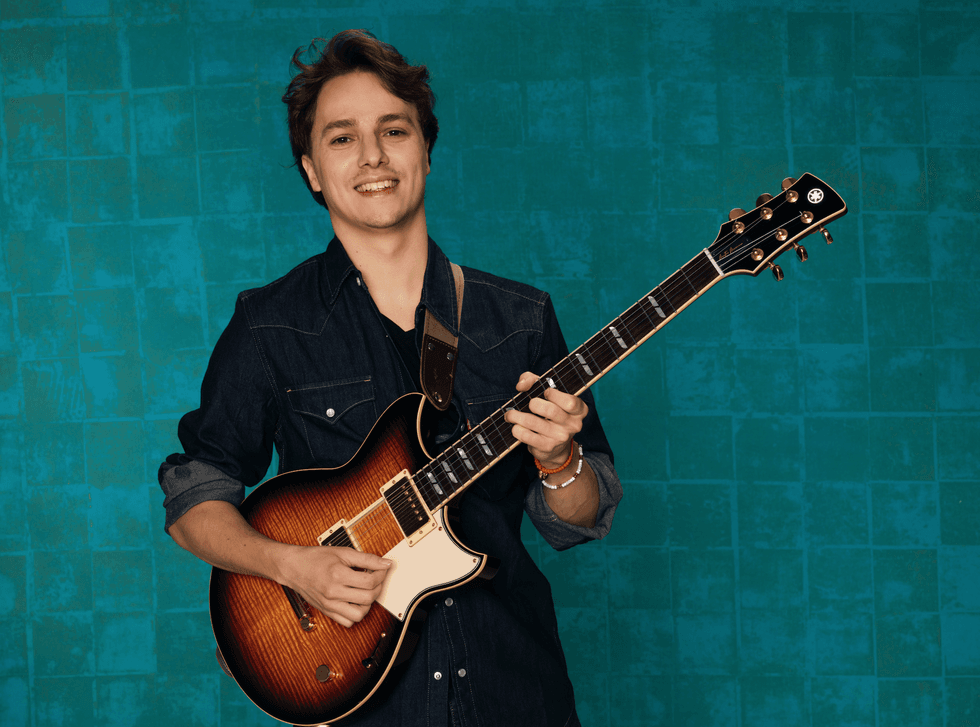
Mancuso with his custom Yamaha Revstar.
Photo by Larry DiMarzio
He stresses that the number one factor in his sound is his fingers—or, more precisely, his nails. “If my nails are too short, the sound is too muddy and dark no matter what pickup or amp I use,” he says. “If they’re too long, they get in the way while I’m playing. It’s very important to me that I have the right length to achieve the clarity and attack I like.”
Asked how he deals with chips and breaks, he holds up his right hand and waves around his index, middle, and ring fingers. “You see that? They’re fake,” he says. “I use acrylic nails on those fingers because natural nails don’t last long with an electric guitar. I remember last year they were completely broken, and I had to go to a nail salon in Tucson."
In all likelihood, Mancuso could play with a boxing glove and still come up with some incredible sounds. With his devastating gifts and mastery of so many musical styles, he could very well be the most versatile and fully formed young guitarist on the scene today, a status that affords him a host of options. He could record an all-out metal album and produce a monster. Or he could go pop and really flip people out. He isn’t ruling anything out.
“I would love to have a pop hit, but I don’t know if I’m able to do it,” he says. “The thing is, I’m not able to sing—that’s the key to that kind of success. George Benson is a great example. He made a lot of incredible music—“Breezin’,” “Weekend in L.A.”—but while he could sing, he also had tunes with no singing. There’s just a good song and a good melody. Maybe that’s a direction I’d like to have. The important thing is that I’m free to do the music I want. I’m open to every musical aspect.”