
Towards the end of Duane Betts’ video for “Heartache,” a melancholy song about grief written after his father died in April 2024, the 48-year-old guitarist etches the initials “FRB” in the sand. It seems like a riddle, or perhaps a non sequitur, until you realize Betts’ late father, Dickey Betts of the Allman Brothers Band, was born Forrest Richard Betts. “It was something that was kind of thought about and plotted out as an easter egg—something very meaningful, but not obvious. We didn’t want to be too on the nose about any of the references,” the singer and guitarist says, speaking to Premier Guitar by phone from a summer home in Jackson Hole, Wyoming, the night before he’s scheduled to perform with the Allman Betts Family Revival in Vail, Colorado. “Some people don’t know that my dad’s first name is Forrest. They might not catch the initials.”
While inspired by the senior Betts’ death at age 80, “Heartache” is a universal ballad, on the edge of Neil Young-style folk-country and, yes, the Allman Brothers’ soulful southern rock. “I’ll wait, watch over you / Nothing I can do,” Betts sings, then repeats the phrase “there’s nothing you can do” multiple times before playing a solo that is both mournful and hopeful on his cherry-red 1961 Gibson ES-335, a guitar he inherited from his father. “I wrote that song down in Florida, shortly after my dad passed away, with my friend [singer-songwriter] Stoll Vaughan,” Betts says. “I had this haunting chorus melody, and I was mumbling ‘heartache,’ and it just went from there. It’s a universal feeling that everybody can relate to. It’s about loss and acceptance and getting through that process.
“It’s about everything and everyone that you’ve lost, you know?” he adds. “The lyric is simple, but it’s vulnerable and personal to me and I’m very proud of it.”
In the video, filmed in Malibu, California, last March, Betts, slender with long hair and a thin mustache, wears open-collar, earth-toned suits that can only be described as “Allman Brothers chic.” In one of these outfits, he wanders into the ocean; in another, he plunges into a pool. “Actually, I don’t think we wrecked any of them,” he says of the clothes. “The first one turned out okay. We just air-dryed it. It was a lot of fun. The pool was about 10 degrees colder than the ocean, and the ocean wasn’t warm.”
Betts made “Heartache” and the rest of his new album, Isle of Hope, with Dave Cobb, the Nashville producer who has worked with just about everybody, from the Bee Gees’ Barry Gibb to pop star Teddy Swims, and has a knack for drawing out the country soul from raggedy-voiced singer-songwriters like Chris Stapleton, Sturgill Simpson, and Jason Isbell. Betts came across Cobb’s work while recording a session with guitarist J.D. Simo; while Betts was waiting for an Uber, “me and J.D. were getting some quality time,” and Betts played him a new tune called “Reckless.” “You know who would love to do this? Dave,” Simo told him.
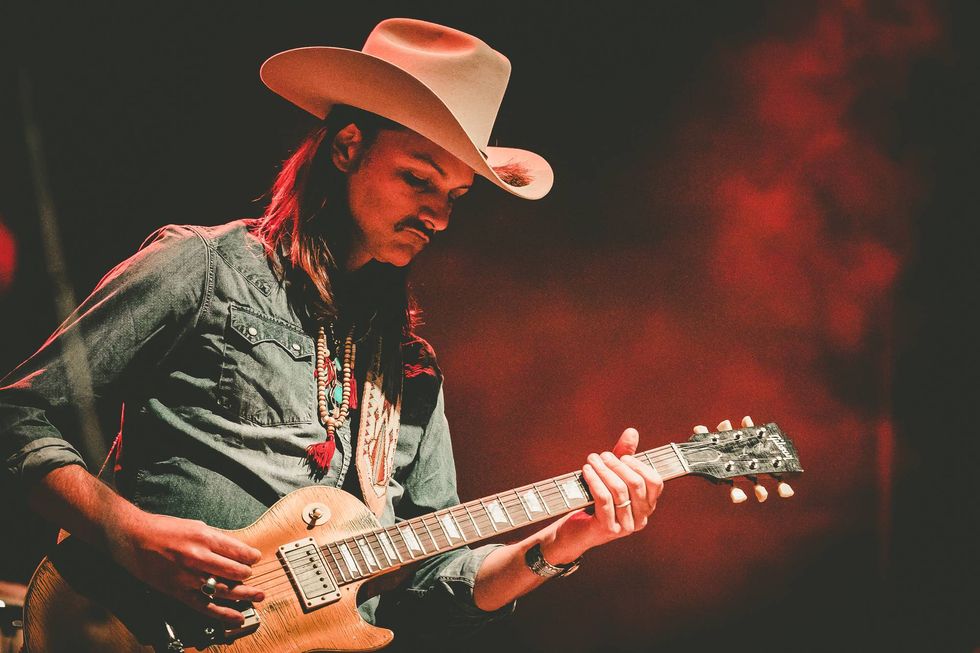
Duane with his Gibson Dickey Betts Les Paul Gold Top prototype #1
Photo by Chris Brush
Duane Betts’ Gear
Guitars
- 1961 Gibson ES-335
- Gibson Dickey Betts Les Paul Gold Top prototype #1
- Pre-war Martin acoustic
- Fender Telecaster (courtesy of Dave Cobb)
Amp
- 1961 Magnatone Troubadour
Pedal
- Union Tube & Transistor NeverMORE
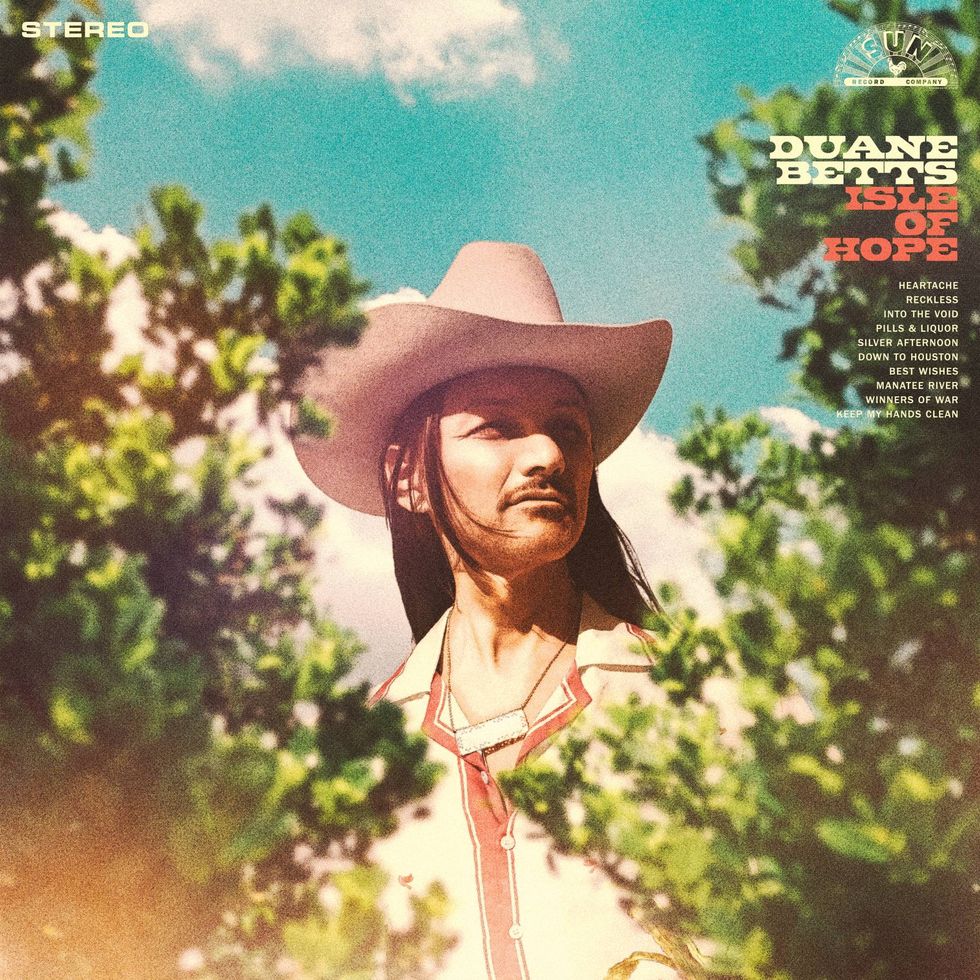
Cobb proved to be exactly as advertised while producing Isle of Hope, an album that balances laid-back, hymnlike tracks such as “Silver Afternoon,” “Best Wishes,” and the lead single “Heartache” with more hard-driving numbers like “Pills and Liquor,” “Down to Houston,” and the closing track “Keep My Hands Clean.” The latter songs capture the tight, barrelhouse swagger of early-1970s Rolling Stones, though they are surprisingly concise by the standards of the Allman Brothers diaspora. Throughout the album, potent slide-guitar solos—performed primarily by Betts and Johnny Stachela—add both fire and texture. Their guitar work often recalls Duane Allman’s playing alongside Eric Clapton on Derek & the Dominos’ “Layla.”
“Dave is a genius in the studio. He can frame things in his head while he’s playing in the band and map everything out perfectly and know where everything fits at all times. It’s what a producer is supposed to do—times 100,” Betts says, launching into a technical explanation of which portions of which studio takes wound up in the final track. “I wanted to have a vehicle like ‘Heartache’ to play a little differently. Dave set me up. I had the solo mapped out over different chords, over a different point in the song, and he changed it and gave me a nice path to just go at the end of the song, over those other chords. It turned out to be a great idea.”
Reproducing the album live has proved to be a challenge as the band rehearses for dates through the end of 2026 and early 2027—mostly because Betts’ road band has only two guitarists, which pushes him to play an acoustic or “an electric like an acoustic.” He adds: “You can’t play all the parts on the record. You have to be thoughtful. ‘Maybe the keyboard player can do something.’”
“We didn’t make a ‘guitar record,’ but there’s plenty of guitar playing on the record.”
Discussing the album, Betts has a habit of changing the subject to move the attention off of himself—his own songwriting, his own vision—and onto the other musicians who worked on the album, particularly his friend Simo on rhythm guitar. “I really wanted everybody to have their moments. J.D. doesn’t play any solos per se, but his guitar work on this record is just excellent,” Betts says. “We didn’t make a ‘guitar record,’ but there’s plenty of guitar playing on the record.”
The new album has a rawer, more spontaneous and live-in-the-studio feel than Betts’ solo debut, 2023’s Wild & Precious Life, a more star-studded affair that featured guests like Derek Trucks—himself the nephew of a late Allman Brothers Band member, founding drummer Butch Trucks—plus Marcus King and Nicki Bluhm. On Isle of Hope, Betts mostly plays an acoustic guitar, a pre-war Martin, although he uncorked the 335 in key moments, like the electric solo in “Heartache.” “I cut the solo after the band went home and got it,” he says.
Has Betts’ playing evolved since Wild & Precious Life? Not in his own estimation. “I don’t know if my playing has changed that much—I kind of play the way I play,” he says. “When given the opportunity to play over different chords, or a different style, you might play differently.”
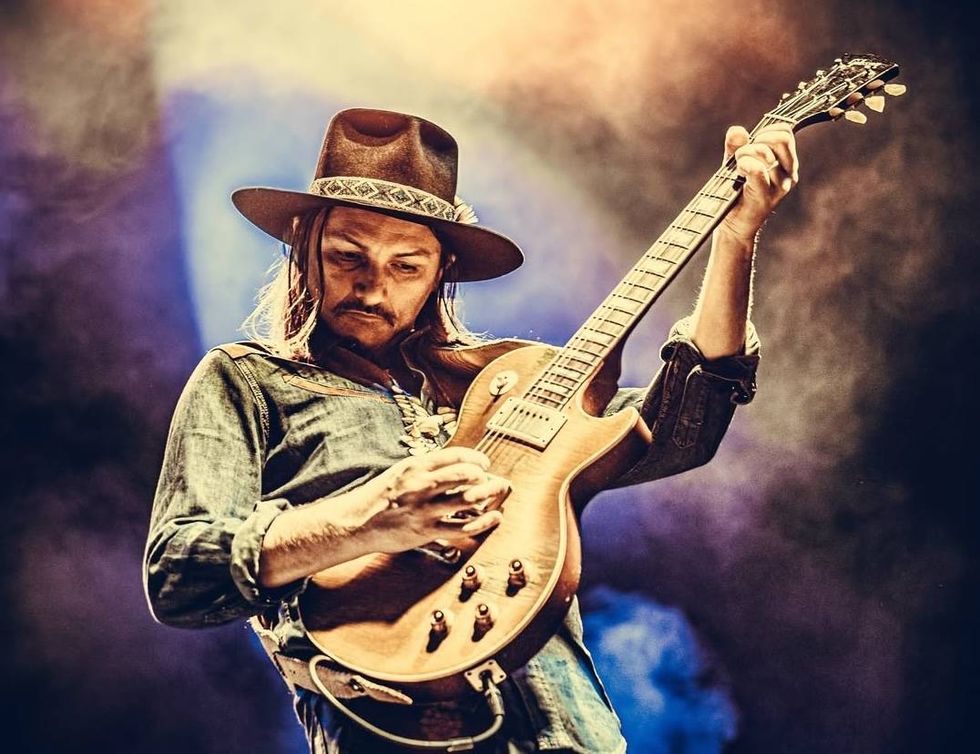
Photo by Jean Frank
Because Isle of Hope is so clearly—and lovingly—dedicated to his late father, Duane has had even more opportunities than usual to reflect publicly on Dickey Betts’ legacy and influence. Betts was a founding member of the Allman Brothers Band in 1969, after he and former bandmate Berry Oakley accepted an invitation from guitarist Duane Allman to join an informal jam session at FAME Studios in Muscle Shoals, Alabama. That gathering ultimately led to the formation of one of Southern rock’s most influential bands.
Duane was born to Dickey Betts and his then-wife, Paulette, in 1978, seven years after his namesake, Duane Allman, was killed in a motorcycle accident. By that time, the Allman Brothers had broken up, then reformed, and were putting out rock albums like Enlightened Rogue during an era of punk and disco. They were touring regularly, and Dickey brought his son on the road. Duane was home-schooled and had a tutor, as he once told the Marin Independent Journal: “It was great. I loved it. ... It was mainly me and the adults. I didn’t get to socialize with kids my own age. I had to make up for that later.” Eventually, he left his father’s hometown of Sarasota, Florida, for his mother’s home base in Malibu. There, he earned his GED and began playing in bands, including Backbone69, whose lineup featured the sons of Roy Orbison, producer Lou Adler, and Berry Oakley.
Around age six or seven, Betts took up drums before switching to guitar. His first electric was a tiger-striped sunburst PRS prototype with a 5-way switch—a model that Paul Reed Smith had personally given to Dickey Betts and Warren Haynes.
“Most of the guitars I own are my dad’s, and it’s really a beautiful thing.”
“I really haven’t played it much,” Betts says. “Believe it or not, I sold it to a good friend because I just wasn’t using it. Then I bought it back. About 15 years later, I thought, ‘Man, it’d be cool to own my first guitar.’” He approached his friend and asked, “You’re not playing as much anymore—can I buy my guitar back?”
“That’s what friends are for,” Betts adds with a laugh.
“Most of the guitars I own are my dad’s, and it’s really a beautiful thing,” he continues. “He was so good at playing that Delta stuff on the National steel. He was such a master, and a student of those guys, and it was always so thrilling to hear him play that style.”
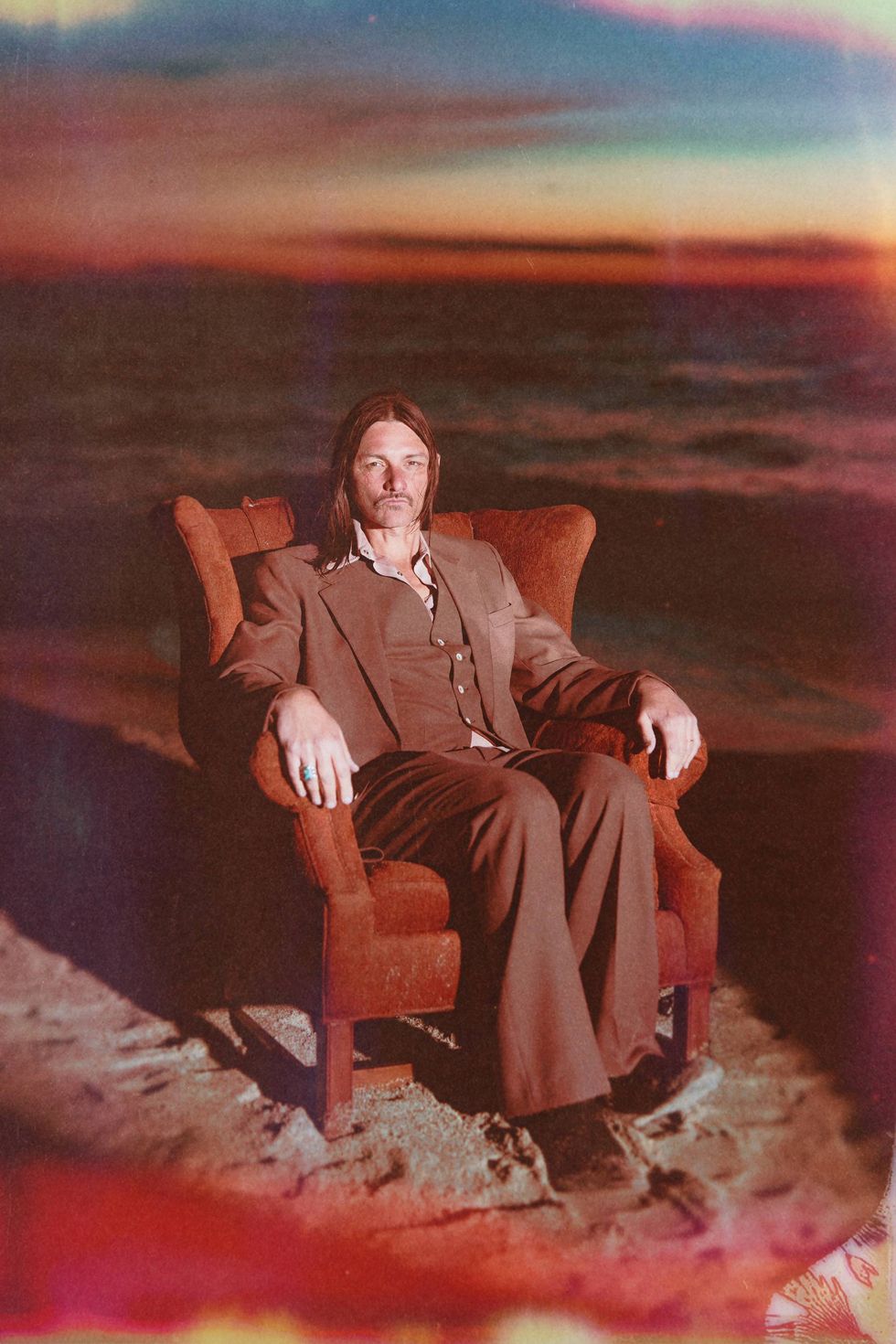
Photo by Bobbi Rich
Children of famous musicians sometimes spend their careers trying to distance themselves from their parents’ work. But Betts is happy to talk about his father, who was his primary guitar inspiration and frequent teacher. Although, he says, “It’s not like we spent an hour a day talking about guitar—or an hour every other day, even. I kind of wanted to learn on my own. I liked the challenge.”
Dickey, he says, “taught me about fundamentals. Like a Chuck Berry rhythm. Like a 12-bar blues. ‘Go listen to Freddie King, “Hideaway.”’ He was turning me on to stuff like that.”
Befitting his own generation, Betts also picked up on the guitar sounds of Nirvana and Smashing Pumpkins, and combined their ideas with the John Coltrane records he was absorbing in his teens. “I forgot who said it: ‘Every rock ’n’ roll guitar player’—whether they’re punk rock, Steve Jones or whoever— ‘should have a little bit of Chuck Berry influence in them,’” Betts says. “That’s how my dad felt. I’m sure Keith Richards feels that way.”
“If you’re being truthful, it can’t be wrong.”
Betts has also forged a creative partnership with fellow Allman Brothers heir Devon Allman, the son of Gregg Allman, who died in 2017 at age 69. The two longtime friends formed the Allman Betts Band in 2018, embracing their shared musical heritage while occasionally inviting other second-generation musicians—among them Dweezil Zappa, son of Frank Zappa, and Tommy Prine, son of John Prine—to join them onstage.
After Dickey Betts’ death, Duane and Devon found common ground in a loss they both understood. “A lot of that goes without saying. We don’t sit and talk about it at length,” Betts says. “He knows. You just look at somebody, and you’re there for them—it’s an unspoken thing. He knows what it’s like.”
Betts says he has found similar understanding among other friends who have experienced the loss of a famous parent. “Alex Orbison lost his father at a young age,” he says. “They’re here in spirit. We’re in the same boat a little more.”
For all the practical lessons Dickey Betts taught his son about guitar—rooted in Chuck Berry riffs and blues fundamentals—it was a more philosophical piece of advice that left the deepest impression. As Duane has told interviewers, his father’s guiding principle was simple: “Go play to nature, and it can never be wrong.”
“He had an abstract way of thinking about art and music and life—the way he wrote some of his songs, like ‘Seven Turns,’” Betts says, referring to the Allman Brothers Band’s 1990 track. “I think what he meant was that god, nature, the universe—whatever higher power you believe in—can’t be wrong.”
“So if you’re being truthful, it can’t be wrong,” he continues. “If you can accurately emulate the movement of water, how could that ever be wrong? That’s god moving right in front of your eyes. He meant that you should try to reflect things that are beautiful and natural. Basically, try to have good taste.”
![Rig Rundown: The Black Crowes’ Rich Robinson [2026]](https://www.premierguitar.com/media-library/youtube.jpg?id=66952027&width=1245&height=700&quality=70&coordinates=0%2C0%2C0%2C0)