


Lily Seabird’s new record, Lightspheres on Their Way, feels like a post-breakup magic mushroom trip in the woods, one you take when the world ceases to make sense, and you need to organize your pain into something you can make peace with. The third full-length from the Burlington, Vermont-based artist sways in a light psychedelic-folk breeze to begin, with a quiet argument with god by way of six-minute opener “The Pulley”: “I’ll ask you again, what pulls us through? Is it the fantasy of a kiss or the work that we must do? I’m frightened to keep going and even more frightened if I don’t.” “Bindlestiff” is all dusty Americana and folk-rock for a desert night, while “Election Day” and the seven-minute odyssey “Portal to the Past” rattle the walls with Crazy Horse abandon; Seabird’s and Rick Soszynski’s galloping guitars channel the wide-open spirit of Neil Young and Frank Sampedro.
As a collection, Lightspheres possesses a feeling of curiosity and play, in Seabird’s arrangements, her lyrics, and how she delivers them. Her voice shakes and trembles in that good way that has turned singers like Adrienne Lenker into the leaders of a new wave of alternative independent music, and the recordings are marked by the sort of intimacy and imperfection that many listeners crave in the age of algorithms. These qualities were come by honestly: Seabird recorded the album at her friend and co-producer Garrett Linck’s home in rural Maine in January 2026, where a woodstove provided the only warmth.
Seabird grew up between Upper Bucks County, Pennsylvania and California, her time split with her divorced parents. She moved to Burlington when she turned 19, planning to stay just for the summer. Eight years later, at 27, the city feels like a piece of Seabird’s character. Talking with her on a video call from her Burlington home, I perceive a level of friendliness and warmth that’s often sheared down when operating in big cities. “You go to other places, and people are always talking about ‘the music industry’ and who knows who and who’s at this show and blah blah blah,” says Seabird. “For us, it’s more like, ‘This is just something to do, and it’s fun.’” During the pandemic years, and even just during Burlington’s long, cold winters, Seabird and her friends stayed indoors and worked on art projects. She cut her first EP, Beside Myself, on a tape machine while stuck at home in the pandemic.
“I can communicate through the guitar in ways that I can’t exactly communicate through words.”
The new record’s title is a nod to how Seabird learned to process the growing churn of change and pain in her life: by viewing each creature, every discrete phenomenon we experience, as an always-moving essence on its own journey. (The idea is mirrored in how most of the songs came together on the road, in the back of a tour van or on a friend’s porch somewhere on the other side of the continent.) Seabird’s explanation is psychedelic and profound: “We’re all going somewhere,” she says, looking up to the ceiling. “You don’t know where you’re going. The thing that really inspires me most in my writing is how we all perceive time, and how that changes throughout the course of one’s life, but also throughout history, and how loss and change can alter that. It’s like when you think of a childhood memory and you’re sad that it’ll never be that way again.”
She continues. “Do you ever feel like you’re so caught up in the spiral of everyday life, this world we’ve created as human beings, and then you go outside and look up at the sky, and you’re like, ‘I am such a tiny little speck flying through space in an ever-expanding universe?’ As we change and move on and grow older, we’re all just going these different ways. God, I sound like a psycho. But it’s how I’ve come to accept these really hard truths of life. It’s also a way to keep going. It’s a way to have hope.” (Being a highly sensitive person has its ups and downs, Seabird shares later. “It also brings me to the place where I’m at now,” she says.)
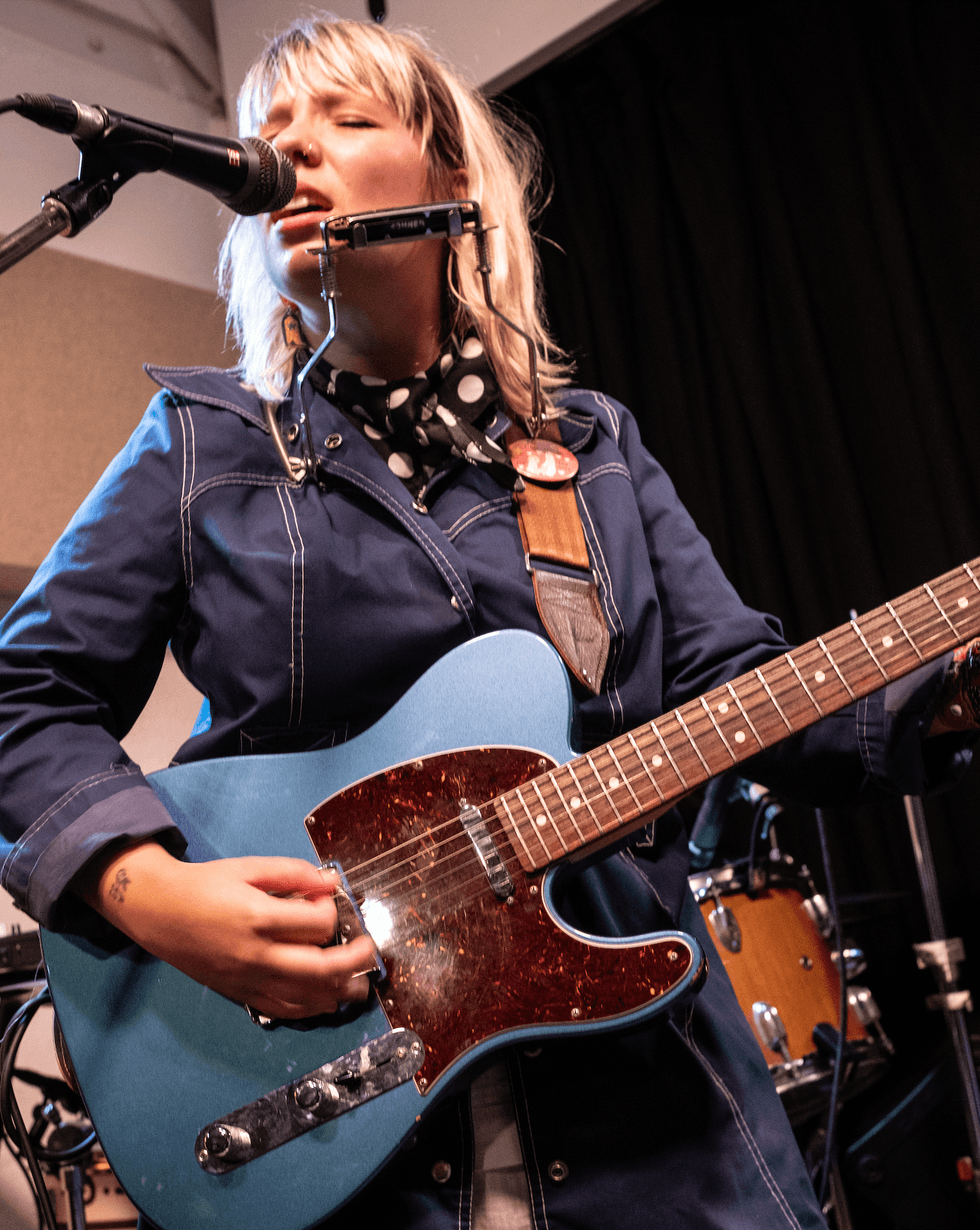
Seabird performs with her trusty Telecaster.
Photo by James Birtwhistle
Lily Seabird’s Gear
Guitar
Amps
1973 Fender Champ (studio)
1974 Fender Bassman (live)
Effects
DenTone Double Alien Hate Fuzz
Death By Audio Reverberation Machine
Ibanez Tube Screamer
EarthQuaker Devices Plumes
Rick Soszynski’s Gear
Guitars
Parts Telecaster with P-90-style bridge pickup
Parts Telecaster with Firebird pickups
Amps
Vintage Fender Champ
RadioShack Realistic MPS-20 Portable Amplifier
Homemade tweed-style amp
Effects
Strymon Deco
Spaceman Effects Saturn VI Harmonic Booster
EarthQuaker Devices Bit Commander
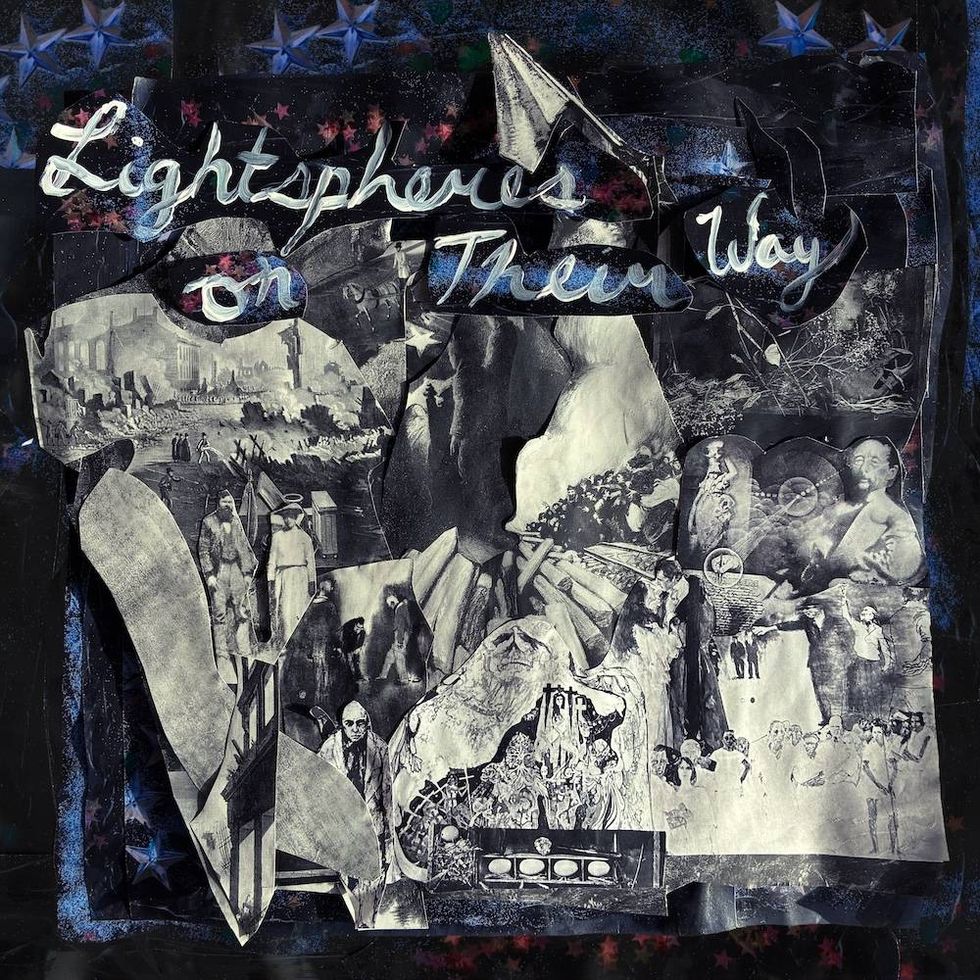
Seabird created the cover art for Lightspheres on Their Way, a bricolage that celebrates the record title’s spirit.
It’s little surprise to learn that the Grateful Dead have shaped Seabird’s approach to not just music, but life in general, and the existential spirit of one of the band’s later-era songs, “Black Muddy River,” hung over the writing of Lightspheres on Their Way. On the chorus, Jerry Garcia offers an interpretation of the afterlife: “I will walk alone by the black muddy river / And sing me a song of my own.”
Chaos and freedom were the two feelings that Seabird channeled while writing and performing her guitar parts for the record. For years, she dealt with the gnaw of impostor syndrome, and the anxiety that men in the guitar world would assume that she doesn’t know how to play the instrument well. Recently, those feelings have dissipated, replaced with the knowledge that, whether in word or sound, Seabird is communing with a guiding creative force. “I can communicate through the guitar in ways that I can’t exactly communicate through words,” she says.
Most of her parts were recorded with her Fender Telecaster and a 1973 Fender Champ that she picked up from Mike’s Music in Cincinnati while on tour; there wasn’t any room in their Toyota Highlander, so Seabird held the amp on her lap. Mike’s Music is also where Seabird found her DenTone Double Alien Hate Fuzz, a Vermont-made boutique pedal with germanium and silicon circuits that can be run independently or together for “armageddon.” With volume levels turned down, radio signals came through on the germanium side—a spiritual and literal embodiment of the record’s driving motifs. The record ends and begins with the same sequence of notes, played by Soszynski, fading into and out of the darkness.
“It sounds like you’re tuning into some distant sonic station from the past, far away,” Seabird says. “You’re turning the radio dial exactly at the right time to be able to get this little glimpse from us, that we made in the middle of nowhere in Maine.”








![Rig Rundown: The Black Crowes’ Rich Robinson [2026]](https://www.premierguitar.com/media-library/youtube.jpg?id=66952027&width=1245&height=700&quality=70&coordinates=0%2C0%2C0%2C0)