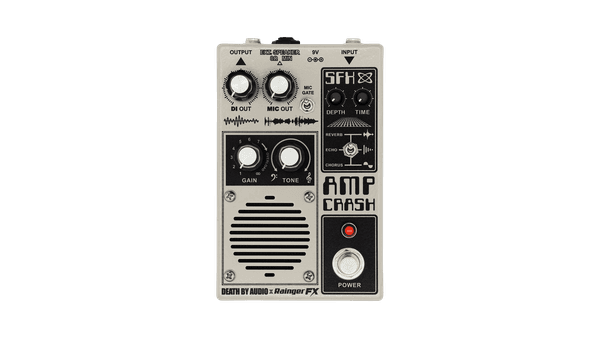

Some of you are lucky enough to avoid bouts with the guitar doldrums. Me? I get stuck in ruts more than I would like. Death By Audio’s wares have bailed me out these troughs more than once. And the company’s new Amp Crash, designed with fellow mad scientist David Rainger of Rainger FX, is yet another device, full of surprises, that can awaken jaded musical hearts.
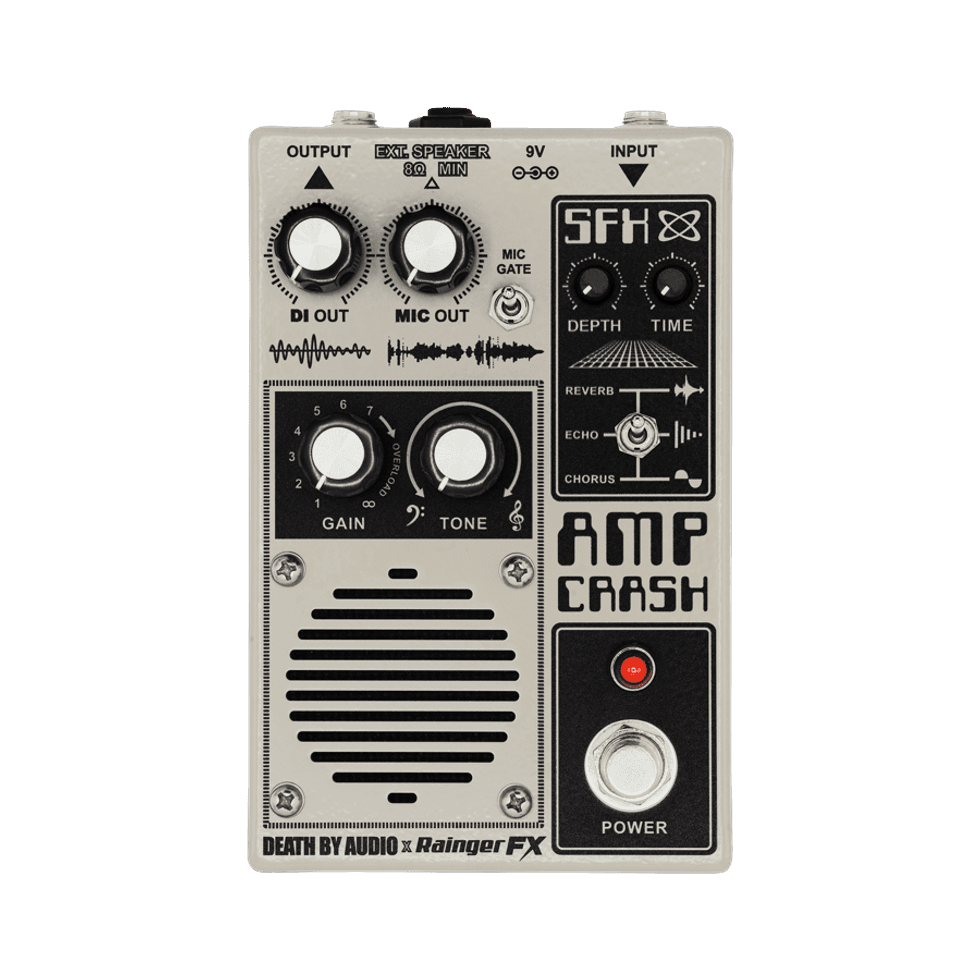
The Amp Crash is many things—none of which seem all that crazy on the surface. It can be an overdrive or a fuzz. It can be a reverb, delay, or chorus. As the grate on the pedal’s face suggests, it can be a little self-contained amplifier that will make your Pignose nervous. You can use it as an amp out in front of your DAW. And because it’s a real amplifier, it can drive an 8-ohm passive cabinet. So where’s the weird, you ask? Well, DBA and Rainger had the good (sick?) sense to wire a microphone into this circuit—one that picks up the sound from the tiny 2" speaker, as well as ambient room sound, and folds it back into the circuit, generating feedback, unexpected overtones, and sound warpage that can be mangled further with the onboard effects.
This opens up a lot of possibilities. At times playing the Amp Crash was like getting locked in Lee “Scratch” Perry’s lunchbox. Other times it was like wandering a house of horrors hosted by psych-punk thugs. But the Amp Crash is also very happy making sounds that fall within the range of conventional—most notably saturation that’s redolent of a vintage low-wattage amp set anywhere from warm to boil.
A Meeting of Melted Minds
DBA is not afraid of building less-than-petite effects. But given how much is stuffed in the roughly 5 ½" x 3 ½" x 2" enclosure, the Amp Crash’s dimensions don't seem like an indulgence. Like many DBA pedals, it looks like it was pinched from the Space: 1999 props department, and in this case the mutant retro-futurist styling is heightened by the speaker grate, which gives the Amp Crash the look of a vintage com-link unit.
The speaker works, of course, because the Amp Crash has a true power amp inside—two, actually. (This accounts for the relatively heavy 300-milliamp draw, and you’ll definitely need a dedicated power supply.) One drives the small speaker. The other, which drives an additional op-amp section along its own signal path, is routed via the output that you plug into a guitar amplifier or a DAW. (A second output is dedicated to driving an external 8-ohm cabinet if you want to go that route.) The pedal’s gain range spans surprisingly clean tones and filthy ones. But the drive it generates—particularly through a guitar amp—is uniquely flavored.
The output for the speaker is shaped by the gain and tone controls. The same controls configure the gain and tone profiles of the second opamp-assisted section, where they are complemented by the DI-out level and the mic-out level controls. The last of these governs how much of the onboard microphone signal is mixed with the DI-out.
Through the whole tone knob range (which is pretty extensive), the output is colored by a snorkely mid range—sometimes in hints, sometimes boldly. Living at the brightest or darkest end of the range doesn’t really eliminate this emphasis as much as it stacks something else on top of the midrange bump. I struggled to think of exact tone parallels. At various times I heard traces of DOD 250, a less screechy Tone Bender, a Way Huge Red Llama, a fixed wah pedal, and the fuzz section in a ’60s solid state Vox amplifier. More commonly, though, the midrangey-ness suggested one, or some combination, of those devices, driving a 8" speaker in a low-watt tube amp. At lower gain settings, these qualities lend the output an edgy growl. At its fuzziest settings, it is brutish and nasty but focused.
“At its fuzziest settings it is brutish and nasty but focused.”
Mutant Zones
All of these sounds can be reshaped, both subtly and radically, by adding feedback via the mic-out control, and zest from one of the three onboard effects. The mic-out control and effects (as well as the mic gate toggle) are very interactive. The feedback from the mic can generate and emphasize various overtones in the output—to subtle, pretty ends if you’re mellow with the mic-out level and effects, or with chaotic outcomes if you lay either one on too thick. That doesn’t mean you shouldn’t push it, though—in true DBA and Rainger FX fashion, some of the most rewarding tones live at these nearly out-of-control extremes.
While the Amp Crash is unorthodox, it is not just a studio tool. There’s no reason you can’t use the Amp Crash as a fuzz or drive in live situations without fear of unwanted surprises. The payoff in distinctive tones could be considerable. But unique sounds are just one possible studio attribute. It’s often the methods Amp Crash encourages that yield the most interesting studio dividends. The strange tone composites you hear in the combination of onboard speaker and guitar amp speaker, for instance, can be recast by varying a microphone’s position relative to the two sources—or by miking amp and pedal speaker in different spaces entirely and sending those signals to two desk inputs. Similarly, endless variations on this effect can be enabled by miking the internal speaker and sending the output to your DAW and whatever sound processing tools live downstream.
The Verdict
We talk a lot about sliding scales here in the “verdict” section. A pedal that is a font of inspiration for one player might confound another. And like many DBA products that commit to a genuinely different approach, the Amp Crash resides in that category. Those inclined to use its tasty drive and reverb/delay/modulation section exclusively will probably find the $395 price hard to justify. Those who delve into the fullness of the Amp Crash’s potential could end up considering that a bargain—particularly if the sounds on tap here become a foundational part of their sound palette.
But that is a very plausible scenario, because the Amp Crash is as rich with distortion suited for common musical settings as it is brimming with strange, esoteric tones. For players who can make use of sounds from both sides of its flavor spectrum—and you can count me among them—the Amp Crash might merit rounding up on all the performance scores listed here.