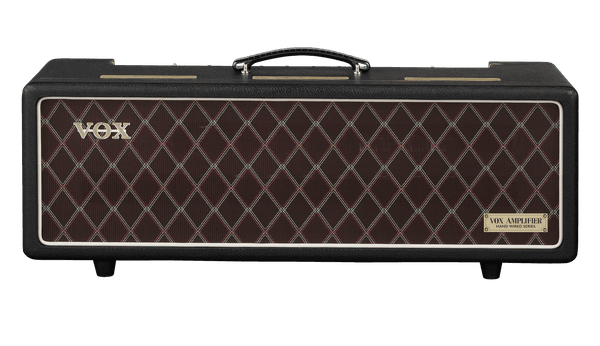
The legendary Vox AC30 is, without doubt, one of the most versatile amps from the golden age of tube tone. Whether used by the Beatles for British Invasion sounds, Brian May for heavy rock, Rory Gallagher for blues, Peter Buck for jangle, or Mike Campbell and Tom Petty for driving, American rock 'n' roll, it has remained a top source of lust-worthy guitar tone for more than 65 years, and a perennial standard onstage and in the studio.
The brand’s long-time owner, Korg, has now made the AC30 even more versatile—while retaining the essentials of the vintage-era design—in its new Hand-Wired model, which is available as a head (tested here) or the more familiar 2x12 combo. The AC30 Hand-Wired retains many key features of the classic, such as normal and top boost channels driving a quartet of EL84 output tubes ostensibly run in Class A mode (cathode-biased, with no negative feedback) and a GZ34 tube rectifier. But it also adds key utilities that enhance its flexibility, such as a master volume, tube-driven spring reverb, and a buffered effects loop.
Channel Crossing
The AC30 Hand-Wired has high and low inputs for each of its two channels. The first channel, normal, utilizes a lone volume control but adds a bright switch that the original lacked, and its tone can be further adjusted by the tone cut (often called hi cut) in the master section. The top boost channel features volume, treble, and bass controls, the latter two of which tap the active cathode-follower tone stage driven by a full 12AX7 preamp tube. Where the AC30 of the early to mid1960s had a tremolo effect, the new Hand-Wired offers up tube-driven spring reverb instead, which is arguably more in-demand today. (We’ll let you be the judge of that). This reverb is more tweakable than most, with controls for both tone and level.
"The AC30 Hand-Wired easily touches on classic cornerstones of Class-A British tone, while offering more versatility than many originals can muster."
As previously discussed, the amp’s master section has both tone cut and volume controls. The former reduces highs in the output stage to smooth out treble bite as desired. The latter is a nifty addition that traditional AC30s lacked, and one that many players will welcome, given how ferociously loud this amp can be. In addition to the now-requisite send and return, the effects loop has a -10dB/+4dB switch to match levels with different outboard effects, as well as a bypass switch. The dual speaker outs include a switch for 8-ohm and 16-ohm loads.
Given its impressive volume capabilities, it’s probably no surprise that the AC30 Hand-Wired is relatively big and heavy for a 30-watt head—just as AC30s have always been—weighing in at a little over 43 pounds. (The combo, with its pair of Vox/Celestion Blue speakers, clocks in at over 70 pounds). Physical dimensions are 27.76"x10.35"x11.89" (including the feet).
Hefty transformers and a large, well-packed chassis all contribute to the amp’s weight. But they also enable the stout performance AC30s are known for. Inside, the Vietnam-made/UK-designed circuit’s components are hand-soldered across a sturdy turret board displaying tidy construction. Getting your peepers in here requires the removal of ten screws from the back panel and sliding out the chassis. Replacing any tubes necessitates the removal of four more screws. It’s a labor-intensive adventure, as was often the case with Vox amps in the past, but it would have been nice to see this maintenance feature simplified. There’s also not a ton of air space or much ventilation for all those hot-running tubes, but again, such has often been the Vox way.
While the circuit generally honors the vintage original, it’s intended to pay tribute to it rather than faithfully replicate it, and a few values have been changed here and there—most notably, perhaps, in the shape of heavier filtering in the power stage. In addition to the power cable and reverb footswitch and its cable, the AC30 Hand-Wired Head comes with a proper speaker cable, an important accessory that many makers neglect.
Copper Blues
For this review, I hitched the AC30 Hand-Wired Head to a 2x12 cab with Greenbacks, a 1x12 with a Celestion Alnico Gold, and another 1x12 with an Eminence Platinum Series Neo. In each case, the AC30 Hand-Wired easily touched on classic cornerstones of class-A British tone, while offering more versatility than many originals can muster. While the top boost channel takes most of the bows, many players appreciate the warmth, richness, and headroom available in the normal channel. My Telecaster loved it. Thick and gutsy when pushed, this felt like the place for meaty Heartbreakers riffs and crunching alt-country, and proved very easy to get along with.
As plenty of guitarists have discovered with AC30s of old, the top boost channel takes careful dialing in to work with a Telecaster or other bright single-coil guitar. But when you get there, it rewards with extra chime and jangle, and high-end sparkle that no other amp quite matches. An ES-335 is a great match for the lively brightness and tactile responsiveness of this channel, too, and the humbuckers very easily pushed the output into the hot-lead zone. With the top boost channel’s volume up to noon and beyond (and the master volume reined in as desired) the overdrive tones might sound a tad fizzy—particularly if the AC30 is a new experience for you—but it’s a sound responsible for countless classic solos, and it cuts through a full band mix with ease.
The spring reverb, which is the new addition in the classic AC30 recipe, is lush and three-dimensional, and sits nicely even in heavy doses, without washing out the amp’s character and responsiveness. The effects loop also works well, and its dual-level switch makes tailoring it to a variety of rack and pedal units a relatively easy thing.
The Verdict
The new AC30 Hand-Wired Head does a great job of capturing several essential voices from the hallowed originals of the early to mid 1960s, while adding features that, these days, are considered essential rather than luxuries. It’s big and heavy for a 30-watt head, but AC30s always were, and the tones are absolutely timeless.
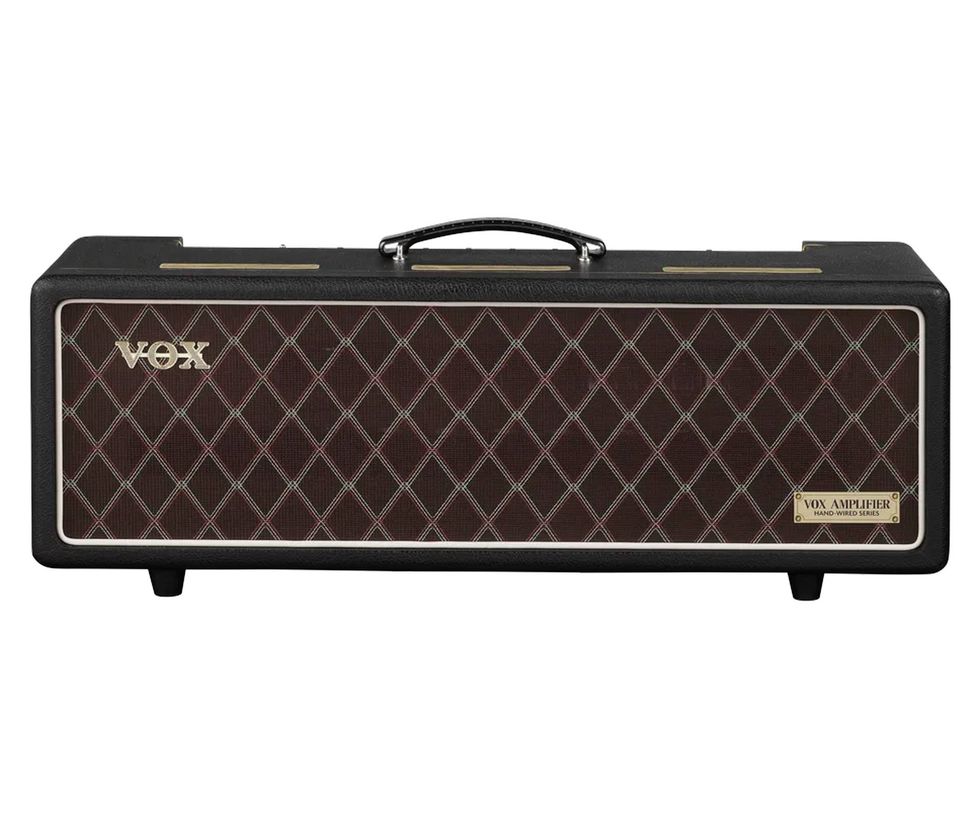
AC30 Hand-Wired 30-watt Tube Amplifier Head
Handwired using the highest-quality components, the Vox AC30 Hand-Wired Head’s brilliant British-style tube tone and traditional construction re-creates the magic of Vox’s vintage early-1960s heyday.