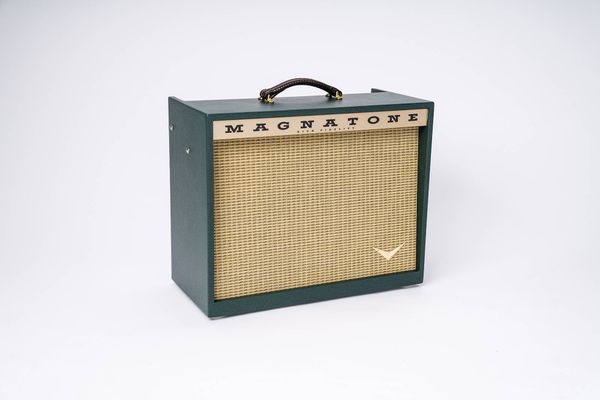

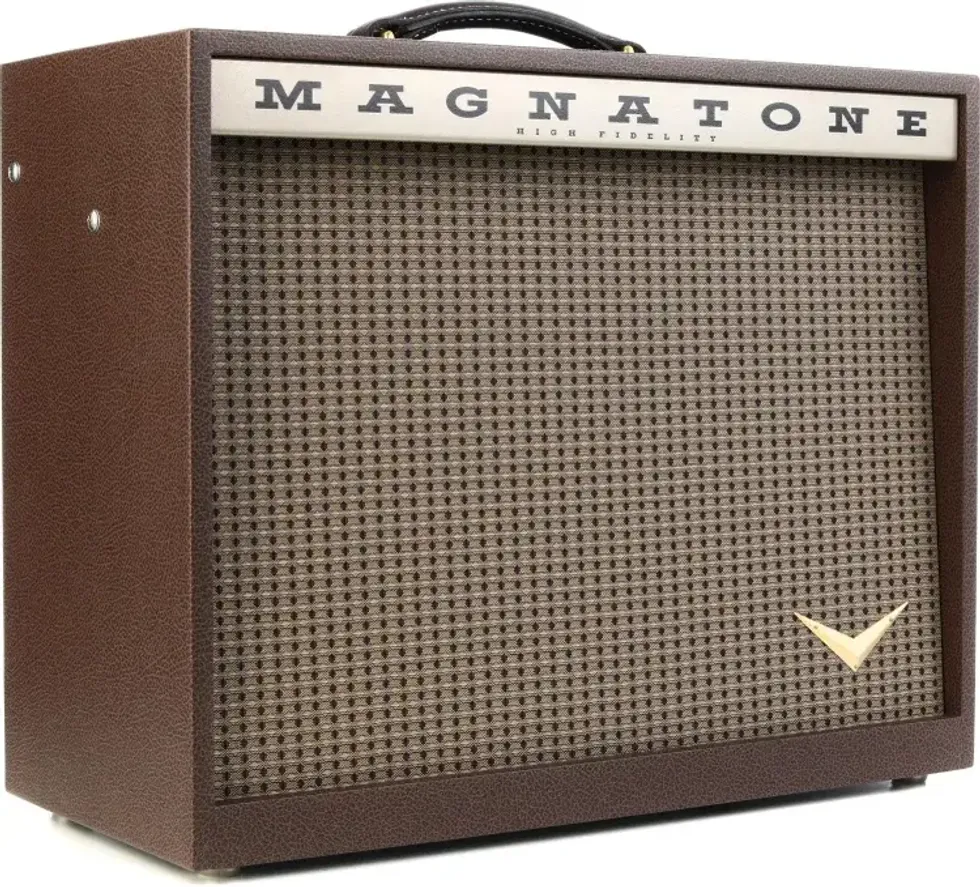
There may not be a single perfect amp in this world, but for me, a Princeton Reverb-style circuit with a 12" speaker comes pretty close. Low-mid power, a little extra bass from a bigger speaker, it’s a just-right recipe for so many situations. Magnatone’s U.S.-made, hand-wired Kingston is a beautiful take on this basic architecture.
Many Kingston specs—the two 6V6 power tubes and 12AX7s in the preamp section, for instance—will look familiar to Princeton fans. There are critical differences, too: Apart from the 12" speaker, the Magnatone has no tremolo, employs a solid-state rectifier, and uses an Accutronics/Belton Digi-Log digital reverb instead of a real spring unit. But the amp sounds fantastic. It’s loud—maybe even too loud for some at-home situations where neighbors are a concern. But unlike a lot of other amps in the 12- to 15-watt category, the Kingston stands a really good chance of hanging with a rowdy band—even after they’ve had five beers apiece and lost all sense of tasteful restraint.
Tight and Light
The Kingston is a beautiful thing to behold. Like most of the Magnatone line, it borrows from the company’s late-1950s cabinet designs, though where the 1950s amps were exclusively brown, you can have the Kingston in traditional brown, camel, a beautiful dark green, or sleek, minimalist black. Controls are straightforward, with knobs for volume, treble, and bass. Though the Kingston isn’t featherweight at 31 pounds, the combination of a relatively light plywood cabinet and compact dimensions make it feel very totable. A Fender ’65 Deluxe Reverb seemed like a sizable boat anchor by comparison. At the same time, the Kingston is super solid, and projects luxuriousness on the outside. On the inside, the circuit board is hand-wired on thick PCB that is well insulated from hot tubes by the substantial steel chassis. If there are any unusual obstacles to easy, ordinary service, they aren’t apparent. And the whole thing feels like it could run many hours and years without attention from a tech.
Magnanimously Monstrous
I don’t think it’s any coincidence that Larry Cragg, the man who helps make Neil Young’s tweed Deluxe sound like Vesuvius blowing its top, consulted on the design of this amp. It may feel light, but it sounds big. Very big. When you step on the gas, the Kingston does not behave like a small amp. The throaty and surprisingly massive drive tones are largely free of the fizz you hear in some amps in this power range. The overdriven output even possesses some of the deep and weighty characteristics of the 1968 Fender Bassman and 2x12 cab that sat next to the Magnatone during this test—a feat that is achieved and aided, no doubt, with the help of the Warehouse Guitar Speaker-designed ceramic 12". And while the Kingston can seem pretty scooped at higher gain settings, it responds to treble addition willingly, without getting sizzly.
Of course, many folks sizing up amps in this class have no intention of running them wide open. A couple 6V6s and a 12" speaker are also a nice way to balance headroom and natural drive if you need space for drive pedals and the nuances in time and modulation effects, and the Kingston excels in this environment. The natural compression that occurs through the first 60 percent of the volume range seems to thicken effects more than obscure or flatten them. Klon- and TS-style drives both sounded deep and complementary rather than flat and harsh—even at advanced pedal gain settings. Ditto for fuzzes like Tonebenders and Fuzz Faces. And effects like chorus and phase sounded especially enveloping.
Magnatone’s 12-watt, handwired combo with 12" speaker opens the field in a competitive class headed by the legendary Princeton Reverb.
All this high-headroom and capacity for high volume does have one minor downside: For a relatively small amp, the Kingston is challenged as a bedroom amp—a function that Magnatone hails as one of its virtues. I still had a great time running the Kingston at its lowest volumes—especially with a little pedal compression and modulation in the mix to enliven things. But it can sound thin on its own at low volume, and it’s hard to resist nudging the volume to recover the thickness in the output that is so addictive. So, bedroom amp? I guess it depends on your roommates, neighbors, and family members. But the Kingston can definitely struggle to get small in some rooms.
Space Status
Magnatone’s decision to use a digital reverb in the Kingston is probably a wise one in terms of keeping costs down. And on balance, I’m happy that they put more effort and expense into making the amp sound fundamentally superb rather than into onboard effects.
That said, spring reverb purists should know there are real, perceptible differences between the sound of the Kingston’s Accutronics/Belton Digi-Log and a real mechanical spring unit. I really like Belton-based digital reverbs in general, and often use a Belton Brick-driven Death By Audio Reverberation Machine with reverb-less amps for its reliably vintage-like sounds. But the Kingston’s reverb is definitely less splashy and spacious than a Fender amp’s spring unit. Next to the ’65 Deluxe Reverb, the Magnatone had to run at about 80 percent to come close to the dimensionality of the Fender’s real spring reverb at just short of 6 on the dial. The Kingston’s reverb also sounds more hall-like than a spring imitation. Did this difference bother me while I was immersed in the otherwise fat, beautiful tones coming from the Kingston? Maybe here and there when I thought about it, but not often. For the most part, the Kingston’s reverb just sounded like icing on a very big, rich, and buttery cake.
The Verdict
Magnatone’s Kingston adroitly and gracefully walks several fine lines: between big and small, between headroom and natural gain and compression, between lightweight and solid. It also inhabits an interesting rung on the price ladder. The Kingston costs $2,349. Fender’s handwired ’64 Custom Princeton Reverb with a 10" speaker is $3,149. A PCB-based ’65 Princeton Reverb is $1,579. So, while the Kingston is a sizable investment—and probably out of reach for some—it delivers very boutique sounds at a price that’s more accessible than many boutique competitors (as well as some big-name rivals) by several hundred, if not a thousand-plus, more dollars. Is the still-considerable price worth it? Given its superb balance, I’d venture that the Kingston is a pretty solid investment—particularly if sweet sounds are the ultimate measure of return.


![Rig Rundown: The Black Crowes’ Rich Robinson [2026]](https://www.premierguitar.com/media-library/youtube.jpg?id=66952027&width=1245&height=700&quality=70&coordinates=0%2C0%2C0%2C0)