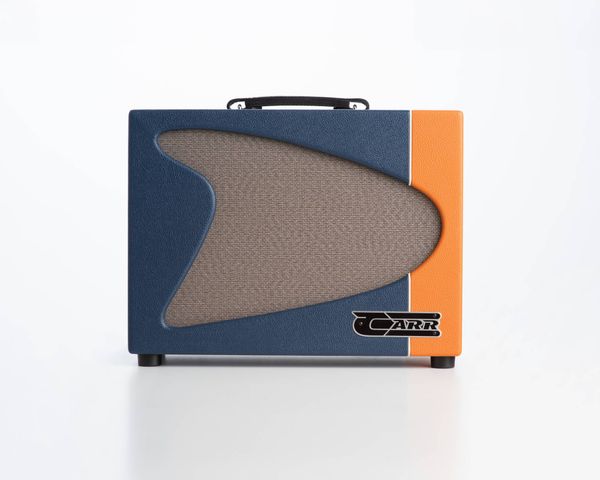

When one thinks about 5-watt amps, it’s often in terms of compromise—things like consideration for the neighbors downstairs, or the houseplant that would flourish in the space where your Hiwatt stack lives. On one hand, Carr’s 5-watt, 1xEL84-powered Trail Rider offers a viable path to such compromises. And with an excellent attenuator on board, it can sound alive and characterful at volumes no louder than your TV. But with the brakes off, the Trail Rider also has the potency to blast a whole city block. And with so many beautiful sounds and colors available at full power, restraint can be difficult.
Bermuda Triangle Address
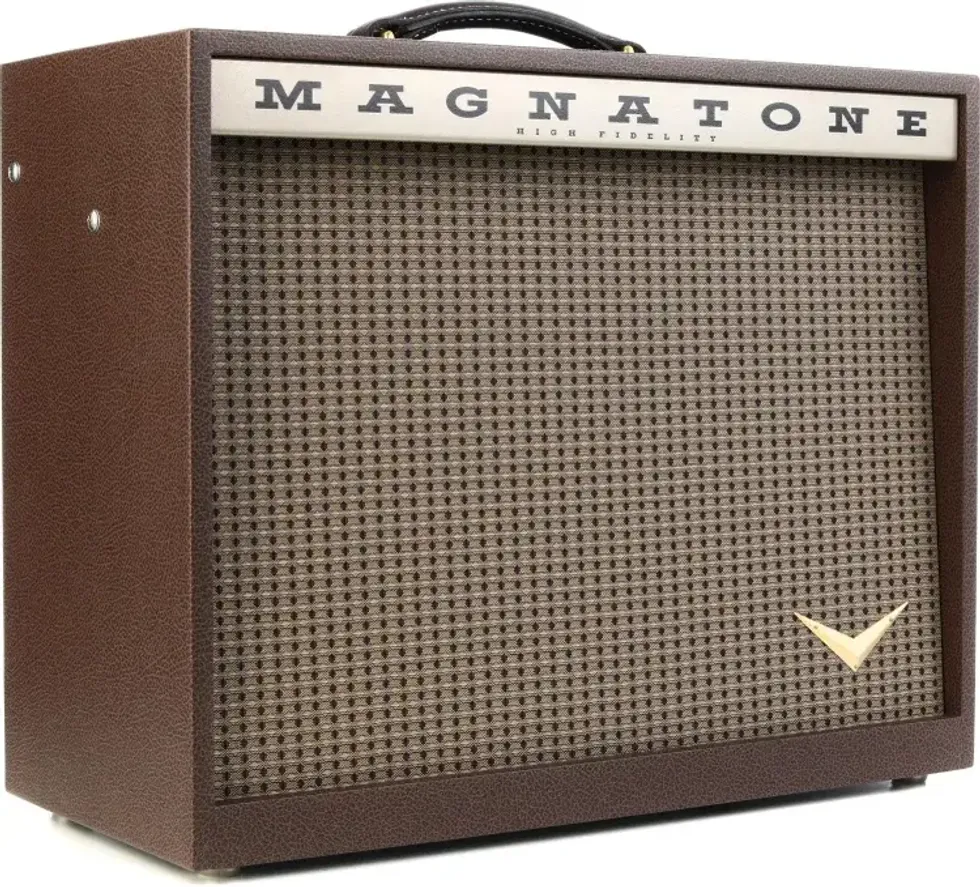
When you think of a 5-watt amp, you probably envision something about the size of a Fender Champ or Vox AC4. But the Trail Rider, at roughly 20" wide, 15" tall and 9" deep, is almost the same size as Carr’s much more powerful Bel-Ray. The dimensions might be less than ideal for some 5-watt amp shoppers looking to maximize space. Thankfully, it looks smashing. But the ace visuals, the expertly crafted plywood cabinet has a practical benefit—it accommodates a 12", 50-watt Celestion A-type speaker, which plays a major role in the Trail Rider’s overachieving performance.
The Trail Rider’s tube complement—two 12AX7s and a single EL84 (along with a 12DW7 for reverb drive and return)—suggests fundamentally English inspirations. And the spirit of the Vox AC4 definitely dwells within the Trail Rider. But like most Carr amps of more recent vintage, the Trail Rider’s vocabulary transcends oceans, borders, and boundaries. Two switchable voices make up the basic tone foundations here. The Voxier of the two is called V67, the other is T57. You probably won’t need three tries to guess that the “T” is for tweed.
Deluxes and Bassmans define tweed tone for most. But tweediness can be a lot of things. Fender’s amp designs in the mid- to late-’50s evolved quickly, and when designing the Trail Rider, Steve Carr homed in on the point at which the tweed amps went from a single tone control that governed the high end, to a 2-knob EQ that controlled bass and treble independently. That simple enhancement opened up a lot of tone shaping range in tweeds like the Pro, Super, and Bassman, and Carr uses that simple but magical formula to fantastic effect in the Trail Rider. Its EQ section is a powerful tool that lends the amp an expansive vocabulary.
Trails Less Taken
One shouldn't be afraid to experiment with radical, unconventional, even uncomfortable shifts in EQ settings on the Trail Rider. In fact, messing with convention is half the fun. Situating the treble and bass at noon reveals the essence of the two voices, but also the basic flexibility of the amp. At these EQ settings—and in either V67 or T57 voices—the first 25 percent of the amp’s volume range offers sweet, lively clean tones that shine on their own, but sound dynamite with drive and distortion pedals. With amp volume in the 30-to-50 percent range, the Trail Rider starts to growl on its own. These textures can be accented with pedals to very cool ends, and the Trail Rider, in spite of its low power, won’t flinch at the addition of fuzz. But it's the Trail Rider’s own beautiful organic breakup that really highlights the EQ’s transformative power.
Treble-down/bass-up settings, for example, worked with the 12" Celestion to coax thick, burbling, jazzy tones from a Telecaster. Meanwhile, cranking the treble generates lead and chord tones that’ll rip, white hot, through the thickest, most muddled mix, and conjures focused, overtone-rich, and very unique distortion textures. These extreme EQ settings are often revelatory and inspiring. They’re also all genuinely useful. Even at its trebliest settings the Trail Rider’s output is never abrasive, and the interactivity of the bass and treble lends a painterly measure of control that is fun, satisfying, and, in a stage or studio setting, immensely practical.
These rules also apply when you wind up the Trail Rider and let it rip. When you get into the upper reaches of the volume, the details and differences that separate the tweed and Vox voices become less discernible amid the natural compression. But at full-blast, playing the Trail Rider is like being drenched in honey. There’s no grating stridency, and the distortion has a smoothness, dimension, and sense of size that’s reminiscent of a black-panel Fender Bassman.
“At full-blast, playing the Trail Rider is like being drenched in honey.”
The Trail Rider feels immediate, too. It’s very dynamic, and sensitive to variations in guitar volume and tone input, which puts even more color at your disposal. You get a sense of incredible efficiency in this circuit—as if your signal is running a flawless baton race, picking up some thickness here, some gain and top end there, and never breaking pace. Tone suck in this circuit simply feels nonexistent.
The Verdict
Steve Carr’s designs are always a treat. And his knack for spinning something new and imaginative from familiar touchstones never fails to surprise. Tweed- and Vox-like flavors are here in abundance, and in many shades. Yet the Trail Rider never feels like an imitation, and it tends to be so sweetly immersive that everything outside the sound you make with it becomes incidental. It pairs beautifully with any guitar (though Telecasters and the ES-335-style designs were especially tasty matches). And the onboard spring reverb meshes seamlessly into the overall tone picture—often feeling like the only effect you’ll ever need.
If there is any compromise or let down involved with playing the Trail Rider, it’s that its attenuated voices, however sweet, can’t match the electric thrill of experiencing the amp at full power. Another sobering factor is the price: $2,900 for a 5-watt amp. But what you hear and feel from the Trail Rider makes the power rating a poor measure of its value. The heirloom-level build quality goes a long way toward justifying the cost.
Above all else, the Trail Rider’s expansiveness, versatility, and shape-shifting capacity to range from clean to crushing could make more than a few amps in your collection redundant and ripe for sale. Viewed through that lens, the Trail Rider’s price could well add up to math that makes sense.



![Rig Rundown: The Black Crowes’ Rich Robinson [2026]](https://www.premierguitar.com/media-library/youtube.jpg?id=66952027&width=1245&height=700&quality=70&coordinates=0%2C0%2C0%2C0)