
Positive Grid’s Spark 40 amp did a lot to make digital amps more accessible and approachable in the minds of value-minded players. In fact, the Spark 40 amp was the best-selling guitar amp of 2023 on Reverb, which says much about how effectively this formula resonates with consumers. Although Positive Grid amps like Spark 40 and its successor, the 50-watt Spark 2, are very capable of being employed in concert settings, many players primarily use them at home as practice amps, perhaps because of their small form factor.
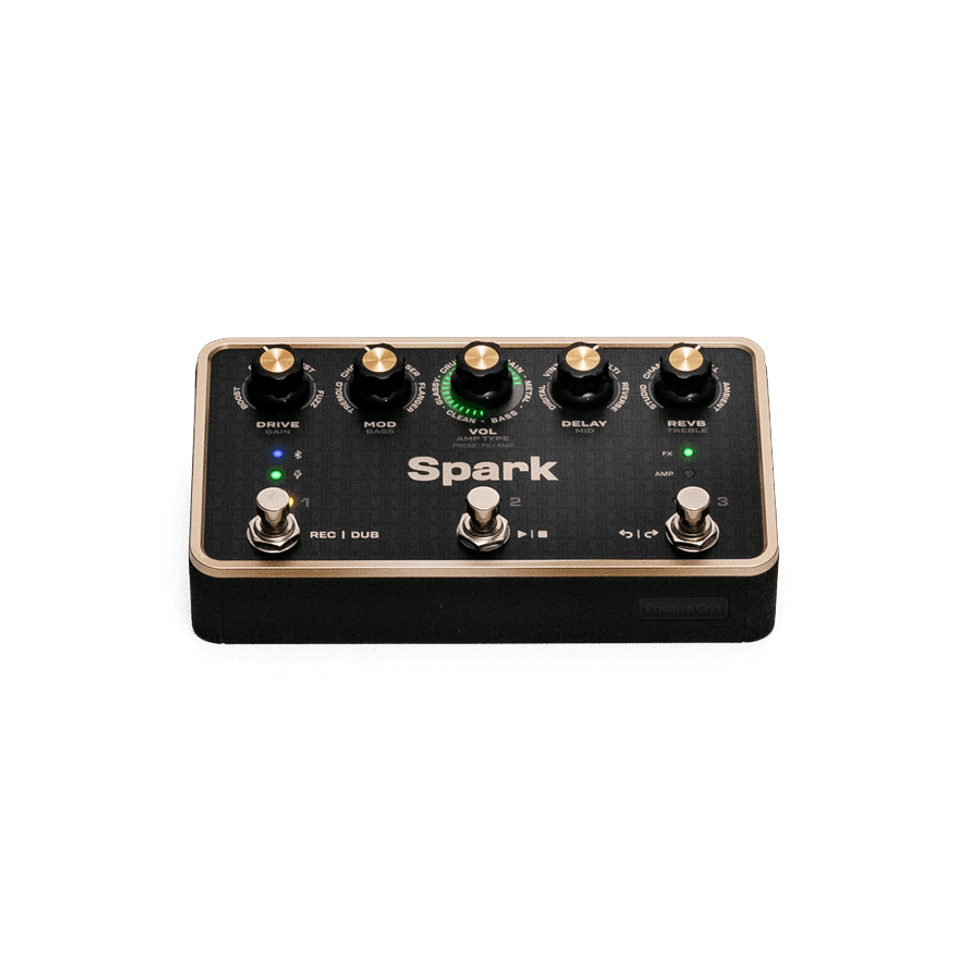
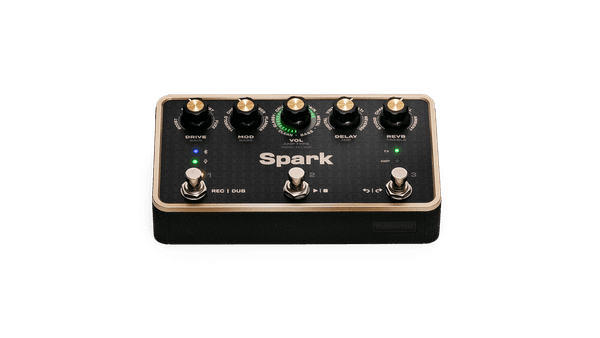
But the new Spark PEDAL takes Positive Grid’s technology and shrinks it into a package optimized for the stage. It’s essentially a complete rig, with 33 amps, 43 effects, and a looper. It can also be used as a recording interface. Better still, it weighs just under 1.25 pounds. You can store six presets across two banks. And you can plug it straight into an amp, PA, powered speakers, or DAW. It even has a built-in rechargeable lithium-ion battery that can last up to seven hours. And for deep divers, there are more than 100,000 downloadable tones available via the Spark app’s ToneCloud. Pretty impressive for a piece of kit that takes up the same amount of room as a few pedals.
Quick Tones on the Go
It’s pretty easy to get around the Spark PEDAL at the purely physical level. The interface has five knobs, and each has secondary functions that switch depending on whether you use amp or FX mode. Amp mode defines your core sound via six basic amp types: clean, glassy, crunch, hi-gain, metal, and bass, and within these amp types, four knobs control gain, bass, mid, and treble. In FX mode the five knobs control drive, modulation, output volume, delay, and reverb, and each knob also activates a sub-menu with more specific options for each effect category—for example, digital, vintage, multi-head, or reverse delay types.
Although there is no onboard display, a color-coded LED that encircles the output volume knob lets you know the level of the effect you adjust. The control panel also has a built-in tuner, which is accessed by holding down the center volume knob. Because the knobs have multiple functions—and some functions, like engaging the looper or preset mode, or switching preset banks, require pushing two footswitches—it helps to keep the manual nearby as you get to know the unit. But once you figure out the lay of the land, navigating the pedal’s intricacies tends to be second nature.
That said, if you only use the Spark PEDAL’s onboard interface to control things, you miss out on the much greater possibilities afforded by the Spark app. Even those new to using an app with an amp or effect are likely to be struck by the ease with which you can pull up and manipulate the seemingly endless array of rigs, as well as the ability to transition between presets without latency.
Sparks of Inspiration
With an Ernie Ball Music Man in hand, I listened to the Spark PEDAL through headphones first—just to hear it in an uncolored state. I know the Spark app pretty well, but I wanted to see if I could use the pedal’s knobs exclusively to create my tones. I selected the glassy amp, added a touch of vintage delay and hall reverb and saved it to preset 1 as a base tone. I then chose the clean amp with a modest amount of multi-head delay and studio reverb for preset 2. Both sounds were fantastic and did the trick for a basic lead and rhythm setup that I could switch between.
When using just the pedal, parameters like delay time and feedback are fixed at settings that work across many musical applications. Though I liked what I heard, these fixed settings could frustrate users that want to work with the hardware side of the Spark PEDAL exclusively. Like I said, fine-tuning these parameters using the Spark app is pretty easy. But you still need the app to pull it off, and for some users this will be a step too far outside the realm of physical interface with the unit itself.
The Spark PEDAL also works great with amps. I hooked up a vintage silver panel Fender Musicmaster Bass amp and was pleasantly surprised. Using the app, I pulled up the “Silver Ship” preset, which is a clean sound based on a Roland JC-120, with compression, chorus, and reverb. I bypassed the amp model to use the effects exclusively and added a vintage delay. The sound was lush, warm, and very JC-120-like—perfect for jangle pop, dyad 10ths riffs, and even metal power-ballad, open-string, broken-chord figures.
One thing led to another, and I found myself dabbling with the “Crazy Train” preset—this time with its Mesa/Boogie Rectifier-inspired amp model activated. After a few slight tweaks to better match the Musicmaster amp, I got a bone-crunching sound with massive bottom end and great definition in my palm-muted low-string chugs. The little vintage Fender sounded like a modern metal machine! The preset’s noise gate worked remarkably well, but even with my guitar volume up at 10, there was little noise to contend with.
“Once you figure out the lay of the land, navigating the pedal’s intricacies becomes second nature.”
Simple Grooves
There are many overlapping features between the Spark PEDAL and its Spark Amp siblings. But one major advantage the Pedal has—apart from its small size—is having three footswitches to control the functions for the pedal’s 60-second looper.
For me, though, the groove looper option, which lets you select the parameters of the loop—number of measures, tempo, and drumbeats—and starts the loop after a count-off is more than enough for my basic needs. It’s a really foolproof way to get rhythmically clean loops.
The Verdict
I’m a big fan of Positive Grid’s Spark amps, and also own one. So naturally, I wondered if I needed the pedal. On the surface, the Spark PEDAL seems to simply be a Spark amp without a speaker. But while they share many features, the Spark Pedal fills a different need. I recalled a time I had to play a jam straight into the house amp dry. It was not fun at all. But the simple, compact, and self-contained Spark Pedal would have saved the day. It puts much of the best Positive Grid technology into a performance-ready, ultra-portable rig that you can transport in a gig bag compartment, use at Madison Square Garden, and ride home with on the subway. That’s about as convenient as it gets.