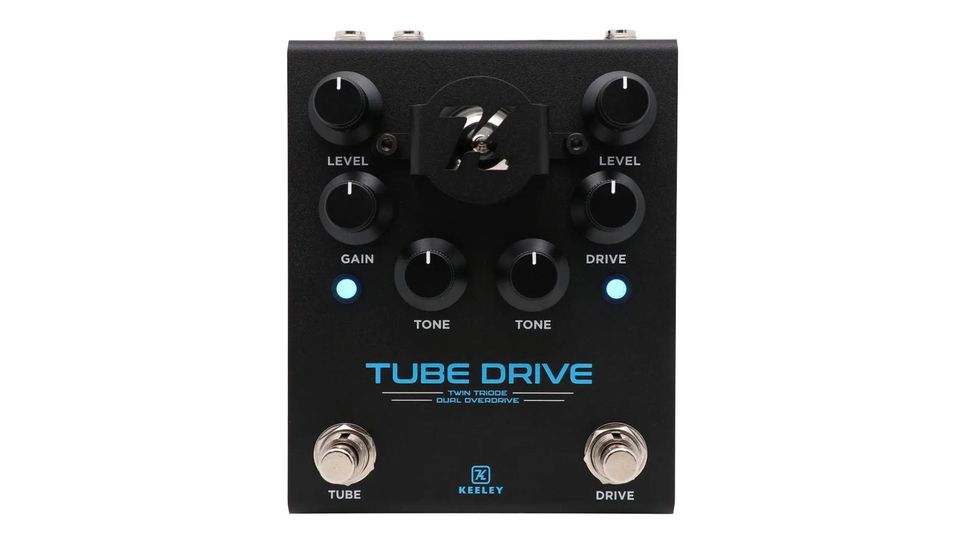
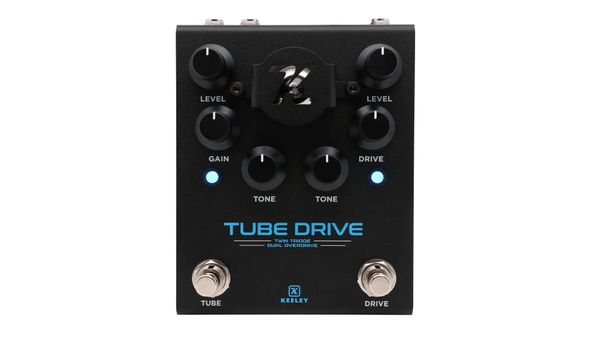

When I see an overdrive powered by a real tube, I’m predisposed to think about all those things that you associate with glowing tubes and overdrive—low-to-medium gain, warm, toasty, maybe even mellow tones. Keeley’s Tube Drive (which was originally issued in a limited edition of 100 fitted with 76-year-old Sylvania 12AT7s) dishes drive tones that are all those things, and sounds beautiful doing it. But the Tube Drive is made up of two sections. One is powered by a 12AX7 (alas, no ultra-rare antique tubes in this version.) The other is Keeley’s Phat Mod, a riff on the JFET Boss BD-2 Blues Driver, another circuit regarded as warm and responsive. Together, though, the two drive circuits expand each other’s range exponentially—right up to wicked saturated sounds that make a low-wattage combo more akin to a big British stack.
Glow Bug
So, two drives, six knobs. Seems simple, just like a dual drive should be, right? Well, not so fast. On the tube side, the controls include a 5E3 tweed Fender Deluxe-style tone stack after the tube. In a real tweed Deluxe the tone stack, and its effect on the amplifier's output, can be difficult to grasp in practice. A technical outline of its function, meanwhile, would take up a significant part of this review. In practical terms, though, the use of a 5E3 tone stack in the Tube Drive means that the tube side tone control shifts the pedal’s gain profile more profoundly than the tone control on your Tube Screamer might. The Tube Drive’s version of this setup does not make the pedal a tweed Deluxe. And thankfully, it’s much simpler to dial in. But it does lend the tube side a more complex range of voices, as well as a dynamic range that a lot of overdrives cannot touch.
The tube side’s drive tones are, predictably, a lovely combination of smooth and gritty. If you’re disinclined to use your guitar’s tone and volume controls, you can dial up low-to-mid-gain drive tones that sparkle with a Telecaster and a Deluxe Reverb—even at fairly advanced gain settings. But the real beauty of the tube side is how it sounds, feels, and functions when you set the level, gain, and tone controls in the latter third of their range, and use guitar volume and tone to shape the output. The clean tones you can access via this technique are beautiful stuff. They are alive, meaty, and sparklingly clear. But when you open up your guitar volume and tone, the output turns savage and nasty, dispensing distortion that’s thick, rich, and loud—and, more critically, tends to sound like an extension of your amplifier’s natural voice. At these settings, very small, incremental adjustments to guitar volume and tone can reshape this distortion in myriad ways between full-bore and clean.
Beyond Blues Driven
Adding additional gain from the drive side at aggressive tube side settings can be deadly—erasing any pretense of the Tube Drive being a polite OD, and transforming the pedal into a rabid distortion machine. By itself, it can be pretty mean. And compared to the tube side, the drive side feels hotter, grittier, and more abrasive in a way that, at times, makes its BD-2 Blues Driver origins seem many miles distant. But this contrast makes the Tube Drive exceptionally versatile.
The Verdict
On the surface, spending almost 400 bones on what’s ostensibly a two-channel overdrive does not sound like a very appealing proposition. But the Tube Drive’s genuine tubiness makes the pedal more than the sum of its parts. Its nastiest stuff can be intense. But set up right, these aggressive tones can be an amazing baseline to work backward from—happily ranging to sparkling clean, if you’re crafty about your guitar settings.

Tube Drive
Dual Overdrive Guitar Pedal, with Per-channel Level, Tone, and Gain Controls, FX Order Switching, 12AX7 Vacuum Tube, TRS Remote Jack, and True/Buffered Bypass - Black