
Preamp pedals can be a lot of things. They tend to get lumped in with overdrives and boosts, and, in a sense, that’s fair. Preamps, ODs, and boosts are all plugged in before an amplifier’s power section, after all—usually employed to add body, grit, or a measure of distortion.
So, what’s the difference? Well, in the absence of a definitive answer about clipping and EQ circuitry differences—and certainly these can be factors—it can be just as helpful to imagine the preamp/overdrive divide in terms of personalities. An overdrive can be charming but brusque—all full of easy answers to life’s problems and, sometimes, a bit of loudmouth. A good preamp, meanwhile, can be the life of the party—an extrovert even! But it can also be an empathetic, responsive listener and conversationalist.
OK, maybe that isn’t the most watertight metaphor, but Seward Park Electric's Maravilla preamp is one pedal that makes it look particularly apt. Compared to many overdrives, the Maravilla has a huge tone vocabulary—one that spans civilized, sparkling, and venomous. It tends to feel exceptionally well integrated with your amp and guitar. And at the right settings, the Maravilla adds color and energy to a signal without hoovering up the oxygen that makes a guitar feel alive in your hands. Whatever you call it, it has more to offer as a tactile link to your guitar and as a tone scalpel than most overdrives I know.
Maximized Multifactedness
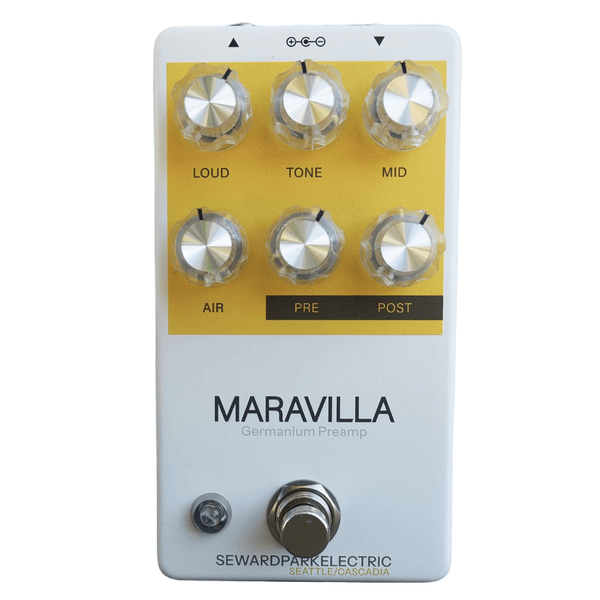
The essence of what makes the Maravilla tick is not terribly complex. Gain is generated via germanium transistors, which are less common in overdrives but make the pedal more dynamically responsive and lend the drive a smoother, less aggro voice. But it’s how the Maravilla builds upon this simple architecture that makes a difference. There is no single drive control on the Maravilla. But a pre-gain control enables you to smash the germanium transistors with input gain, while the post-gain control enables you to take the output from the germanium transistor section and pound the transformer for even more saturation. Transformers are not unheard of in effects pedals, but they aren’t commonplace either. Functionally they can take the place of buffers. But here, as in other excellent preamp-inspired pedals like Hudson’s Broadcast, the Maravilla also uses a transformer to lend extra richness to the distortion.
This simple, if slightly unorthodox, gain chain conjures many complex drive shades by itself. But the Maravilla’s powerful, fluid EQ section also transforms the distortion. The pedal even offers a post-gain presence control, called “air” here, that changes the gain and compression characteristics, along with how the pedal responds to touch and picking dynamics.
“Just as with single coils, the germanium bits of the Maravilla’s beating heart are responsive to touch, tone, and volume dynamics in ways that expand the PAF vocabulary.”
The Punch Spectrum
Uncovering Maravilla’s treasures can feel like fumbling in the dark at first—such are the interactive sensitivities of the six controls. Having all six knobs at noon positions is not a bad place to begin, and you can usually find a baseline not too far from your guitar and amp’s natural voice in these regions. But it pays to be bold as you venture forth from there. And getting a feel for how the post- and pre-gain controls shift the feel of your rig is an ideal launch pad for these experiments.
Slightly advanced pre-gain levels tend to generate sounds and attack most like a conventional overdrive. And depending on where I set the pedal’s EQ, I find sounds similar to those from the Klon and Tube Screamer clones I use as overdrive reference. High post-gain settings in isolation introduce a lean, clean, muscular edge to an amplifier’s input. Any setting that favors heavy pre- or post-gain levels can yield creative results. But it’s when the two are used together in generous servings that the Maravilla comes alive.
As organic amp-style drive goes, the sound and feel of both gain controls at 3 o’clock is hard to top. With a Telecaster and a Vibrolux on either side of the Maravilla, I heard a meaty, rambunctious version of this combination that suffers little from compression or unflattering midrange spikes. You can dial in plenty of compression and odd EQ peaks with the air and EQ controls if you want. But in terms of creating burly, blossoming, naturalistic variations on your natural guitar/amp voice, the two gain controls working together with smooth EQ combos yields the goods. Maximum pre- and post-gain settings sound fantastic too and made the Telecaster and Vibrolux sound positively Marshall-like. But any of these combinations of high pre- and post-gain distortion can be tamed and made near-clean with guitar volume attenuation, and I tended to keep them at higher levels for that reason.
Humbuckers, predictably, have a different relationship with Maravilla. I found the sweetest drive sounds by favoring the pre-gain, using a less dynamic air setting and more conservative tone levels. But just as with single-coils, the germanium bits of the Maravilla’s beating heart are responsive to touch, tone, and volume dynamics in ways that expand the PAF vocabulary. The Maravilla dazzles with Vox- and Marshall-style amps too. It can make an EL84-based rig sound sizzly. But dialing back the pedal’s rangy treble control and adding a scoop of preamp gain can give the combination a buzzy ’60s-practice-amp-set-to-blast essence that, with a little guitar volume and tone attenuation, recalls the crunchy/fuzzy tones David Hidalgo and Tchad Blake cooked up for Latin Playboys’ records. If you’re strictly into the maximum rock ‘n’ roll potentialities of a British amp and the Maravilla, though, fear not. It’s just as easy to dial up monster sounds as it is to find off-kilter ones.
The Verdict
Using the Maravailla in performance can be tricky business if you don’t do your homework. And paradoxically, this means its wonderful versatility may be its only drawback. But this is a drawback in very relative terms. The homework Maravilla demands of you is 101-level stuff. Yes, small adjustments to any of the Maravilla’s controls can profoundly affect the whole, and you might create something ghastly before you happen upon the magic recipe that matches your aims. But the Maravilla is forgiving, and you get used to the sweeps and range in its controls fast. It’s fantastic for awakening lifeless, one-dimensional signals that are missing energy or a certain EQ emphasis. It can add aggression through unique shades of saturation that can span smooth and fuzzy. And as you get to know its core strengths, you may find that some of the strangest sounds it produces might just become the most essential. Indeed, if the most obvious tone sweeteners here don’t convince you of Maravilla’s ability to outperform your average overdrive, the unexpected surprises most certainly will.