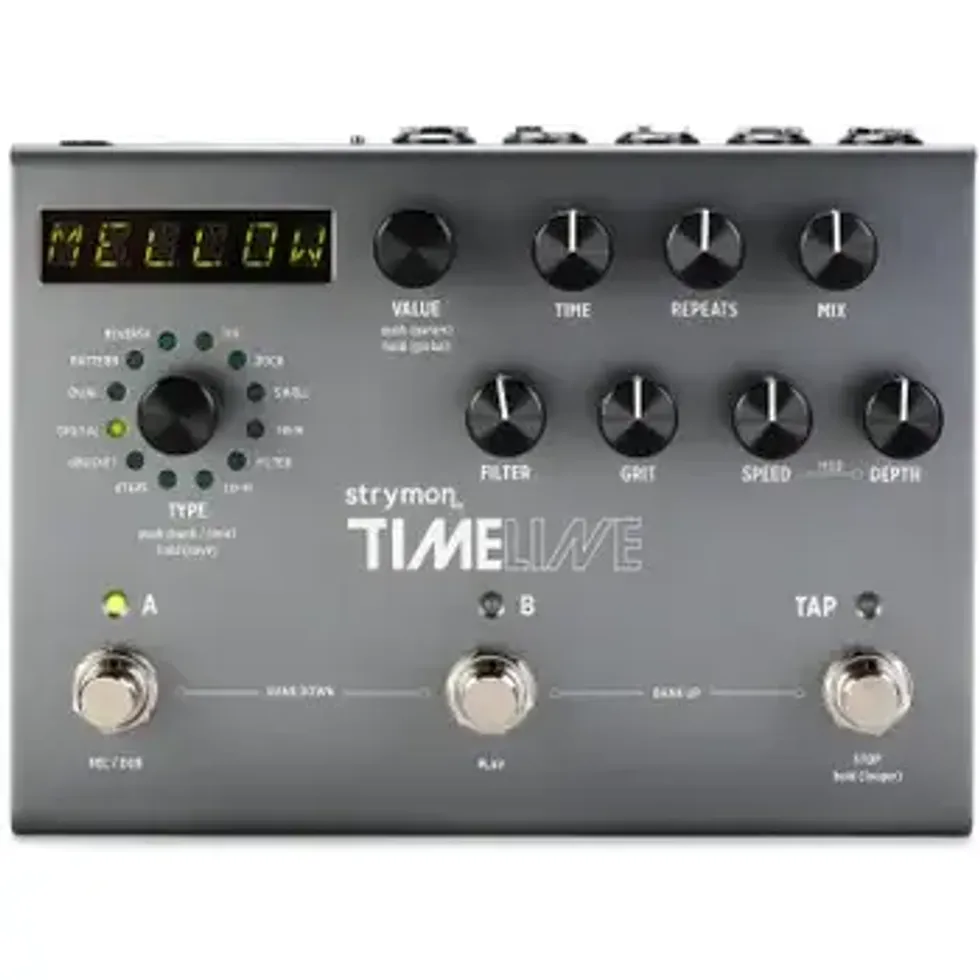
The original Strymon TimeLine always possessed the power and potential to transcend a mere guitar effect. Not long after its release, I got to know a sound guy who used one at every show. I’ve also seen them in synth-filled studios where a lone guitar sat tucked away, almost as an afterthought. To me that says a lot about what the TimeLine achieved in terms of user friendliness, power, and flexibility. Did its ability to work across disciplines make it less potent as a guitar effect? No way. The TimeLine was and is a blast to use for both straightforward guitar delay applications and late-night, down-the-rabbit-hole creative meanderings that birth whole musical pieces.
The new TimeLine MX is more of the same—a lot more. So much more, in fact, that I’ve heard grumblings about its $679 street price. If you’re a guitarist happy and fulfilled by making do with a Carbon Copy, and you’re skeptical about what the TimeLine MX can offer you, I get it. Even some delay power users may be hard-pressed to justify the expense. But after a few weeks of tinkering with the MX, it’s easy to imagine how guitarists who divide their time between home studio and performance—and for whom atmosphere and the ability to use echo as a compositional prompt is critical—will get back every penny of their $679 investment, and then some. This isn’t a perspective I arrived at because I imagined myself forever probing the MX’s deepest capabilities. It’s simply because the TimeLine MX proved fun, engaging, inspiring, and full of surprises, day after day.
Exponential Explosion
To try to describe every MX feature in the space of this review would be folly. (If you think I’m kidding, check out Strymon co-founder and designer Pete Celi’s deep dive video for the unit. It’s as long as a feature film.) But there are a few new core developments that are truly big news. The most important fundamental enhancement is the twin delay architecture, which enables you to use two delays in series, parallel, or in a stereo setup that sends different delays to different destinations.
Then there are the new algorithms, which include a wobbly vintage oil can-style delay, a slice-dice-and-reconstitute spectral delay, a Binson-inspired drum-style echo, and a rhythmically-driven multitap voice. There’s also a reverb mode you can add to the mix, if the new delays weren’t enough. These new algorithms join the lo-fi, digital, dBucket, and filter delay modes (to name just a few) that were stars on the original TimeLine. I’m sure there is a formula that can calculate the tone possibilities afforded by single, dual, stereo, series, and parallel iterations and combinations of the 12 algorithms. But frankly, the enormous sum of potential outcomes is something you feel more than you calculate. Scrolling through this many voices is often just flat-out thrilling, intoxicating stuff that makes afternoons and late nights disappear.
“Scrolling through this many voices is often just flat-out thrilling, intoxicating stuff that makes afternoons and late nights disappear.”
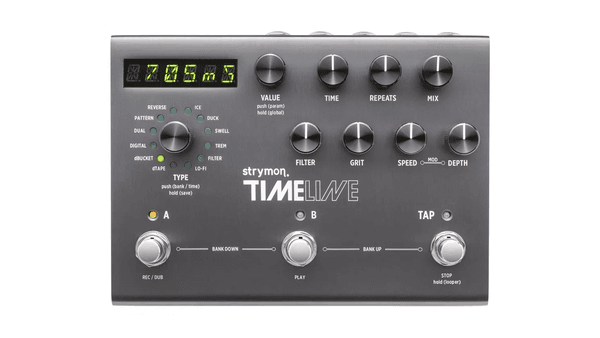
The “feel” factor is something that works in another design dimension, and that’s the unit’s layout, flow, and functionality. For a delay capable of a virtually incalculable number of sounds, the MX is still fairly compact—a design factor that was certainly part of its appeal to the synth artists and sound people I mentioned earlier, and, needless to say, a big deal for the pedalboard set. A more important facet of the MX’s ergonomics, however, is the sense of workflow. The new screen is super clear and organizes essential information well. The seven basic controls are arranged linearly in a single row, which makes them easy to scan and facilitates the development of muscle memory. The secondary functions are easily controllable via the assignable speed and depth knobs. The value and type knobs on either side of the screen—which work as both rotary and push-button controls—interface seamlessly with the readout. The bank-up, bank-down, tap-tempo and looper controls are also dead simple. Altogether, it’s a great study in flow and how to make a complex digital pedal accessible.
Surrounded By Sound, Drowned in Sensation
Highlighting just a few of the many remarkable sounds here could take up many pages. Here are some favorites anyway: The lo-fi is much more than a dollop of EQ blunting slathered over your original signal. There are options to change sample rate and bit depth that render the output a glitchy, grotesque mess, which, when mixed low and added in series or parallel to a lush and hazy drum delay, evoke fractured deep space communications embedded in the background of a gauzy, blissful dream. The spectral delay can be tuned to foreground sugary high-octave reflections in an array of crystalline, stained-glass echoes. But that formula can be flipped on its head, turning clear glass into mystery fragments of murky, patina’d sonic terra cotta. And while the drum echo doesn’t precisely replicate the sound signature of that lunatic device’s electromechanical quirks, the ability to edit the characteristics of each “record head’s” performance (via a very clever graphical representation on the view screen) means you can craft very hazy, syncopated repeats that are a perfect match for fuzzy and scuzzy overdrive.
The Verdict
Echo might be the only truly indispensable effect in my sound world, and I find the idea of spending lots of good money on great delay sounds totally relatable. So, when I consider the $679 Strymon asks for this high-quality, thoughtfully designed echo engine room, I wince ever so briefly before smiling at the possibilities. And these possibilities are copious, indeed—certainly for the side of my creative self that loves meandering through ambient music spaces, or spending hours soundtracking the abstract films cluttering my head and hard drives.
Musicians that work these fields with more focus and discipline than I possess have even more reason to be excited about what the TimeLine MX can deliver so intuitively. So will the many rock, pop, dance, and hip-hop musicians and producers that borrow from the ambient playbook. Less patient users, and I certainly count myself among this sect, can run into some hiccups: No delay this deep and capable can be navigated by intuition alone. But the essentials can be learned via the included five-page startup guide, and you have to be pretty lazy to get lost in the weeds here.
Back to that price: It’s probably one that needs to be considered on a sliding scale. For a lot of artists, the Timeline MX could be the backbone of a desktop studio or pedalboard. For players that view the TimeLine MX through that lens, the price is a fair one or better—especially when you consider its excellent workflow.