
For all of digital modeling’s advances, there are thrills that it struggles to replicate, and one of the most ecstatic of these is the sensation of standing next to a rotary speaker, cranked to the gills as it roars and spins and threatens to transmogrify into a living, heaving beast. It’s a sensation that’s rarer than ever with Hammond B-3 bars and big touring budgets going the way of the dodo. If you’ve never had the pleasure, I recommend finding a way to get close to one.
So, no, digital can’t capture the multisensory experience of moving air and whirring cables that one experiences sitting next to a shaking Leslie any more than it can imitate the feel of sitting next to an idling Ferrari. But what it can do is emulate how that rotary speaker will sound to a microphone, which for most purposes does just fine. And you’d have to search far and wide to find a designer that works harder at capturing the nuances of rotary speakers than Croatia’s Dawner Prince.
There’s a good reason—apart from copious engineering chops—that Dawner Prince excels at recreating rotary sounds: company founder Zoran Kraljevic is a certifiable Pink Floyd freak. With Gilmour plainly on his brain, he’s produced a first-rate Echorec-style pedal in the form of the Boonar and the Pulse, an homage to the obscure Doppola rotary speaker (which was modeled on the Maestro Rover). Like the Doppola-derived Pulse, the new Eclipsa takes inspiration from a rotary system that might have been relegated to total obscurity were it not for the patronage of Mr. Gilmour—the Yamaha RA-200.
Just as the Doppola and Maestro Rover’s designs differed significantly from the rotating drum and horn concept behind the Leslie, the Yamaha took a novel approach to generating rotary sounds—using three speakers of identical size oriented to create a phasing effect as they spun. The sonic product—a focused, midrange-heavy whoosh—starting dotting, and at times dominating, Gilmour’s live sound in between the Animals and The Wall tours. But you need not be a Pink Floyd obsessive to appreciate the Eclipsa’s super-rich, enveloping version of the RA-200 sound. Like a touch of butter and salt, it’s good on just about everything.
[It] feels simultaneously physical and phantasmal—like there’s the ghost of a real-deal RA-200 in the room.
Motion Potion
It’s hard to avoid closing your eyes when you play the Eclipsa. For one thing, its modulations have a near-narcotic effect. But there is something very authentic in the energy of those modulations—and the picture that energy paints—that feels simultaneously physical and phantasmal, like there’s the ghost of a real-deal RA-200 in the room. It’s a strange and very satisfying sensation.
At most settings, the Eclipsa creates decidedly richer sounds than those produced by an analog vibrato pedal or a Uni-Vibe (though it does a superb job of emulating the latter on a fat dose of vitamins). Before I plugged in, I guessed that the midrange emphasis might have a bossy flattening effect in some situations. I was very wrong. As it turns out, the midrange lends a compelling tautness to the modulations—not enough to diminish the bubble-gum elasticity in them, but enough to add a perceptibly springy quality.
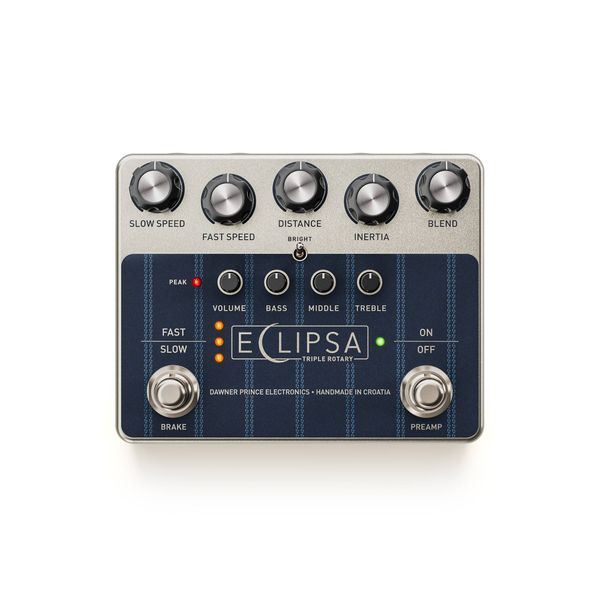
The Eclipsa provides a number of ways to reshape that springiness. The most critical, perhaps, is the distance control, which emulates the effect of moving a microphone closer or further away to a RA-200’s rotary array. Obviously, virtual proximity makes the modulations more pronounced and detailed, but it also highlights the high-midrange that elevates a guitar’s profile in a mix. More distant settings have a slight darkening effect that also bleeds a bit of perceived kinetic force, making guitar and modulations alike a lot more low-key. The Eclipsa’s mix control can radically reshape the modulation response too. It imitates a shift in emphasis between the dry signal from a real RA-200’s 4x12 speaker cabinet and the rotary array, with many blends in between. Then there’s the onboard Alembic F2-B preamp emulation, which features its own bass, middle, and treble knobs as well as a volume and bright switch. The interactions between these controls can yield a lot of subtle shading and bits of EQ emphasis that lend intricacy and precision to the modulations, and they are very satisfying to explore.
Pedal To The Metal, Slam On the Brakes
Much of the fun related to rotary speakers is related to the sensation of acceleration and deceleration that come from switching between high- and low-speed modes. It’s one of the best bits of the Eclipsa’s design. There is ample range in the two controls that determine the slowest and fastest speeds, and the ramp speed can be altered via the inertia control, which, like the Eclipsa as a whole, has an eerily authentic mechanical feel. You can also bring the modulations to a complete stop by pressing and holding the fast/slow footswitch. It can be a slightly awkward process at first, but mastering this simple touch can prompt dramatic shifts between the very immersive modulations and a dry signal. It puts a cool arrangement tool at your feet, not to mention the potential for a little sound theater worthy of Pink Floyd.
The Verdict
Though the interactivity of its controls suggests complexity, at its core the Eclipsa is a very straightforward, easy-to-master affair. It’s fantastically realistic, and positively addictive. It’s completely at home with distortion and drive ranging from mellow boosts to gnarly fuzzes to tweed Deluxe-style saturation (which became my favorite recipe). Dang, it’s expensive. But you need only play the Eclipsa for two minutes to know why. It’s a lovingly built thing and a deep sonic experience. And if rotary-style modulation is at the heart of what you do, I’d consider parting with a few effects to justify the expense. It’s a calculation I’m probably doing as you read this, because you can consider me hooked on the Eclipsa.




![Rig Rundown: The Black Crowes’ Rich Robinson [2026]](https://www.premierguitar.com/media-library/youtube.jpg?id=66952027&width=1245&height=700&quality=70&coordinates=0%2C0%2C0%2C0)