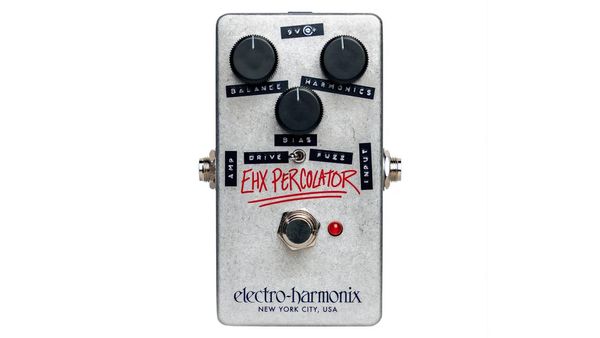

The InterFax Harmonic Percolator HP-1 circuit revealed its magic to me over a long period of time. Like just about everyone, I’ve never played an original. And when I finally encountered a reproduction at a recording session, it was the wrong pedal at the wrong time. I walked away from it vaguely disappointed and moved onto other things. Luckily for me, though, I came to be a colleague of Premier Guitar editor Joe Gore. Joe’s simple guidance for navigating the Harmonic Percolator lit the way to loving the circuit.
I mention this journey because I think a lot of readers experience a crooked path to grasping the Harmonic Percolator. And one thing the new Electro-Harmonic EHX Percolator does well—apart from kicking up a glorious racket—is make the HP-1 a little more accessible. Interestingly, it accomplishes this by adding another layer of options in the form of a hard-clipping fuzz mode and a bias control.
Bubbling Over
The original HP-1’s mysteries live as much in its fundamental voice as in the interplay between a guitar and its controls, which number just two. The drive and distortion that the pedal generates aren’t really the creamy, hot-tube-saturation sort. And though the harmonics and overtones it produces are indeed lively, the basic voice has a dry, husky edge. Even the compression it imparts can be unusual, in that it seems to strip less oxygen from the signal. The EHX Percolator captures these fundamental, and sometimes alchemical, aspects of the HP-1’s voice.
The EHX’s controls can be less than intuitive. The balance and harmonics knobs—the only ones on an original HP-1—are effectively a master volume and an input gain control (which functions more or less like a guitar volume knob). There is no dedicated gain or tone control. This makes the bias control on the EHX Percolator an extra-cool addition—it alters the distinctive distortion flavor in ways an original HP-1 cannot, and in a manner that a tone or gain control never would. Situating the bias control at noon makes the EHX Percolator sound a lot like a basic HP-1, and a few degrees to either side of noon gives you interesting variations on that core tone. Turning the knob further counterclockwise, however, adds an almost tweed Deluxe-like saturation that can fracture in cool, chaotic ways. At more extreme clockwise reaches, the bias control kicks up busted-speaker scuzz dust and gnarly, tattered voltage-starved effects that verge on fuzzy.
The Hidden Hand
And that leads us to another bonus feature the EHX Percolator offers—the drive/fuzz switch. The drive mode lifts the clipping section. Curiously, though, the drive mode often sounds closer to the HP-1 voice than the fuzz side. At bias settings that align with the original HP-1 voice, the clipping doesn’t add much to the pedal’s personality. In fact, I’d argue that it has a flattening effect that strips away the drive mode’s most alluring complexities. Introducing unusual bias settings brings the fuzz more alive, though. And that angular huskiness at the Percolator’s core can, at many bias settings, lend focus to cracked and deviant fuzz tones. These, in turn, can sound fantastic when fed to another sweeter gain source.
The Verdict
The EHX Percolator, like its inspiration, is an idiosyncratic thing. But for $99, it’s a crazy-inexpensive and super-cool way to extract yourself from a distortion tone rut. It’s exceptionally responsive to guitar volume and tone input as well as picking dynamics, which stretches its vocabulary even further. For the right player it can be a transformative addition to a stale old gain chain.