Some pieces of gear become legendary because everyone used them. Others become legendary because one person used them, relentlessly, until the sound became inseparable from the player. The original MXR Flanger/Doubler—the M-126 rack unit, a fixture of studios and touring rigs throughout the ’70s and ’80s—belongs mostly to the second category. Yes, it swept through countless studio sessions in its heyday, doing the jet-engine swoosh work flangers are built for.
But its most famous devotee wasn’t chasing psychedelic swirl. Dimebag Darrell, who used the M-126 as a staple of his live rig, utilized its doubler function as an always-on thickener that let his single guitar occupy the space a fleet of overdubs would otherwise fill up. That’s a strange kind of legacy for a rack unit: famous not for a given solo, but for making one guitar sound like more than one guitar, subtly of all things, in the background of some of metal’s most iconic tracks.
Of course, Dimebag’s stealth-thickener case is only one half the story this mono circuit tells. Dial the flanger mode toward more classic, chorus-style settings, and you’re squarely in the territory that defined an entirely different corner of ’80s guitar: the shimmering, liquid clean tones of Andy Summers’ work with the Police, Adrian Belew’s otherworldly textures with Bowie and King Crimson, Eddie Van Halen’s more atmospheric flourishes (think “In A Simple Rhyme”), and the deep, gothic swirl Robert Smith built entire Cure records around.
It’s a testament to the original circuit’s range that it served both the gated-guitar bombast of Pantera and the shimmering clean-tone architecture of “Walking on the Moon.” And this pedal captures that split personality faithfully.
Two Voices, One Bucket-Brigade Heart
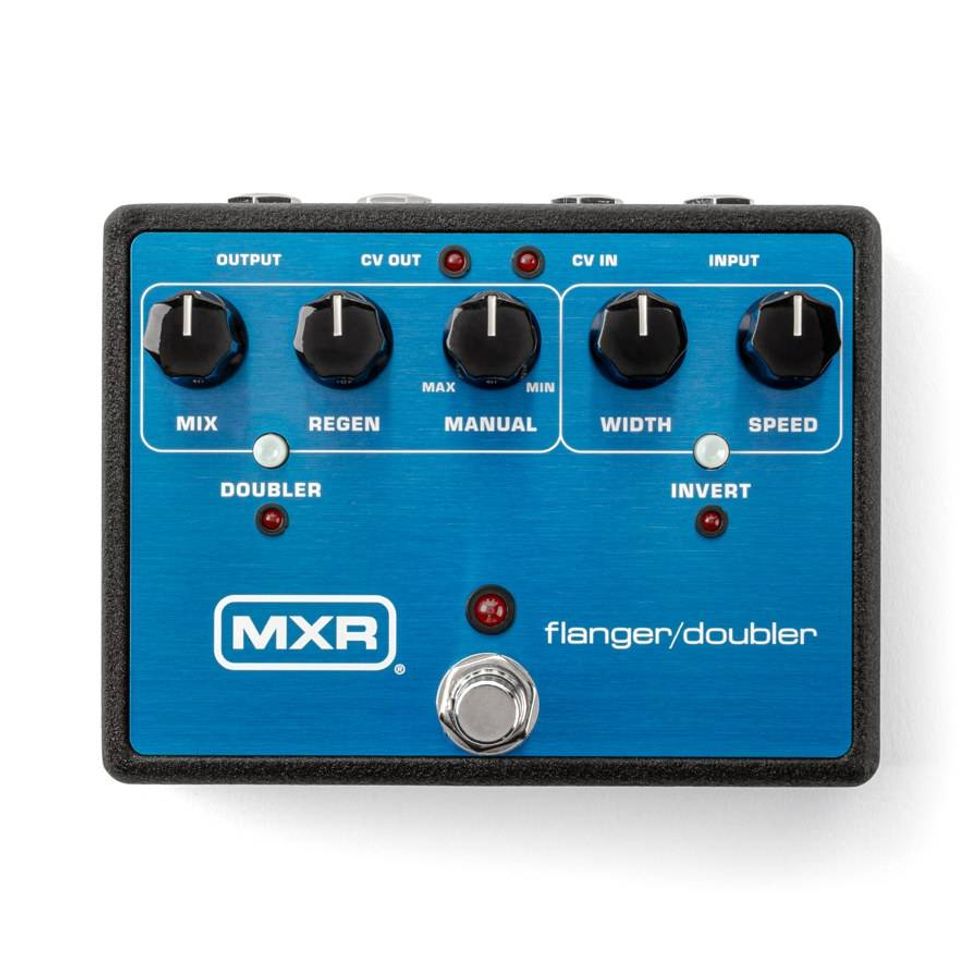
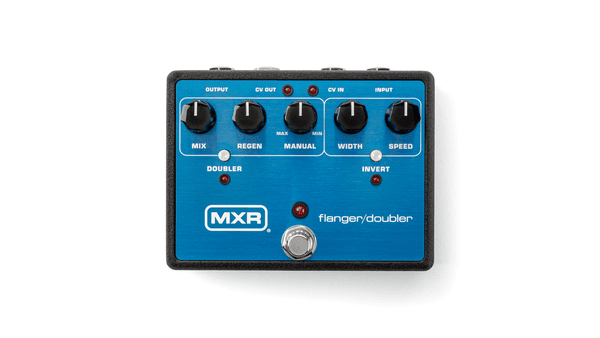
The new Flanger/Doubler is unambiguously analog, built around genuine bucket-brigade devices rather than a digital approximation. A dedicated doubler button toggles between the pedal’s two personalities. Flanger mode delivers that sweeping, metallic, jet-engine swoosh, all shimmering comb-filter movement and swirl. Doubler mode does something subtler and, frankly, more useful for many working guitarists. It splits your signal, delays one copy just slightly, and recombines it with the dry signal to create the illusion that you tracked the part twice. There’s no pitch drift (as long as the width control is set to zero,) no irregular pick attack like you might encounter in an actual double-tracked take—just an instant, single-pass thickening that can turn a thin single-coil strum into something that sounds like it’s already been mixed.
Once you’ve picked your mode, the real sculpting happens across five very interactive controls. Manual sets your base delay time—essentially, where in the frequency spectrum the effect’s comb-filtering sweet spot sits. It works hand-in-glove with width, which determines how far that sweep travels from the manual-set center point. Speed, unsurprisingly, governs how fast that sweep oscillates back and forth, ranging from a glacial .03 Hz crawl all the way up to a frantic 18.5 Hz flutter that starts to resemble ring modulation.
“There’s no pitch drift, no irregular pick attack like you might encounter in an actual double-tracked take—just an instant, single-pass thickening that can turn a thin single-coil strum into something that sounds like it’s already been mixed.”
The Regen Generation
Regen is where the personality really lives. It’s a feedback knob, feeding a portion of the delayed signal back into itself. Pushing it from 0 toward 100 percent takes you from a smooth, mellow coloration to aggressive, metallic resonance. And then there’s invert. Flip it, and the wet signal’s polarity reverses entirely, which sounds like a spec-sheet footnote until you actually hear it. Suddenly your settings range from open and vocal to mid-heavy and filtered using the same control settings you had before you flipped polarity. It’s a clever way to expand the pedal’s usable palette without adding a single additional knob.
A mix knob blends wet and dry to taste, and MXR was smart enough to include two LEDs that visually track delay time—a small, thoughtful touch for anyone who’s ever tried to dial in a flanger sweep onstage while a screaming PA drowns you out. CV in and out jacks let the Flanger/Doubler talk to modular synths, sequencers, and CV-enabled expression pedals. And a line-level switch keeps it well-behaved when you feed it hotter studio-level signals rather than a guitar’s comparatively polite output.
The Verdict
At $333 street, the MXR Flanger/Doubler is priced somewhere between boutique premium and mass-market affordability. That said, it’s not strictly a “character” pedal that’s useful for just an occasional outré moment. Just as it did with the late, great Dimebag, it has the potential to become the very heart of your tone, and the pairing of the doubler and a tight gate is pure magic for riffs. If you’ve spent years chasing a “how did they get that thickness?” tone on a favorite record, there’s a significant chance that this box can provide an answer.