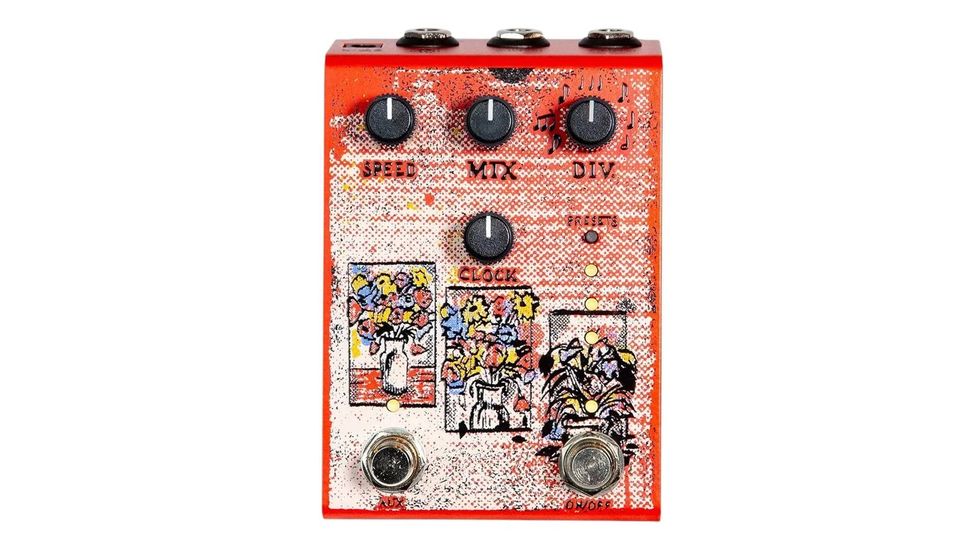
If you’ve never played a Beetronics pedal, the company’s extroverted design ethos might seem like a style-before-substance exercise. Nothing could be further from the truth. For starters, Beetronics’ wares are genuinely substantial in terms of quality. The brand is also inventive—and more than a little irreverent at times—when it comes to sonics.
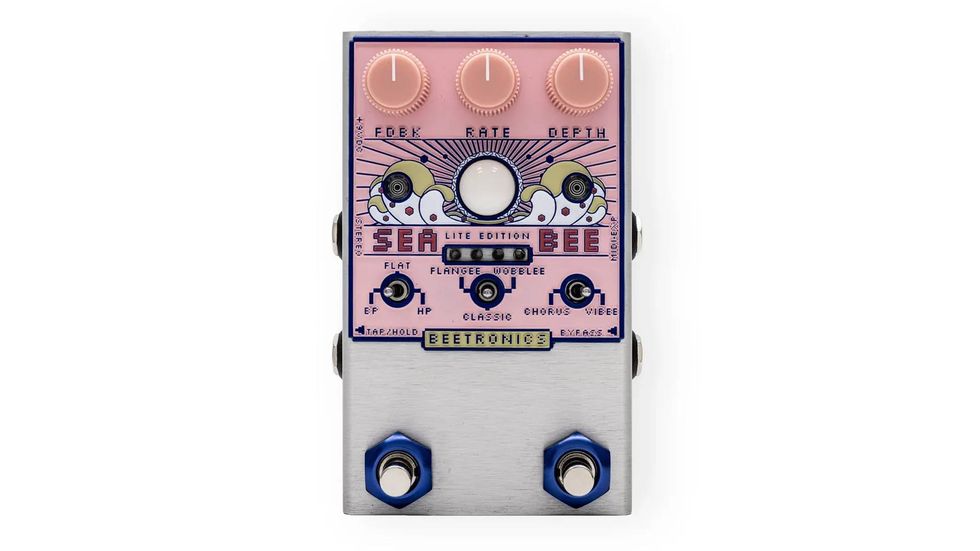
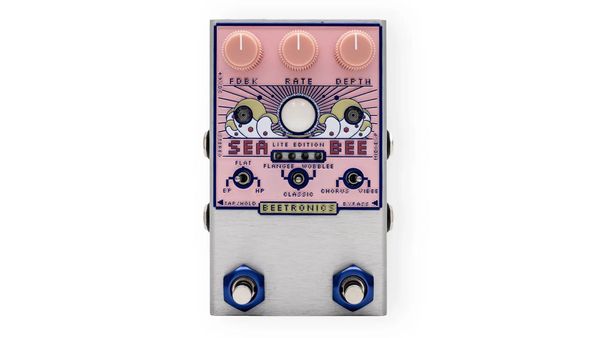
The Seabee Lite (the “lite” most likely refers to its relatively low weight rather than any reduced functionality) is an analog chorus/vibe and occasionally mutant flange-oid modulator. It might not be the company’s most radical offering, and in many respects, it's downright conventional and accessible. But it finds a unique way to walk that path, using an interesting basic chorus voice as a foundation—and in classic Beetronics fashion, offering many enticing ways to mangle it.
Arcade Acumen
While there are more complex modulators out there, the Seabee Lite is nevertheless not for minimalists or the faint of heart. None of the functions here are terribly esoteric. And the three knobs, three toggles, and two footswitches are, by some standards, positively streamlined. But their interactivity, which is a real creative asset here, can mean it’s easy to get a little lost at times.
The pedal’s preset capacity helps address the problem of a porous user memory, to some extent. There are eight factory presets and eight blank ones to make your own, which opens up all kinds of possibilities for texture shifts from song to song. (Presets can also be managed via MIDI.) But the preset functionality can be a minefield of its own if you tend to prioritize other facets of your performance. Because the Seabee Lite’s footswitches are the responsive soft-relay type, their placement makes it easy to accidentally move from live to preset mode. And if you then activate a preset, you’ll need to scroll through all of your presets to get back to live mode. Your results may differ based on your balletic capacity, concentration, and ease with dancing the preset two-step. Me? Well, I messed up a lot.
“Woblee and vibeee modes mixed together might inhabit pedal’s weirdest, most-seasick depths.”
The good news, of course, is that these complexities are the product of cool options. The Seabee Lite expands on a basic chorus’ usual rate-and-depth control set with a feedback control, which is typically seen on a flanger. It lends a given chorus setting a “vowellier,” more wobbly voice. But you can also alter the basic feel of the chorus by switching to flange or wobble mode. In the former, the sinewave that makes up the chorus is more angular and trapezoidal, and extra delay is added. The resulting tones don’t have the jet-phase intensity of a real flanger, but they can still be deeply strange, and some of the most authentically 1980s-style textures live in this hybrid mode. Wobblee utilizes an even greater delay time range—around 25ms—and features a drifting LFO that randomizes the wave peaks within that range, evoking a less-steady-on-your-feet sensation.
The flangee and wobblee voices also sound awesome with the vibee vibrato mode. Flangee can give the vibrato oscillations an almost tremolo-like pulse, which sounds extra cool in stereo. Woblee and vibee modes mixed together might conjure the pedal’s weirdest, most-seasick sounds. In both mode mixes there are lots of subtle shades to use, too.
Chorus Lane
Perhaps because the Seabee Lite’s basic voice has to accommodate so many accents and inflections, that voice is a little more open than some standard-bearing analog choruses. It’s not as syrupy, chewy, or deep as a Blue Hippo or CE-2, but there’s a lot of upside to that. Again, the airier voice allows more room for detail in the pedal’s more intense modulations. But those older analog choruses can be thick and watery to the point of dark, which doesn’t work for every guitar or amplifier voice. If the Seabee Lite’s voice is comparatively thin and toppy, it sure makes a good fit for a burly PAF’s output. And with the high-pass, bandpass, and flat frequency response toggle settings, you can tailor these sounds in even more specific ways.
The Verdict
How you relate to the Seabee Lite’s video-game riot of color and sound will probably depend on how much need for weird there is in your expression. But the Seabee Lite isn’t all bizarro indulgences. The fundamental analog voice is solid and versatile, even if some might find it lacking a touch of body. And while some features can seem clumsy and cluttered, the pedal also inhabits a real sweet spot between a modulator that creates decision fatigue and a 2-knob vintage-style unit. It’s a place you can live creatively without getting too bogged down, and that might be the Seabee Lite’s real magic.


![Rig Rundown: The Black Crowes’ Rich Robinson [2026]](https://www.premierguitar.com/media-library/youtube.jpg?id=66952027&width=1245&height=700&quality=70&coordinates=0%2C0%2C0%2C0)