The Hazee Delay, the first in Beetronics’ new Pollinator series, is the company’s first entirely digital pedal, and it’s as bonkers and jam-packed with fun, freaky sounds as you might expect. Having spent a nice chunk of time getting to know the California-based pedal company’s Seabee a few years back, I figured this deeply modulated delay would get weird. I still wasn’t ready for just how warped this little wasp is.
Pollinator’s Plan
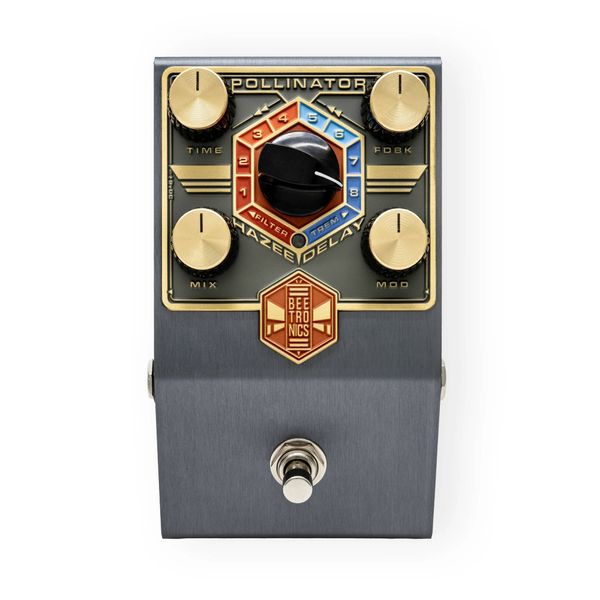
The Pollinator series comprises pedals smaller and more streamlined than most Beetronics fare, all in a uniform-sized enclosure. The four knobs on the pedal’s face are simple enough. Mix takes your signal from 100 percent dry to 100 percent wet, time sets the length between repeats, feedback controls how many repeats you hear, and mod handles speed of the modulation in each mode. The rotary dial in the middle is the Hazee’s heart, though. To the left are four delay modes modulated by a filter; to the right, four more modulated by tremolo. Each side uses the same four repeat patterns: forward, forward plus octave up, reverse, and reverse plus octave up.
I confess to being less than enthused about Hazee’s look. I was a big fan of the Seabee’s detailed, eye-candy looks, and Hazee’s control panel is pretty enough, with classic Beetronics shapes and colors. But where Seabee’s ornate control console occupied most of that stomp’s top, the bulk of Hazee’s surface is a flat, brushed-grey that comes out rather dull in person. A small gripe about an understandable effort to keep prices low, but worth noting when we’re in the Beetronics hive of inspired pedal aesthetics.
Hazee’s Honey
Hazee is not designed to be a traditional delay pedal; Beetronics’ website admits as much. It’s made for generating soundscapes, ambience, and weirdness. That said, Hazee can be rendered predictable. It just takes a fair bit of tinkering, tweaking, and listening to learn how it interprets your signal. At first, when it regurgitates it back to you, it can be hard to make heads or tails of the echo itself. What you give is not necessarily what you get back, and that’s part of the fun.
Set for maximum repeats, the Hazee stops short of self-oscillation, which might make it more useful for people looking to keep a lid on their chaos. On the left side of the rotary dial—the filtered settings—the modulation knob introduces broad, long-frequency sweeps at counter-clockwise positions. Turn it clockwise, and your sweeps get tighter and shorter until they blur together in a thick morass of texture. (Remember, the mix control lets you dial the madness down if it’s too in-front for your taste.) The same dynamic applies to the four trem-modulated settings. Slower delay-time settings are positively vertigo-inducing, conjuring the sunset comedown of an acid trip in the Mojave Desert. Nudge up the delay speeds a little, and you can dial in ’50s and ’60s sci-fi film scores and all manner of retro-tech goodness. Max the delay control out, and again, you have total pandemonium that can be held at bay with the mix knob.
Flipping through and learning how Hazee’s various modes interact with these controls takes time. It does become intuitive after a while, but at first, you need patience and deep listening to figure out just what the hell is going on with those repeats.
The Verdict
Hazee streets for $50 less than the analog BeeBeeDee, another simpler, less expensive line of pedals from Beetronics. But this is a delay made for the mad-scientist guitarists among us. It ain’t gonna be for everyone, but musicians ready to blow up the borders around their sonic playgrounds will have a blast with the Hazee.
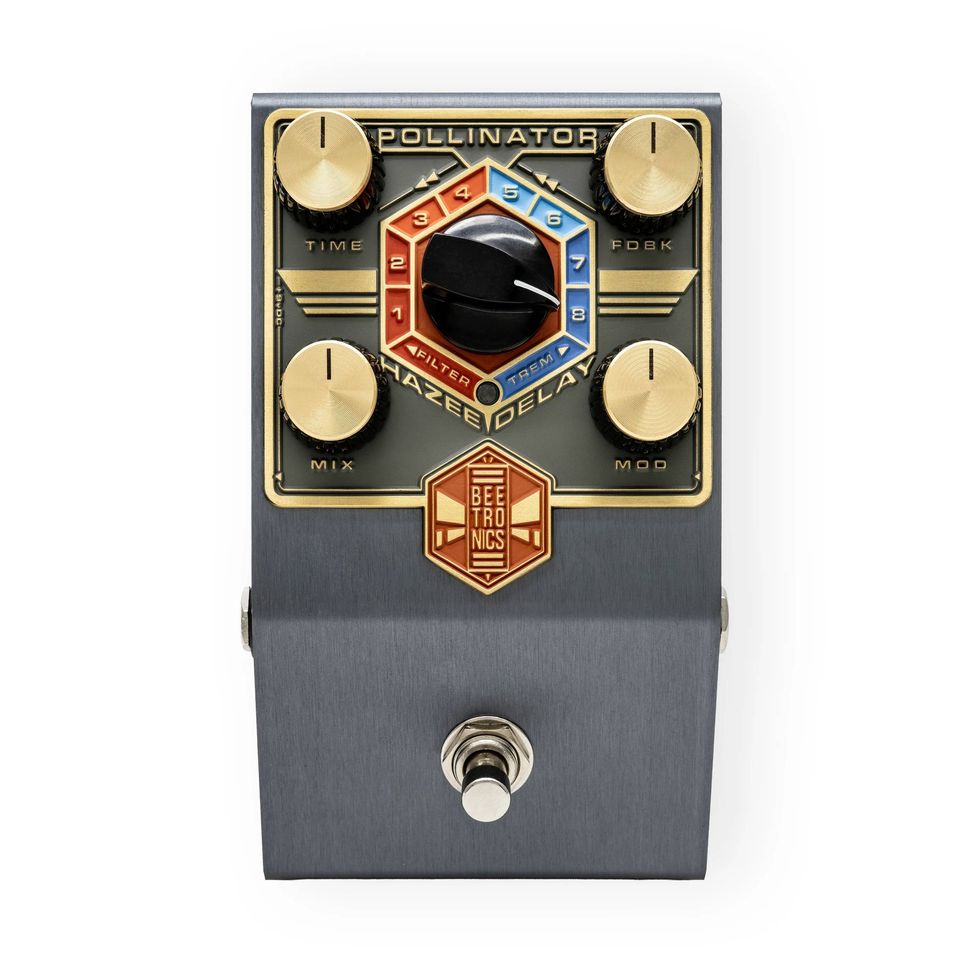
Pollinator Hazee Delay
The Pollinator Hazee Delay is a hive full of evolving delay textures. At its core, it’s a modulated delay where the repeats are shaped by either a filter or a tremolo, depending on the selected mode, allowing each repeat to bloom, shift, and evolve beeyond a traditional delay.