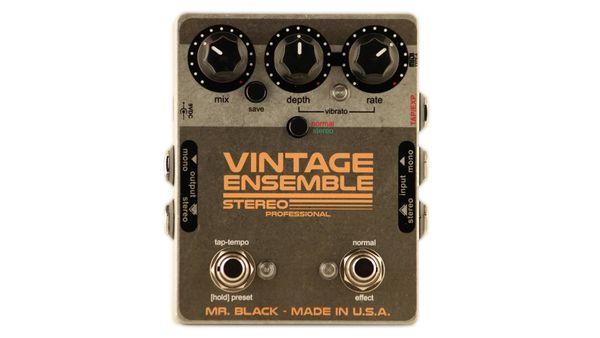
Mr. Black has a knack for modulation magic! This is not a line from a lost Lewis Carroll novel, nor is Mr. Black a giant, top-hatted rabbit. In fact, Mr. Black is Jack Deville, a very real Portland, OR pedal builder of some renown who crafts ambitious and creative modulation pedals among his many other effects. Deville’s work spanned two companies over the last two decades: Jack Deville Electronics and Mr. Black. With both companies, Deville built modulators with clear vintage-analog origins as well as more exploratory units like the Mod.One and the Jack Deville ModZero. On the surface, the new Vintage Ensemble Stereo Professional seems to lean vintage analog. But while it’s an overt homage to the Boss CE-1 Chorus Ensemble in sound and style, it takes a primarily digital route to emulating the CE-1’s sound. The results are lovely—particularly in stereo, where the Vintage Ensemble takes on a dreamy, Cadillac richness.
Vintage Lineage
Mr. Black’s digital Vintage Ensemble Stereo Professional is the third evolution in a series that began with the very simple, 3-knob Vintage Ensemble. That evolved into the Vintage Ensemble Stereo. This newest iteration features tap tempo and MIDI capability. It also adds independent delay lines in stereo mode, which thickens up and animates the chorus image, and a continuous chorus/vibrato mixer that enables many nuanced mod textures. It’s this just-right kind of control set—not too busy, not too thin—that makes the Professional a practical, appealing performance and gigging tool.
"If I were overdubbing on top of a guitar sound this fat, I’m not sure I would add much more than a shadowy acoustic track."
I don’t have a vintage CE-1 on hand to compare to the Professional, but I know the sound well via records and studio encounters. I also have a few excellent analog BBD choruses that live squarely along the Roland/Boss CE-1/CE-2 chorus voice spectrum. The Professional satisfies in many of the same basic ways as those choruses. It can be swimmy, hot-tub warm and immersive, subtle, and very evocative of real rotary speakers at some settings. It bears many of the sonic hallmarks of real CE-1 or early Roland Jazz Chorus (from which the CE-1 was born). In my mind that means a kind of constant roundness and contour in the modulation shapes, as well as a tasty bit of brightness that illuminates the harmonic details in those contours. It’s very alive, and can bounce and stay syrupy at the same time—qualities that define the clean chorus sounds of James Honeyman-Scott and Johnny Marr, but which also leave room for higher-gain players. The Vintage Ensemble Stereo Professional does all this with real aplomb.
Modes and Zones
The Professional’s enhancements are all practical additions to an already well-rounded feature set. The continuous wet/dry blend (which in some ways replaces the chorus/vibrato footswitch on a CE-1) requires a little get-to-know-you time. It has a wide range and, depending on where you set the equally sensitive depth control, can yield a lot of modulation shades that the CE-1 and other analog choruses and vibratos can’t deliver so easily. Once you’re at ease with it, though, the blend control starts to feel really intuitive.
Like me, you may well decide that most of these sounds are equal shades of awesome. But scanning the many possible permutations opens up different moods and wells of inspiration, and makes it easy to tailor very different guitars to the pedal and your amp. The wet/dry blend can also be controlled by an expression pedal via the expression jack. And between this function (which can add really cool variation to a solo or contrast to a verse, chorus, or bridge section) and the footswitchable preset (more are accessible via MIDI) you can achieve really drastic shifts in color.
No function on the Professional adds as much dimension as when you use the pedal in stereo. The normal and stereo modes lend the Professional a different voice, even with a single amp in the mix. But with two amps, the Professional becomes a sort of re-mastered, Cinerama version of itself. I heightened the contrast by using Fender- and Vox-style amps next to each other, and the enveloping sensation of wide, deep modulations moving across an even wider physical field, and in twin waveforms that modulate in opposite directions, is addictive. If I were overdubbing on top of a guitar sound this fat, I’m not sure I would add much more than a shadowy acoustic track. At wet/dry blend levels that favor the vibrato you can get supersized Magnatone-style vibrato tones, which also sound really cool with a dark push from a smoky overdrive or fuzz. There are also many excellent rotary-type sounds to uncover and explore.
The Verdict
When set to its most CE-1- and JC-120-like sounds, I’m not sure I’d be able to tell the Vintage Ensemble Stereo Professional from the originals, and I’d be surprised if anyone could pick out the difference in a mix. These qualities alone make it impressive as a stand-in for those now very expensive units. But it’s the sounds in between—the blends of vibrato and chorus mixed with various depth rates and mono or stereo routing—that make the Professional a little extra special. Ordinarily, chorus is something I strongly prefer in its analog form. But the Professional comes off as convincingly analog, and even when played alongside favorite analog choruses I found plenty of tones that I preferred from the Mr. Black. Certainly, there are many more sounds to explore here than in a run-of-the-mill chorus. And when you factor in that sonic abundance alongside the sturdy U.S. build, the $299 street price seems especially fair.