
DigiTech’s humble Bad Monkey, an inexpensive pedal released in 2004 and discontinued in 2016, went from cult classic to holy grail in 2023 after JHS Pedals’ Josh Scott put out videos titled Bad Monkey Does the Klon and NOTHING will ever sound like the Klon…except for the Digitech Bad Monkey. In these videos, Scott demonstrated the Bad Monkey’s ability to produce sounds nearly identical to those of a Klon. Though numerous affordable pedals can approach Klon-ness to the point of being nearly indiscernible, the videos still sent prices for Bad Monkey skyward. And rational or not, like the Klon, the Bad Monkey became a status symbol among tone chasers. I got sucked into the hype myself and looked for a second Bad Monkey to back up my original. To my disappointment, every listing was at least 20 times the $25 I had paid many years ago. Fast forward to earlier this year though, and I picked up a Bad Monkey secondhand for a mere $75 at a big box retailer very attuned to used gear prices. What caused this precipitous price drop?
My guess is that it has something to do with the release of the Badder Monkey, an updated version of the Bad Monkey, released under the DOD banner (DigiTech’s sibling brand). The Badder Monkey takes a lot of inspiration from its big brother, but also adds unique—and very useful—features that don’t show up on every overdrive.
Pay No Attention to the Zany Chimp
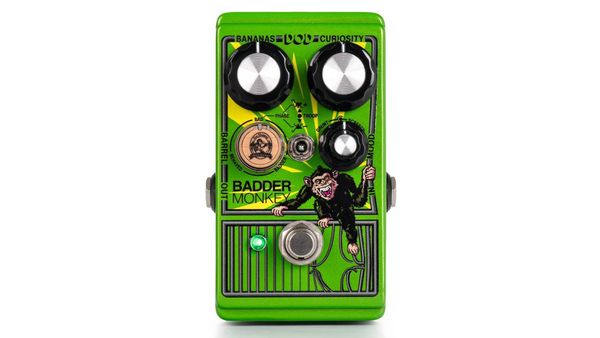
The Badder Monkey’s vibe is, in a word, playful—it arrived in a box chock-full of fun swag, including a neon green barrel keychain with tiny monkeys inside, and the pedal’s gain and level controls are labeled bananas and curiosity, respectively. Mood is a post-distortion, dual-concentric EQ control; in the center position, no frequencies are boosted or cut. But the left side of the concentric knob, labeled grunt, is a low EQ control with +/- 22dB of boost or cut centered at 100 Hz. The right side, labeled screech, is a mid/high EQ control with +/- 12 dB of boost or cut centered at just above 3 kHz.
These control names don't lend much clarity to how the Badder Monkey works. But don’t be fooled by the pedal’s kitschy lean. It’s a serious tone machine that houses three independent parallel overdrive circuits—behaved, bad, and badder. Bad is essentially the classic Bad Monkey circuit, while behaved and badder are lower and higher gain variants. The barrel knob, which is (of course) shaped like a miniature barrel with a picture of a monkey on it, is a 360 degree pot with three detents. It lets you access any of the three circuits independently via the detent positions or blend the sounds. You can get blends of behaved and bad, bad and badder, or badder and behaved, by positioning the barrel control in-between the respective detents. The blends generate many captivating sounds, but there’s much, much more!
"The Badder Monkey has a dark and warm quality that makes things feel easy to play."
Between the bottom two knobs is a 3-position toggle that lets you choose in- or out-of-phase options for the blended sounds. In the up position, the bad circuit is in phase with the behaved and badder circuits, and in the down position the bad circuit is out of phase with behaved and badder. In the middle position, called troop, all three circuits run simultaneously in parallel and the barrel blend knob is bypassed. Thankfully there is a visual cue to help you know where you are: The pedal’s LED lights up green in troop mode and blue in the up or down modes.
Simian Sound Sojourns
I tested the Badder Monkey with an Ernie Ball/MusicMan Axis Sport through a vintage Fender Bandmaster Reverb head paired with a Celestion-equipped 1x12 cabinet. The first thing I did was compare the Badder Monkey’s bad setting to my Bad Monkey; sure enough, it was practically identical. Like the Bad Monkey, the Badder Monkey has a dark and warm quality that makes things feel easy to play. I rarely got an unpleasant sound out of my original, and that applies to the Badder Monkey’s bad setting, too. Even when I dimed the screech control (high EQ) it never got anywhere near ice-pick territory. Instead, there was more clarity present when I hit chords with more complex harmonic makeup. To see if I could get the Badder Monkey to sound unpleasantly bright, I turned the grunt (low EQ) all the way off while maxing the screech. Even here, to my surprise, the Badder Monkey still did not exhibit any significant harshness. And in this setting, with the gain, err … bananas at 3:00, I got early Metallica Kill ’Em All-type rhythm sounds.
For more extreme sounds I put the barrel control between bad and badder, and the blend toggle switch in the out-of-phase position, with the gain at maximum. Here, I achieved fuzz tones that were massive and beefy, yet remained articulate. It was perfect for Sabbath-esque rhythm parts or thick, sustained David Gilmour solos.
Between the blends, voices, and phase options, the Badder Monkey’s sonic versatility is very impressive. At the other end of the gain spectrum, in the behaved setting, with gain low at around 8:30, and EQ controls at noon, I got gorgeous clean boost sounds that added body to Hendrix-y double stop figures and John Mayer lead lines played via single-coil pickups. Adding a touch more gain and sustain for lead lines was merely a function of blending in a slight mix of the “bad” voice.
The Verdict
Too often, when companies “update” a product, the changes are unnecessary, if not ruinous—most people who want a reissue just want it left exactly as it was. But the Badder Monkey’s innovations dispel that notion. This iteration is a genuine tone workstation, one that nudges you to keep chasing the perfect version of whatever sound you’re after. And while its $149 price is higher than the Bad Monkey’s, it's a bargain once you factor in how much ground it covers—clean boost, overdrive, and filthy fuzz. I was a fan of the Bad Monkey even before its moment in the sun, and I’ll certainly be adding a Badder one to my board.
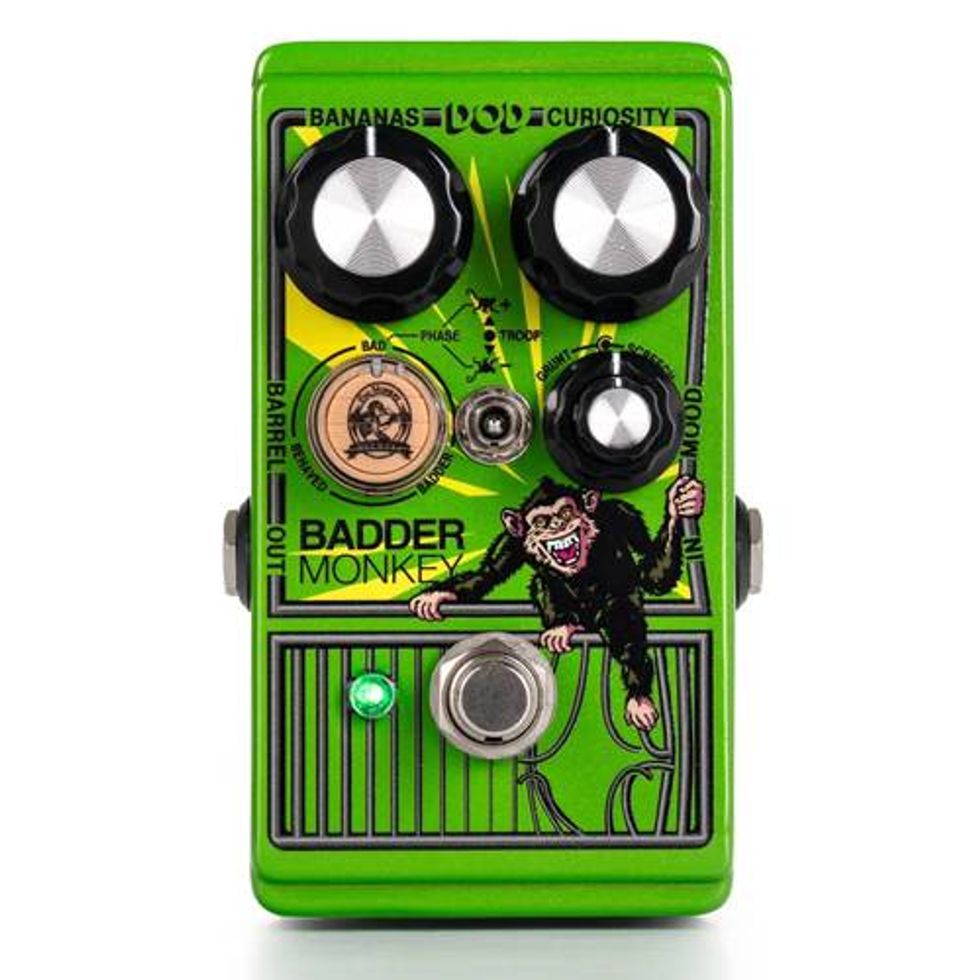
Badder Monkey
TS-style Overdrive Guitar Pedal with Bananas, Curiosity, Mood, and Barrel Knobs and 3-way Troop Toggle