
As any gear fiend knows, there are rabbit holes deep enough to swallow the curious whole. Hardcore Big Muff heads inhabit one such den, because a Big Muff is many things. It’s evolved often, sometimes in very small increments—and that’s what makes it the perfect object of obsession. Those little differences yield tangible results. A ram’s head really does cut more than a Sovtek “Civil War.” A triangle-type is abrasive in a completely different, more focused kind of way than an op amp Muff. They also feel different under the fingers. I’m more inclined to write a sludgy riff and dig into Robert Fripp sustain moves when I use a Sovtek than I am with a ram’s head, which, for all its capacity for articulation, brings out a janglier, more detailed type of fuzz. Little differences, yes. But each Big Muff is a very unique experience—particularly when you play loud.
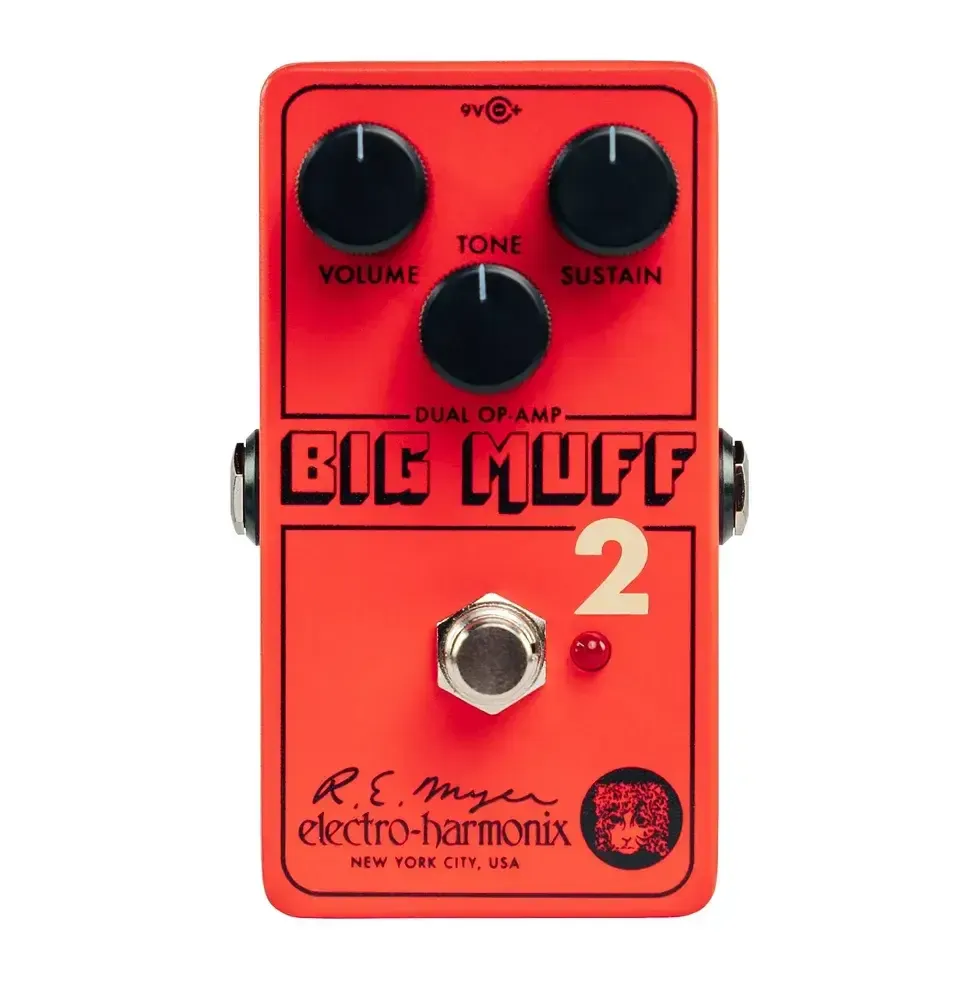
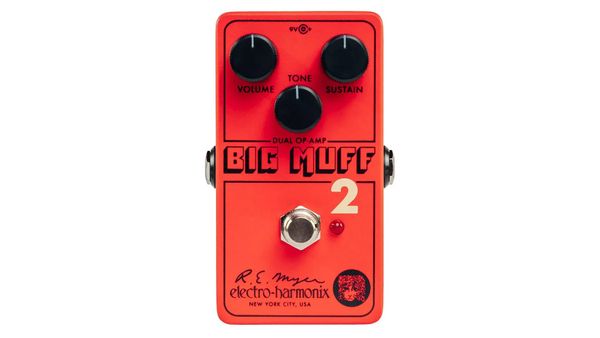
So a tip of the cap to Electro-Harmonix, JHS, and the original king of Big Muff design, Bob Myer. Each had a hand in bringing the Big Muff 2 to life. Myer drew up the original dual-op amp concept in the 1970s. It lay dormant until JHS’ Josh Scott found the schematic in an archive dig with Myer. Electro-Harmonix heard the real differences in tone and built the thing. What they’ve collectively brought together is, at least to this Big Muff fiend’s ear, a unique and compelling tone tangent.
Stretches in the Low-Mid Zone
The essence of the Big Muff Pi 2’s subtle yet profound difference is a low-mid distortion response that—alongside triangle, civil war, and ram’s head types—give it a wider-view, less compressed sound and feel in that frequency. It shares the same muscular, massive underpinnings as all Big Muffs, and there is crossover between the Big Muff Pi 2 tone profiles and those of other types. But strum a first position A-major chord and you’ll notice that the more open low-mid range gives the Big Muff Pi 2 a distinct growl. It’s throatier. There’s even some rasp in the high-mid range. But it’s also smooth at many settings. And the combination of its guttural qualities, rasp, and smoothness adds up to a real balance that gives chords articulation and makes solos sing.
“The combination of the Big Muff’s guttural qualities, rasp, and smoothness adds up to a real balance that gives chords articulation and makes solos sing."
Its agreeability extends across guitar and amp types, too. A Rickenbacker with Hi-Gain pickups and a AC15-style circuit sounded wrecking ball-devastating in terms of scale and aggression, but also walked a fine line between open and compressed that let melodic nuance shine through. A Jazzmaster and piggyback Fender Bassman sounded fantastically huge and rich, too. Extracting extra sustain via feedback and heavy vibrato sounds especially insane with this pairing—full of overtones and outsized cello timbres colliding with garage-punk wails. Even an SG, for all the mass it added to the AC-style and Bassman pairings, maintained a sense of poise—overtone detail illuminated, space left for melodic creation.
The Verdict
It bears mentioning again that there is Venn-diagram style crossover between all classic Big Muff voices, and the Big Muff Pi 2 is very much part of that family cluster. If I had to pick a most distinct tone combination that sums up the Big Muff Pi 2 voice I’d probably say something like, “The cut of a ram’s head with the smoothness of a Sovtek.” But that would be an oversimplification that fails to tell the whole story. In functional and practical ways, the Big Muff Pi 2 impresses mostly for its balance. A less committed fuzz observer may not understand why the differences in the Big Muff Pi 2 are a big deal, even while toggling between equally, uniquely great Big Muffs to hear its extra-oxygenated low-mid range and purr. But for anyone who knows how these slight differences can shift the mood of a song, riff, or lead—and how distinct each one feels under the hands—the Big Muff Pi 2 voice is an intriguing option. Especially at an $122 street price that, for a Big Muff fan, verges on theft.