

Reverb’s impact on popular music may outshine that of any other effect. Most recordings have some form of natural or artificial reverb to fill out space or add texture, and that’s because reverb can affect a song’s mood almost as much as the notes themselves.
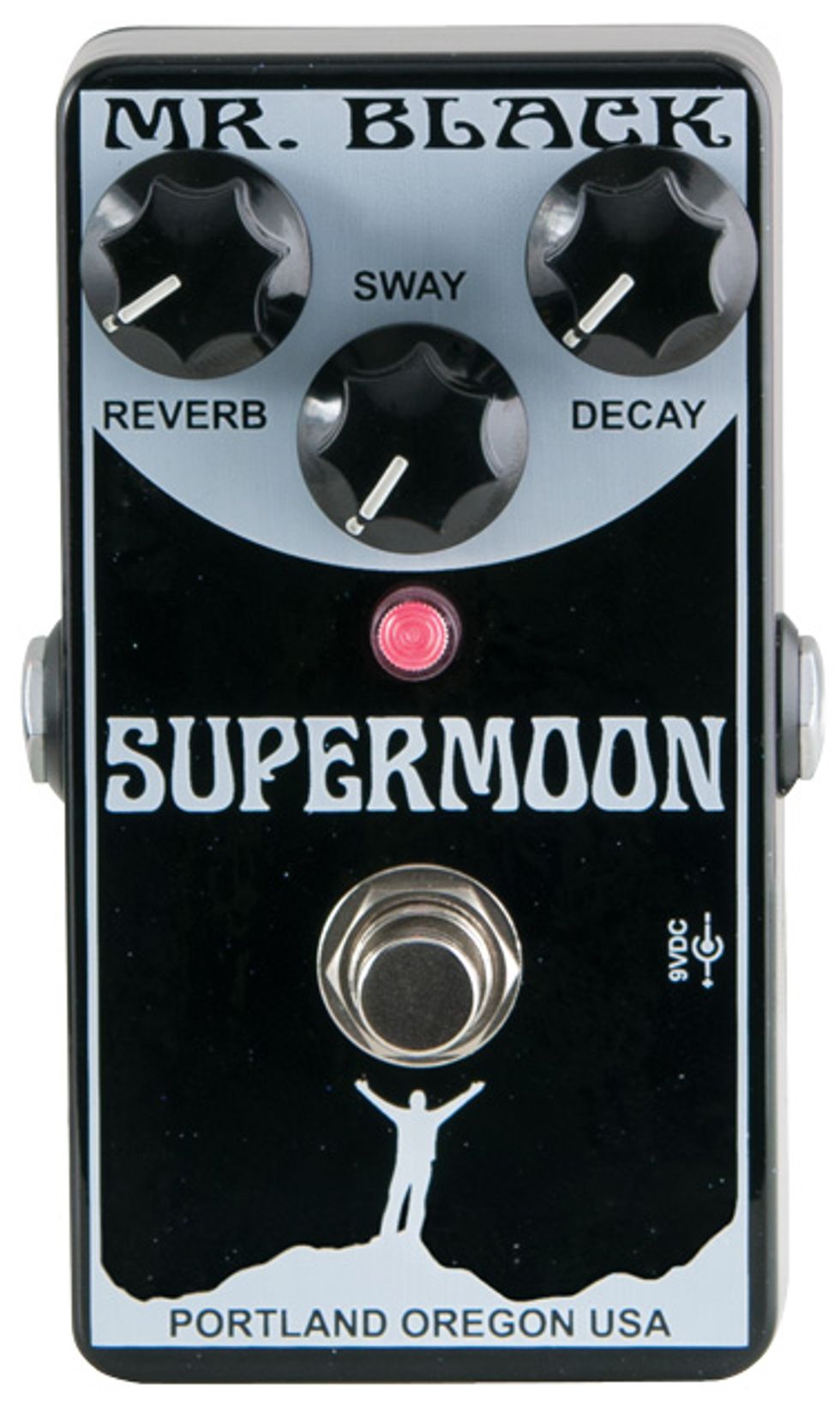
Effect lovers such as pedal builder Jack Deville understand this. His new SuperMoon, an ambient modulated reverb from a subdivision of Jack Deville Electronics called Mr. Black, mines this potent effect. The pedal’s digital circuit is designed for vast-sounding, lo-fi reverberation with precise control over decay rates. A pitch-shift control lends this atmospheric effect an eccentric twist.
Fly Me to the Moon
Dialing in cosmic reverb tones is simple, thanks to the SuperMoon’s three straightforward controls. One sets the reverb mix level. (Maximum wetness is 1:1.) Another regulates decay time. A third knob, labeled “sway,” applies wobbling pitch modulation to the effect. The reverb's maximum setting of 300 milliseconds is ideal for cavernous-sounding passages, while a heaping 30 seconds of decay time lets you create Fripp-like soundscapes and howling volume swells.
The SuperMoon features true-bypass switching. It can be powered by either a 9V battery or a Boss-style power supply. (Since it’s a power-hungry digital effect, you'll probably want to go the latter route.) It’s hand-built in Portland, Oregon.
Ratings
Pros:
Easy to dial in sounds. Small footprint. Exciting pitch-shifting tones.
Cons:
Fixed modulation rate. Somewhat limited applicability.
Tones:

Playability/Ease of Use:
Build/Design:
Value:

Street:
$179
Mr. Black SuperMoon Reverb
mrblackpedals.com
Into the Void
You won’t mistake the SuperMoon’s spacious sounds for a dynamic-sounding spring reverb—its lo-fi voicing is more akin to that of a dusty record than a warm, bubbly vintage spring. But its precise control, distinctive texture, and mammoth-sized spread make it a stellar tool for ambient passages, endlessly reverberating chords, and swaying, pitch-shifted echoes.
I auditioned the SuperMoon using a Fender Classic Player Strat and a Mesa/Boogie Dual Rectifier, with the pedal connected via the amp’s effect loop. I set the pedal’s reverb and decay knobs halfway up and turned off the sway control to evaluate the pure reverb sound. Playing the sparse, clean-toned intro to the Cure’s “If Only Tonight I Could Sleep,” I immediately noticed the reverb’s granular quality and super-smooth decay. Turning down the decay and pushing the reverb mix yielded a cool, futuristic-bathtub quality, with the effect bursting loudly and quickly dying off. Patching in an Ernie Ball volume pedal and maxing the reverb and decay knobs, I generate dazzling ambience that bloomed and faded with each swell of the treadle.
The real fun began when I turned up the sway knob to add pitch shifting. My Strat’s neck pickup provided perfect clarity and presence for the reverb’s crawling modulation. Reverb can be eerie to begin with, but the SuperMoon’s creepiness was off the charts. Sadly, the pitch-shift rate is fixed, so you can’t get fast, alien ray-gun spurts and other weird astral effects.
The Verdict
If you’ve longed for a simple, compact reverb that excels at nearly limitless ambience, it’s worth considering the Mr. Black SuperMoon. It’s great for hall- and cathedral-type reverb, and it’s endlessly fun. With its even, somewhat static response, the SuperMoon won’t replace for your favorite spring reverb and all its subtle nuances—but to be fair, that’s not the pedal’s goal. It’s designed for would-be celestial travelers seeking tones wider than the skies above—and on those terms, it’s a cosmic knockout.



![Rig Rundown: The Black Crowes’ Rich Robinson [2026]](https://www.premierguitar.com/media-library/youtube.jpg?id=66952027&width=1245&height=700&quality=70&coordinates=0%2C0%2C0%2C0)