
Many folks consider Eddie Van Halen the greatest guitarist of all time. But his contributions to the gear world have been significant, too. In just a few decades, guitars and amps built with his input have become staples of the hard rock and metal world. He was just as keen about designing effects, and worked on many signature MXR EVH pedals alongside Dunlop senior engineer Bob Cedro and Eddie's right-hand man, Matt Bruck. Eddie didn’t merely lend his name to the projects—he was directly involved from conception, to development, to sign-off, for almost 20 years.
In 2015, MXR released the 5150 Overdrive, a stellar pedal that earned a Premier Gear award. Eleven years later, the Modern High Gain, a pedal conceived while Eddie was still alive, is a reality. If you’re a skeptic, you might assume this new pedal is a cash grab—one more way to capitalize on Eddie’s good name. But that’s definitely not the case. I reached out to the MXR EVH team and they confirmed that Eddie was instrumental in the pedal’s design. But regardless of the name on this box of high gain, it absolutely rips.
Fire Inspired
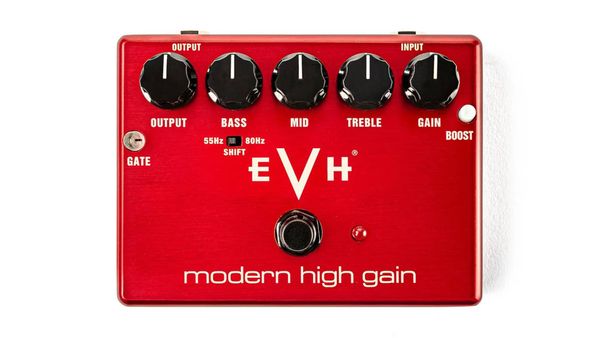
Where the 5150 Overdrive was delightfully crunchy, the Modern High Gain summons the firepower of the amp’s red channel. Like the 5150 Overdrive, it comes in a wide enclosure. Typically, these bigger enclosures are used for dual footswitch pedals, but the Modern High Gain employs a single full-sized footswitch, with a mini button for the boost function. There’s also a mini knob for its noise gate, in addition to controls for output, gain, bass, mid, and treble, and a bass shift switch that enables selection of an 80 Hz or 55Hz cutoff frequency for the bass control. The pedal is relatively big, which will probably trouble players concerned about space, but it’s nice that the controls are easy to navigate. Furthermore, the top-mounted jacks help minimize the space the pedal eats up on a board.
Heat For Days
Both my EVH-inspired superstrat and I were itching to play the Modern High Gain through a tube combo, and as soon as I turned the pedal on—with all the knobs set to noon—I was blown away. I got ultra-inspiring hard rock tones that sounded like a hot-rodded version of a hot-rodded Marshall, which is, obviously, pretty hot. Notes sustained so long, and legato licks were so easy to play, that I had to laugh. Eddie’s signature brown sound comes through loud and clear, and is unmistakably wired into the Modern High Gain’s DNA. But there’s something a bit more contemporary and refined in the mix, too. While the output can be super-saturated, it offers lots of note clarity. Palm-muted riffs feel immediate and sound very articulate. Rhythm guitar parts in the style of “Panama” have a vicious bite in the higher notes and an overall richness that’s genuinely satisfying to hear and feel. It’s not surprising that the pedal does this kind of thing so well given Eddie’s penchant for these rhythm textures, but it’s thrilling to hear them leap from a speaker in response to your own picking.
“It’s probably safe to say the Modern High Gain is less about sonic flexibility as it is about supersonic ferocity.”
Even with the gain set high, note separation is excellent. On many lesser pedals or amps, these sounds would dissolve into an indistinguishable mess. But because the Modern High Gain handles complex chords and tone clusters so well, I found myself composing riffs with triad and triad-inversion shapes that I wouldn’t dare try in different high-gain settings. The capacity for complexity works on the low end, too—even with a 7-string, low-tuned riffs and chords were very well-defined.
The Modern High Gain’s ability to stay so articulate often gets an assist from the noise gate. Certainly, I felt more comfortable exploring super high-gain regions knowing how effectively it can clamp down on the junk you don’t want to hear. At times, it’s so effective that you have no sense you’re plugged into a high gain pedal.
If there’s any downside to the Modern High Gain’s aggression, it’s that you won’t find much in the way of low-gain sounds. Even with the gain knob turned down to around 7 o’clock, it rips with a snarl reminiscent of early Van Halen. The amount of gain produced was about that of an overdrive maxed out. It’s probably safe to say the Modern High Gain is less about sonic flexibility as it is about supersonic ferocity.
Although there’s a mini switch for the boost function, the Modern High Gain’s boost isn’t meant to work independently, like you might see on a two-in-one overdrive/boost. In fact, the boost only works when the distortion is engaged. It offers up to +3dB of gain to the pre and post gain sections of the circuit and provides a welcome extra edge in some situations. That might seem completely unnecessary on a pedal this hot, but at high-gain settings the boost can be just what you need for transitioning from a rhythm part to a solo. And at the lower gain settings, engaging the boost is still helpful for adding a touch of clarity. It would be nice if it were a full-sized switch, but its location—at the very edge of the enclosure—makes it possible to use effectively in performance.
The Verdict
It’s hard to stand out in a market flooded with distortion pedals, but the Modern High Gain manages it. Behind its fierce persona, it’s voiced in a very musical way, which makes sense given its Van Halen pedigree. Hearing such a well-executed, modern evolution of the brown sound is exciting, but also just musically interesting and inspiring. If you’ve always wanted to add a dash of Eddie’s high-gain secret sauce, the MXR EVH Modern High Gain is the one.
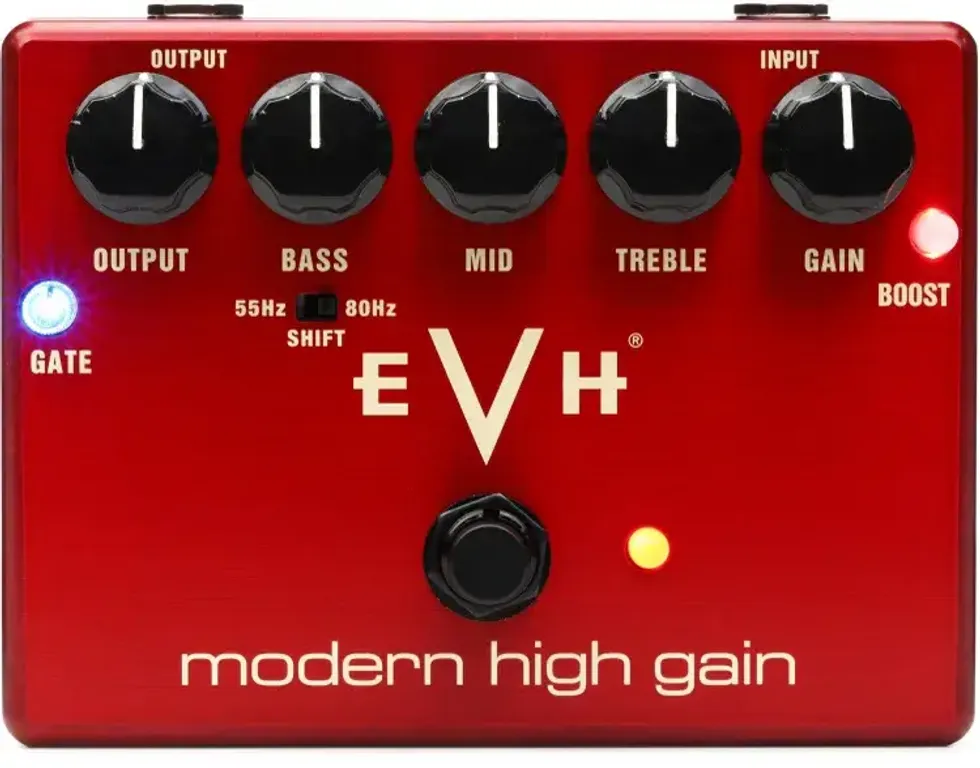
Modern High Gain
Distortion Guitar Pedal with Output, 3-band EQ, Gain, Noise Gate, Boost, and Frequency Shift Controls