
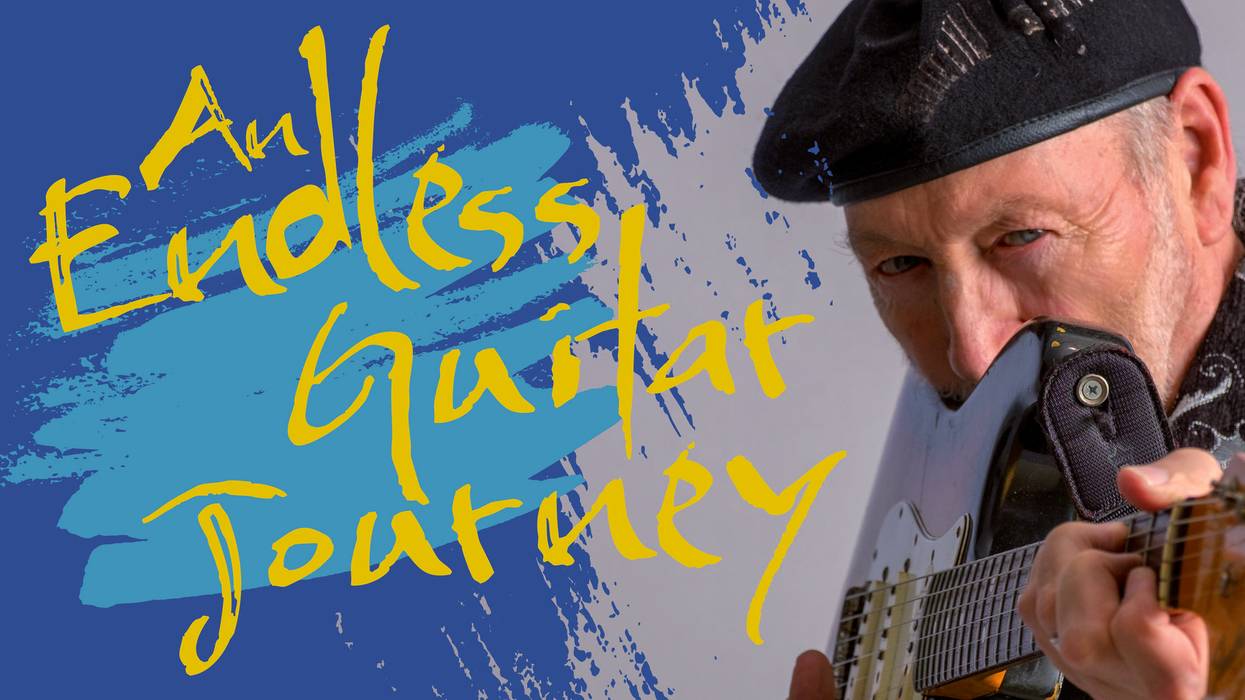

“I didn’t want to be another imitator of Chicago blues,” Richard Thompson tells PG of his early guitar development. “When I was growing up in London, by about 1963, there were a lot of very good guitar players around, like Peter Green, Jeff Beck, and everyone else who seemed to have had a run in the Yardbirds. They’d never been to Chicago, or even out of England, probably. But they could do Buddy Guy and Magic Sam.”
Nearly 60 years into his career, Thompson has a new album—his touring schedule and writing regimen indicate an artist still in motion. He’s unwilling to rest on any laurels, but it isn’t as though he hasn’t received them. Back in 2012, Nashville’s Americana Music Association issued him a lifetime achievement award and invited him to play in the city’s fabled Ryman Auditorium. Remember, he’s an Englishman. But if anyone from the other side of the pond deserves an Americana award, it’s Richard Thompson.
“I was kind of surprised when my manager said, ‘Oh, they want to give you an award,’” he remembers. “And I thought it’s a little strange because I’m not a country artist, but I think ‘Americana’ is a broader term that covers everyone from Booker T. Jones to r&b. It’s a roots thing. And Scottish and Irish music is a massive influence on country music, the Celtic influence that goes along with the African influence. All that kind of blends into country and rock ‘n’ roll. So I suppose I must be kind of rootsy.”
Richard Thompson is one of our best living guitarists—there’s certainly no denying his virtuoso wizardry on the instrument. Like Jimi Hendrix, B.B. King, Django Reinhardt, and Jerry Garcia, Thompson’s phrasing is recognizable from the very first note. His attack is precise and angular. His powerfully articulated pull-offs and bends seem to leap from his fingertips at right angles, like shards of glass from a broken mirror. This staccato style works perfectly in punk and math rock, too. So many guitar players, from Tom Verlaine and Mary Timony to James Walbourne and Carrie Brownstein, owe Thompson a serious debt.
It’s not only Thompson’s soloing that informs his greatness. He also has perhaps the most stable hands in the business; his arpeggios flow like a steady, fast-moving river, steeped in current. For proof, see any live acoustic version of his classic tune “1952 Vincent Black Lightning“ and remember it’s only one guitar doing all that. Whether he’s playing solo or out on the road with a full band, watching Thompson perform always brings pleasant surprises. Just when you think he’s pulled every rabbit from his hat, year after year he finds new ways to delightfully evince another coin from behind your ear.
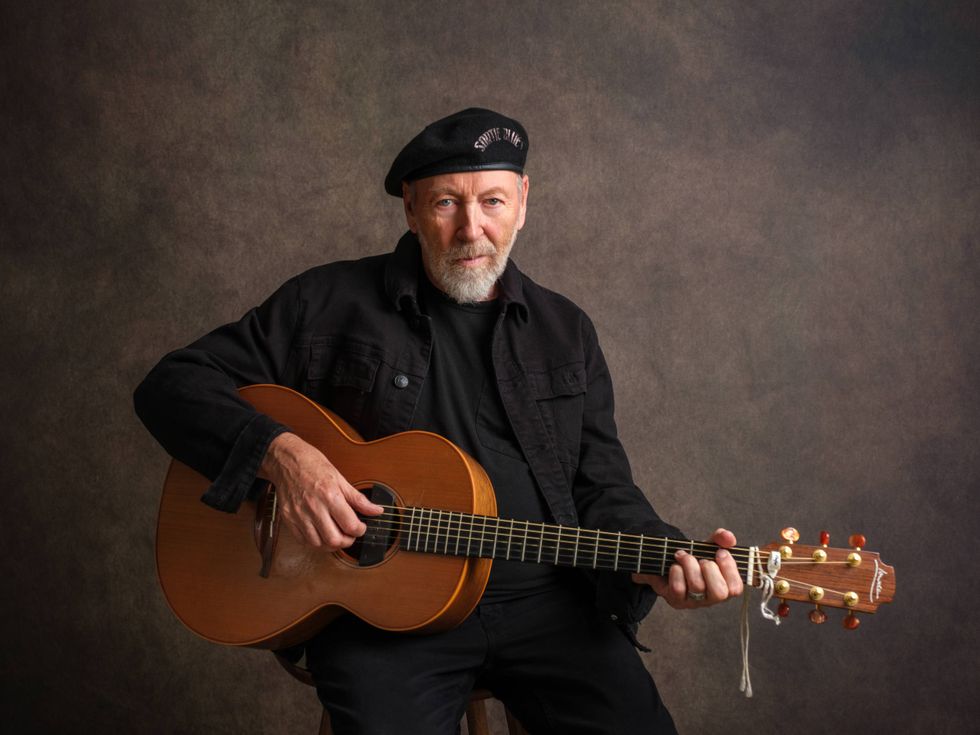
Photo by Paul Clampin
Richard Thompson Gear:
Guitars and other string instruments:
1966 Martin 000-18
Lowden Signature acoustic
Lowden F32
Lowden classical
Lowden S series
Lowden electric
1959 Fender Stratocaster (with ‘55 neck)
1966 Fender Stratocaster
Fender Strat, black/silver (parts)
Fender Stratocaster, white (newish)
Fender American Professional Classic Stratocaster (with Rio Grande pickups)
Fender Telecaster (parts) (2)
Fender Telecaster 12-string (parts)
Gibson SG, black
1920 Gibson mandolin
Amps:
1966 Fender Deluxe
1956 Fender Deluxe
Various Fender Vibrolux, Champs, and more
Divided By 13
Headstrong 1x12 (2)
Effects (acoustic):
Ridge Farm 2-channel tube pre amp
TC Electronic delay
TC Electronic rotary
Effects (electric):
Fulltone OCD
TC Electronic delay
TC Electronic octave
TC Electronic Shaker
Boss tuner
Strings and picks:
Elixir electric strings (.009-.042)
Elixir acoustic strings, bronze (.012-.053)
Custom-made picks, “Les Paul” shape
In late summer, this founding member of seminal English folk rock band Fairport Convention Zooms in from his London home while preparing for a run of music festivals that have become something of an annual tradition. He’ll play events like FolkEast in Suffolk and the Bromyard Folk Festival before autumn settles over England. He pans his camera around the house to show where he’s sitting—Thompson splits his time between the UK and a place in New Jersey. His living room, draped in soft yellow tones and furnished with traditional pieces, looks more like the pad of a London accountant than the legendary music troubadour he is. There’s no obvious trace on the walls or shelves of his long career in rock ‘n’ roll.
And yet, he was there. Fairport Convention has been described as England’s answer to the Byrds. If the latter took folk songs from American musicians like Pete Seeger and Bob Dylan and reformed them into Billboard chart toppers like “Turn! Turn! Turn!” and “Mr. Tambourine Man,” Fairport Convention, drawing on Irish, Scottish, and English folk, made similar moves at the same time in Swinging London, releasing groundbreaking albums like Liege & Lief and Unhalfbricking. Ground zero, then, was the legendary Marquee Club, where bands like the Who and the Rolling Stones took early steps toward superstardom and where Fairport Convention also played.
“Jimi Hendrix got up and played with us a few times. He played whatever we were playing.”
There were other clubs, too: “I remember at a place called the Speakeasy—it was on Margaret Street in London—Jimi Hendrix got up and played with us a few times,” Thompson recalls. “He played whatever we were playing. I remember one night he sat in on ‘Like a Rolling Stone,’ and one night we did Paul Butterfield’s ‘East-West’ together.”
In that moment—London in the ‘60s—did Thompson feel something significant was happening? Did he and his cohort recognize they were living in what would later be considered a landmark time in rock history? “I think we thought this wasn’t some creative high spot, that whatever was happening would keep happening in different forms,” he explains. “I think we looked back on the ‘50s as being the revolution. But the ‘60s were more revolutionary, really. Of course, there were new, better recording techniques. But if you just look at the music, we’re still in the shadow of it, I think. If you only take the Beatles, Jimi Hendrix, and Bob Dylan, those three artists alone still have such an influence over music. People are still wearing Led Zeppelin t-shirts, for heaven’s sake. Back then, we sort of thought, ‘Oh, it’s just the Who. It’s just the Yardbirds. It’s just Jimi Hendrix.’ It’s only really recently that I look back and realize how special it all really was.”
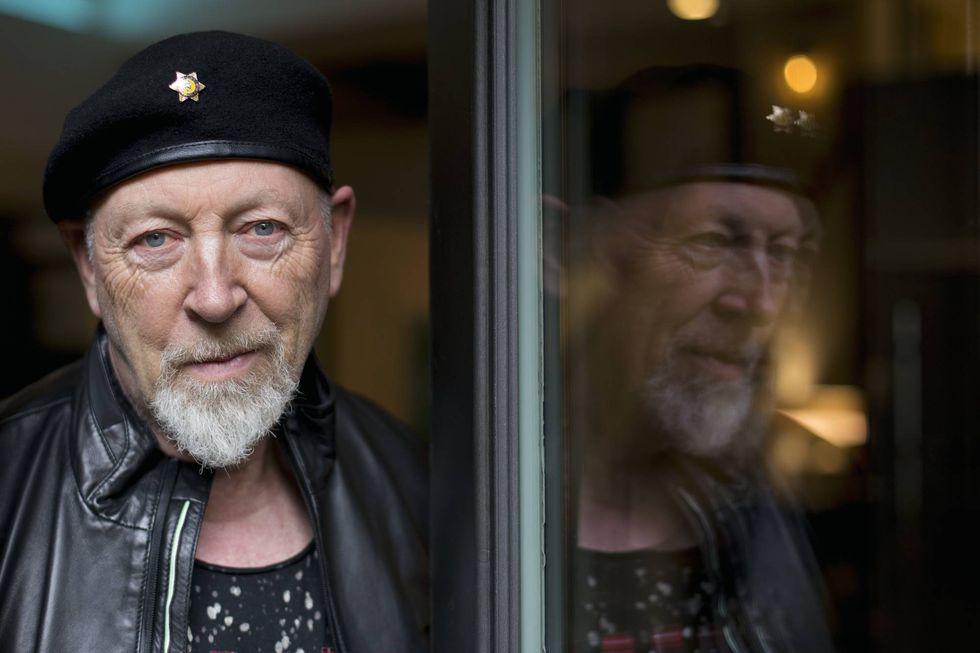
Photo by Tom Bejgrowicz
Thompson shares more about how he developed his own playing style in those days: “I wanted to sound unique. I thought that if I could develop something that has an element of where I come from, if it sounds a bit Scottish, a bit English, then that could be a singular thing. And I looked for distinctive sounds on the guitar, too. When I got a Stratocaster in ‘68 or whenever it was, I found the out-of-phase position on it and thought, well, this is great. It’s got that kind of hollow sound. ‘I’m sure no one’s done this before,’ I said to myself. I thought I had invented a lot of things that I later found out were totally untrue! But for me, it was kind of a fresh sound.”
There may be no other artist who so deftly bridges the old country with the new world. PG readers, for example, may understand the differences between the sounds of Muscle Shoals, Memphis, and Bakersfield, but some may plead ignorance about the analogous sonic regions of the United Kingdom. When asked, Thompson breaks down what makes a song sound like it’s from the UK versus the States. “It’s a balancing act, really,” he explains. “I like to think that I’m grounded in English, Irish, and Scottish folk music, and that everything comes from that. When you add rock ‘n’ roll to that, you see what you get. And that is what we’ve been doing since Fairport Convention began around 1968; I’m still playing around in that field because it’s a very unploughed field, as far as I’m concerned. I don’t have many rivals lurking in that particular piece of acreage. So, for me, there’s a lot to explore. And it uses sounds from both sides of the Atlantic, including accordions and fiddles.
“In terms of modality,” he continues, “the Scottish and Irish scales are very predominant. I use two Scottish pentatonic scales, which overlap into American Appalachia, so you don’t necessarily hear something alien immediately. And the Mixolydian mode is a very common mode in British folk music. And you have that in American music as well. These are kind of signposts, and as long as I sound like me, I’m happy.”
When asked about his practical approach to the guitar, his answer adds up to a Richard Thompson master class: “Obviously, if I’m on a plane all day or something, I can’t play. But otherwise, I do play nearly every day. I think in music there’s a limitless number of things to discover. You can get kind of bogged down looking at your own instrument and just see familiar patterns—you look at your fingers, and they’re going to the same places. For me, inspiration comes from listening to other instruments. Sometimes I’ll listen to John Coltrane, or a sitar player maybe. I think that’s the way to be inspired. I’ll start to think, ‘How do I fit that onto a guitar? Something that’s very easy on another instrument, how do I do that on the guitar, where it’s much more difficult?
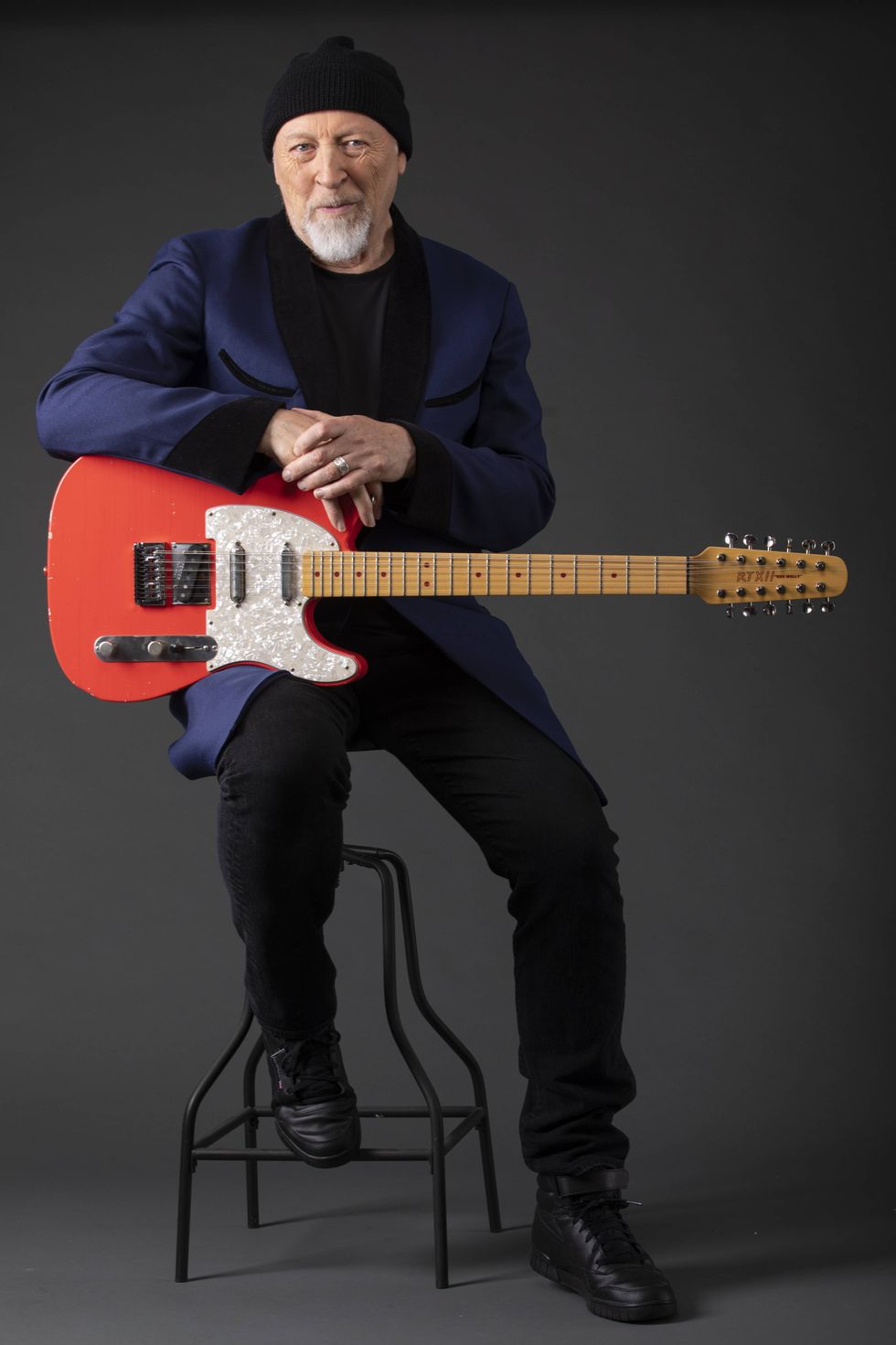
Photo by David Kaptein
“Another thing is vocal accompaniment,” Thompson continues. “When I’m playing guitar, I’m nearly always playing it in a song, and every song presents different possibilities, so a song can suggest things. If I’m playing acoustic, it’s a big thing to make enough sound—to keep enough strings ringing. Do I need to go into another tuning to make it sound better? Can I take a solo that keeps the spirit of the song going, without it sounding like something’s dropped out? And if I’m playing electric with a band, I think, ‘How do I keep the spirit of the song going if I play a solo?’ How do I keep the lyric’s message going and the narrative moving?’ So every song presents different problems that you have to overcome. Sometimes you have to think of a new kind of fingering to play a song in a certain key, and you think, ‘This is tough; I’ve never done this before. I’m going to have to stretch myself. I’m going to have to really practice this particular sequence or this particular fingering, particular shape, or else the song is going to lose something.’ There’s all these things happening to push you forward, and I think you really have to always be a student of music, because there’s always stuff to learn. And if I think I know everything, I’ll go and listen to Stravinsky or something!”
“I thought that if I could develop something that has an element of where I come from, if it sounds a bit Scottish, a bit English, then that could be a singular thing.”
His new LP, Hippies, Thugs and Heroes, lives up to his career-long quest to stretch himself. Whether you’ve been listening to him for decades or you’re brand new to his music, this record is quintessential Richard Thompson. In songs like “The Big Smoke” and “Unsung Hero,” he moves effortlessly between folk-rock and sounds grounded in country and blues from Texas and Tennessee. Thompson generally likes the darker shades of life. Lyrically, he is known for his exploration of disappeared love, of the vagaries of relationships gone wrong. On this new record, for instance, “Make Believe You Don’t Know Me” joins classic Thompson heartache numbers like “Shoot Out the Lights,” “I Misunderstood,” and “When the Spell Is Broken.”
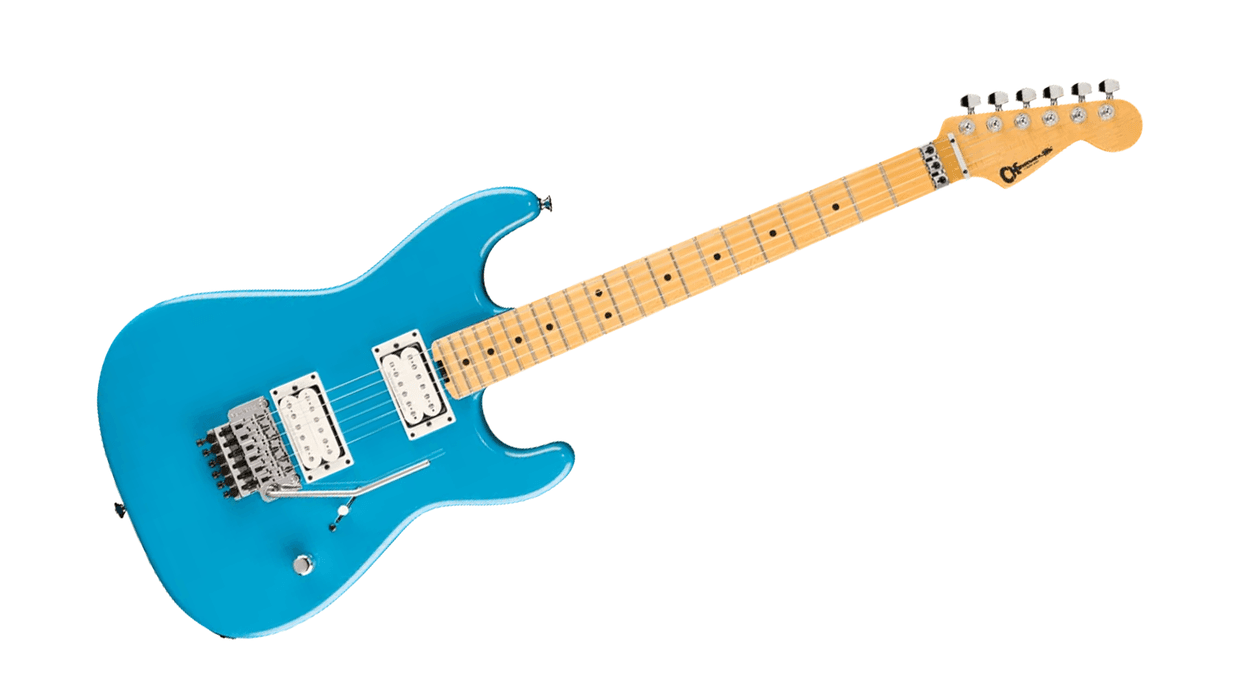
Thompson is known to use a Strat as his main axe. For years, he could be seen wielding a red “partscaster” built for him by guitar tech Bobby Eichorn. That instrument is no longer part of his arsenal. Instead, he’s playing a black partscaster Strat with a silver pickguard. “I also have a ‘60 white Stratocaster,” he says, “and I use a couple of three-pickup Telecasters—I like even my Teles to have three pickups. Those are all my stage guitars, mostly Strats. But I have a Gibson SG that I sometimes use in the studio, and an old Gibson jazz guitar, too. I have others here in London that I don’t use on tour anymore, but they come into the studio too, including my 1966 Stratocaster. I don’t have tons of instruments, but I suppose I have far too many. I like to think they’re not being neglected. If I’ve got a guitar I haven’t played for five years, I’m inclined to give it to somebody else, friends or family.”
These days, he puts his electrics through Divided By 13 amplifiers. “I tend to stick with one amp,” he says. “The Divided By 13 amps are built in Long Beach, California, and the one I use is a two-speaker cabinet with two mismatched Celestion speakers. It’s got two circuits: a Vox circuit and a Fender circuit. You can choose one or the other, or you can blend the two of them, which is kind of the best of all possible worlds.”
When I ask Thompson about his long-held Martin 000-18, the one pictured on the cover of his first solo album, Henry the Human Fly, he reaches just off camera and suddenly pulls it into frame. “Here it is!” he exclaims. “It’s a 1966, but I found it in New York in 1971 when I was on tour with [original Fairport Convention member] Iain Matthews. There’s a place, it’s still there, in Greenwich Village called the Music Inn, and I got it there for 200 bucks. About a year later, I also bought a 1920 Gibson mandolin there for 100 bucks. Those were the days, as they say! Anyway, the Martin 000-18 has been severely battered over the years. I used it a lot on tour throughout the ‘80s. One night in Germany, I left the stage for the interval and put it down next to a spotlight on the floor. When I came back, it had nearly melted into pieces. It was frying on the floor. Terrifying, really. Now I just keep it around the house.”
Thompson will turn 78 on his next birthday, but there’s no sense of him slowing down. In the country-folk song “Bad Liver/Broken Heart,” Canadian artist Scott Nolan writes from the point of view of a Thompson-like troubadour and croons, “In this line of work no one retires.” I ask him if he ever thinks of hanging it up, and he doesn’t hesitate in his response: “At the end of a long tour, I might not pick up a guitar for a few days, but then the pleasure of it gets me. I like to feel I’m in shape to play, so it’s good to keep up exercises, and there are no limits to where you can go musically. I’m always noodling with song ideas as well. As a performer, I would seriously miss that wonderful transaction with the audience—so I’ll stick at it as long as I can.”
![Rig Rundown: The Black Crowes’ Rich Robinson [2026]](https://www.premierguitar.com/media-library/youtube.jpg?id=66952027&width=1245&height=700&quality=70&coordinates=0%2C0%2C0%2C0)