
Since hitting the market in 2019, Fender’s Tone Master digital tube-emulation amps have found a devoted following among modeling enthusiasts and open-minded tube-amp aficionados alike. When it came to the tube faithful, simply a lack of outright condemnation would have counted as a win. So seeing Tone Master versions of the Deluxe Reverb, Princeton Reverb, Twin Reverb, Super Reverb, and ‘59 Bassman turn into stage fixtures amounts to knocking it out of the park.
Now, the family includes the Tone Master ’59 Twin-Amp JB (Joe Bonamassa) Edition. It’s a digital rendition of the 85-watt, 2x12 “high powered” Twin introduced in 1958 and which became, in vintage-original form, a mainstay of Bonamassa’s rig. And with six power levels ranging from the full 85 watts down to 0.5 watts, it’s big but immensely practical.
Tweed Suit
For those unfamiliar with previous Tone Master offerings, the digital lineup (which should not be confused with the Custom Shop Tone Master tube amp of 1994-’02) is made up of models that replicate the sound, but just as critically, the look and functionality of the company’s iconic ’50s and ’60s amps. They don’t try to deliver too much at once, like so many other digital amp solutions. Rather, they focus on what’s familiar, accessible, and attractive to players with vintage tastes. Essentially, they are as simple as the amps that inspired them.
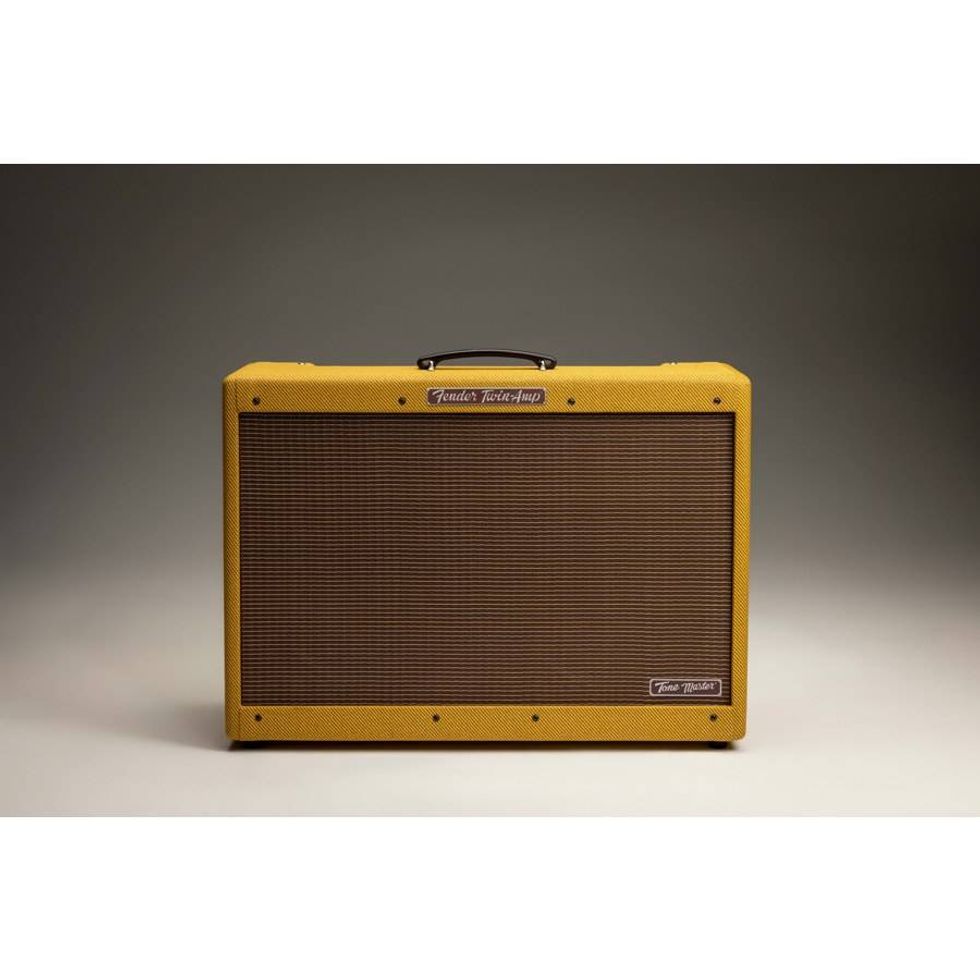
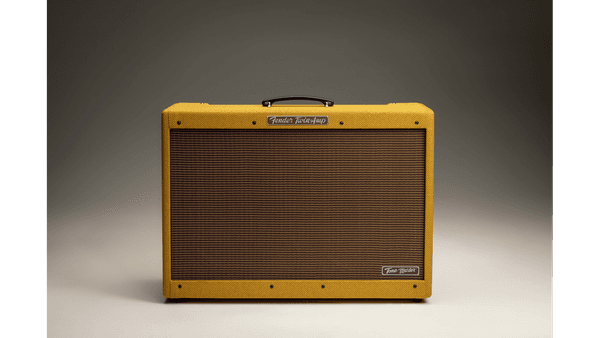
For its part, the Tone Master ’59 Twin-Amp makes the sound of one of the rarer tone legends from Fender’s golden age widely available by replicating the 5F8-A tweed Twin circuit. The amp certainly looks the part with its lacquered tweed, gold-striped, brown grille cloth, and sturdy rubber “dog bone” handle. It’s housed in a traditional pine-ply cabinet measuring 26.5"x17.5"x10.5" But unlike its analog antecedent, it weighs just 30 lbs. That’s extra impressive given that it’s a true 2x12—a feat made possible using light neodymium Celestion Joe Bonamassa JB-85 Neo speakers.
The control panel closely matches the original’s. There are high- and low-impedance inputs for the normal and bright channels, plus controls for normal volume, bright volume, treble, bass, middle, presence, and reverb. That last one, a digital convolution-based spring reverb, is a modern addition (Fender didn’t put spring reverb in an amp until 1963), though I doubt many players will gripe about the period-incorrectness. Of the two switches, one turns the power on and off, and the other toggles between on and a silent mute mode, which stands in for the standby switch on a real tube amp.
The back panel is home to the 6-position output power switch, which drops the wattage from 85 watts to 45, 20, 5, 1, and 0.5 watts. There’s also a pushbutton for vintage and tight low-end response. The latter position is useful for tightening up any flabbiness that comes with replicating vintage tweed sag, and it expands the amp’s capabilities and voice in ways that make space for players with more modern tone tastes. On the back panel there’s a send and return for the post-modeling-amp effects loop; a jack for the two-button footswitch (included) that selects the reverb and effects loop; and the impulse response and DI features, which include XLR line out, a ground lift switch, level control, and slide switch for three mic choices (U67, SM57, and a combo of the two) used with the onboard cabinet simulation. These, and other mic setups and IRs, can be reconfigured and saved via Fender’s Tone Master IR Manager app.
Master Plan
I lined up a Gibson ES-335 with humbuckers, a Les Paul with P-90s, and a Fender Telecaster to hook up to the JB Edition. And while the tube snob in me was prepared to say, “Well, it’s okay, but…,” I have to admit to being floored by the authenticity at times—it truly feels different from many modelers as an amp experience. Modeling-amp market leaders like Fractal, Line 6 Helix, and Neural DSP—all of which I played in the room beside this Tone Master—excel at generating multiple authentic tones for recording and front-of-house sound. But they often struggle with an authentic “amp in the room” sound and feel in live situations, unless you’re sending them through big-stage PA rigs. Smaller cabs can have an adverse effect on realism, too. The Tone Master ’59 Twin-Amp, on the other hand, sounds entirely like an amp in the room, because it is. The accurately emulated 5F8-A preamp and output stages do their thing through real guitar speakers in a real cab, and it makes a huge difference.
Once you’re done pondering the tech inside the box, there’s a lot of thick, juicy, and convincingly tweed-era tone to dig into. The JB Edition can be fat, round, and clean, roaring, chunky, crunchy, and hot in lead settings. The EQ stages are versatile in the same way as in the original tweed Twin-Amp, which is to say flexible, but not quite modern-amp flexible. My guess is that many players will find a few favorite settings here, stick with them, and modify the amp’s output level with the power switch. The bright channel has a little more gain and grind than the normal channel at equal volume settings. In an original tweed Twin, the only difference between the two channels is a small capacitor on the bright channel volume pot that lets more high end through at lower settings. In any case, jumping the two channels together with a short cable, as many players will do, usually yields the tastiest results and the best of both worlds.
“The accurately emulated 5F8-A preamp and output stages are doing their thing through real guitar speakers in a real cab. And it makes a huge difference.”
Part Brit Brute
While resolutely ’50s Fender in nature—and a predecessor to Jim Marshall's work by several years—the 5F8-A tweed Twin was arguably the most Marshall-like amp the California company ever made. And while it’s true that the London amp maker based its first designs on Fender’s own 5F6-A tweed Bassman, Marshall coupled their adaptation with 2x12 cabinets. So, the 2x12 configuration here gives the Tone Master ’59 Twin-Amp an extra transatlantic feel, which is a big part of the tweed Bassman and Twin appeal in the first place. Crank either or both channels up to 4 or so and the JB Edition starts to roar with a convincing throaty, tactile, tube-like grind that is utterly delectable, and not at all cold or sterile. Hitting the front end with overdrive from a Klon-like Wampler Tumnus Deluxe and an Analog Man Prince of Tone proves that it takes pedals well, too. The convolution reverb does its job well and the effects loop functions beautifully. Sending the IR/DI out to a powered PA cab and recording interface also yielded great results.
The Verdict
The Fender Tone Master ’59 Twin-Amp JB Edition is a big amp designed for big stages. It’s also a very convenient amp for situations that require a quieter small-stage and studio approach. There were occasions I wished for an output power setting somewhere between the 20-watt and 5-watt options. The former is still ear-slammingly loud in a small room, while the latter doesn’t deliver quite enough energy to the speakers and cab to maintain the big-amp realism. That might be nitpicking though. In most other ways, the Fender Tone Master ’59 Twin-Amp JB Edition is an impressive package, with the potential to make players on both sides of the digital divide very happy.